On his third birthday Oskar decides to stop growing. Haunted by the deaths of his parents and wielding his tin drum Oskar recounts the events of his extraordinary life; from the long nightmare of the Nazi era to his anarchic adventures in post-war Germany.
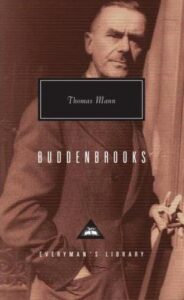
A classic of modern literature: Buddenbrooks is the story of four generations of a wealthy bourgeois family in northern Germany facing the advent of modernity; in an uncertain new world, the family’s bonds and traditions begin to disintegrate. With an introduction by T. J. Reed, and translated by John E. Woods.
As Mann charts the Buddenbrooks’ decline from prosperity to bankruptcy, from moral and psychic soundness to sickly piety, artistic decadence, and madness, he ushers the reader into a world of stunning vitality, pieced together from births and funerals, weddings and divorces, recipes, gossip, and earthy humor.
First published in Germany in 1901, when Mann was only twenty-six, Buddenbrooks surpasses all other modern family chronicles in its immensity of scope, richness of detail, and fullness of humanity. With remarkable fidelity to the original German text, this superb translation emphasizes the magnificent scale of Mann’s achievement in this riveting, tragic novel.
The year is 1928. On the outskirts of a large German city, three young men are earning a thin and precarious living. Fully armed young storm troopers swagger in the streets. Restlessness, poverty, and violence are everywhere. For these three, friendship is the only refuge from the chaos around them. Then the youngest of them falls in love, and brings into the group a young woman who will become a comrade as well, as they are all tested in ways they can never have imagined. . . .
Written with the same overwhelming simplicity and directness that made All Quiet on the Western Front a classic, Three Comrades portrays the greatness of the human spirit, manifested through characters who must find the inner resources to live in a world they did not make, but must endure.
Austerlitz, the internationally acclaimed masterpiece, is the story of a man’s search for the answer to his life’s central riddle. A small child when he comes to England on a Kindertransport in the summer of 1939, one Jacques Austerlitz is told nothing of his real family by the Welsh Methodist minister and his wife who raise him. When he is a much older man, the fleeting memories return to him, and obeying an instinct he only dimly understands, he follows their trail back to the world he left behind a half century before. There, faced with the void at the heart of twentieth-century Europe, he struggles to rescue his heritage from oblivion.
Steppenwolf is a poetical self-portrait of a man who felt himself to be half-human and half-wolf. This Faust-like and magical story is evidence of Hesse's searching philosophy and extraordinary sense of humanity as he tells of the humanization of a middle-aged misanthrope. Yet his novel can also be seen as a plea for rigorous self-examination and an indictment of the intellectual hypocrisy of the period. As Hesse himself remarked, "Of all my books Steppenwolf is the one that was more often and more violently misunderstood than any of the others".
Emil Sinclair ist ein Junge, der in einem als "Scheinwelt" beschrieben bürgerlichen Elternhaus aufgewachsen ist. Dies ist die dramatische Geschichte seiner Abstieg - gesteuert durch sein frühreifen Schulkamerad Max Demian - in eine geheime und gefährliche Welt der Kleinkriminalität und Revolte gegen Konvention und seiner Erwachen zu Selbstheit.
Thomas Mann's last great novel, first published in 1947 and now rendered into English by acclaimed translator John E. Woods, is a modern reworking of the Faust legend, in which Germany sells its soul to the Devil. Mann's protagonist, the composer Adrian Leverkühn, is the flower of German culture, a brilliant, isolated, overreaching figure, his radical new music a breakneck game played by art at the very edge of impossibility. In return for twenty-four years of unparalleled musical accomplishment, he bargains away his soul - and the ability to love his fellow man.
Leverkühn's life story is a brilliant allegory of the rise of the Third Reich, of Germany's renunciation of its own humanity and its embrace of ambition and its nihilism. It is also Mann's most profound meditation on the German genius - both national and individual - and the terrible responsibilities of the truly great artist.
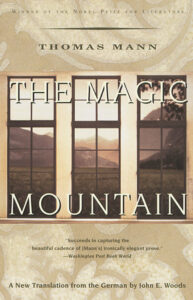
In this dizzyingly rich novel of ideas, Mann uses a sanatorium in the Swiss Alps, a community devoted exclusively to sickness, as a microcosm for Europe, which in the years before 1914 was already exhibiting the first symptoms of its own terminal irrationality.
The Magic Mountain is a monumental work of erudition and irony, sexual tension and intellectual ferment, a book that pulses with life in the midst of death.
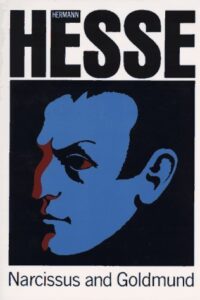
Narcissus and Goldmund tells the story of two medieval men whose characters are diametrically opposite: Narcissus, an ascetic monk firm in his religious commitment, and Goldmund, a romantic youth hungry for knowledge and worldly experience. First published in 1930, Hesse's novel remains a moving and pointed exploration of the conflict between the life of the spirit and the life of the flesh. It is a theme that transcends all time.
Welcome Back!
Track your reading progress and sync your library.