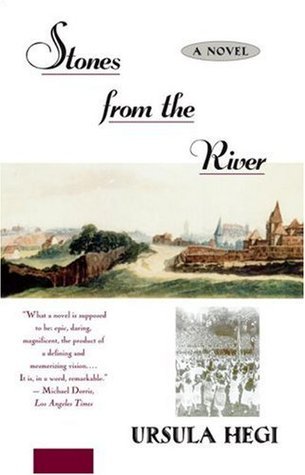
From the highly acclaimed, award-winning author of Floating in My Mother’s Palm comes a stunning novel about ordinary people living in extraordinary times.
Trudi Montag is a Zwerg—a dwarf—short, undesirable, different, the voice of anyone who has ever tried to fit in. Eventually she learns that being different is a secret that all humans share—from her mother who flees into madness, to her friend Georg whose parents pretend he’s a girl, to the Jews Trudy harbors in her cellar.
Ursula Hegi brings us a timeless and unforgettable story in Trudi and a small town, weaving together a profound tapestry of emotional power, humanity, and truth.

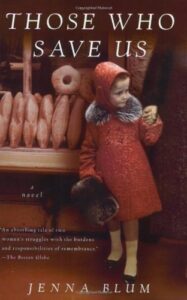
For fifty years, Anna Schlemmer has refused to talk about her life in Germany during World War II. Her daughter, Trudy, was only three when she and her mother were liberated by an American soldier and went to live with him in Minnesota. Trudy's sole evidence of the past is an old photograph: a family portrait showing Anna, Trudy, and a Nazi officer, the Obersturmfuhrer of Buchenwald.
Driven by the guilt of her heritage, Trudy, now a professor of German history, begins investigating the past and finally unearths the dramatic and heartbreaking truth of her mother's life.
Combining a passionate, doomed love story, a vivid evocation of life during the war, and a poignant mother/daughter drama, Those Who Save Us is a profound exploration of what we endure to survive and the legacy of shame.
Paris, July 1942: Ten-year-old Sarah is brutally arrested with her family in the Vel' d'Hiv' roundup, the most notorious act of French collaboration with the Nazis. but before the police come to take them, Sarah locks her younger brother, Michel, in their favorite hiding place, a cupboard in the family's apartment. She keeps the key, thinking that she will be back within a few hours.
Paris, May 2002: On Vel' d'Hiv's sixtieth anniversary, Julia Jarmond, an American journalist, is asked by her Paris-based American magazine to write an article about this black day in France's past. Julia has lived in Paris for nearly twenty-five years, married a Frenchman, and she is shocked both by her ignorance about the event and the silence that still surrounds it. In the course of her investigation, she stumbles onto a trail of long-hidden family secrets that connects her to Sarah. Julia finds herself compelled to retrace the girl's ordeal, from the terrible days spent shut in at the Vel' d'Hiv' to the camps and beyond. As she probes into Sarah's past, she begins to question her own place in France and to reevaluate her marriage and her life.
Writing about the fate of her country with a pitiless clarity, Tatiana de Rosnay offers us a brilliantly subtle, compelling portrait of France under occupation and reveals the taboos and denial surrounding this painful episode in French history. (front flap)
A grand love story and an epic tale of three brothers whose lives are torn apart by war.
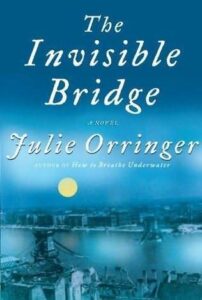
Paris, 1937. Andras Lévi, a Hungarian Jewish architecture student, arrives from Budapest with a scholarship, a single suitcase, and a mysterious letter he has promised to deliver to C. Morgenstern on the rue de Sévigné. As he becomes involved with the letter’s recipient, his elder brother takes up medical studies in Modena, their younger brother leaves school for the stage—and Europe’s unfolding tragedy sends each of their lives into terrifying uncertainty.
From the Hungarian village of Konyár to the grand opera houses of Budapest and Paris, from the lonely chill of Andras’s garret to the enduring passion he discovers on the rue de Sévigné, from the despair of a Carpathian winter to an unimaginable life in forced labor camps and beyond, The Invisible Bridge tells the unforgettable story of brothers bound by history and love, of a marriage tested by disaster, of a Jewish family’s struggle against annihilation, and of the dangerous power of art in a time of war.
In January 1945, in the waning months of World War II, a small group of people begin the longest journey of their lives: an attempt to cross the remnants of the Third Reich, from Warsaw to the Rhine if necessary, to reach the British and American lines.
Among the group is eighteen-year-old Anna Emmerich, the daughter of Prussian aristocrats. There is her lover, Callum Finella, a twenty-year-old Scottish prisoner of war who was brought from the stalag to her family’s farm as forced labor. And there is a twenty-six-year-old Wehrmacht corporal, who the pair know as Manfred–who is, in reality, Uri Singer, a Jew from Germany who managed to escape a train bound for Auschwitz.
As they work their way west, they encounter a countryside ravaged by war. Their flight will test both Anna’s and Callum’s love, as well as their friendship with Manfred–assuming any of them even survive.
Perhaps not since The English Patient has a novel so deftly captured both the power and poignancy of romance and the terror and tragedy of war. Skillfully portraying the flesh and blood of history, Chris Bohjalian has crafted a rich tapestry that puts a face on one of the twentieth century’s greatest tragedies–while creating, perhaps, a masterpiece that will haunt readers for generations.
Cristabel Seagrave has always wanted her life to be a story, but there are no girls in the books in her dusty family library. For an unwanted orphan who grows into an unmarriageable young woman, there is no place at all for her in a traditional English manor. But from the day that a whale washes up on the beach at the Chilcombe estate in Dorset, and twelve-year-old Cristabel plants her flag and claims it as her own, she is determined to do things differently.
With her step-parents blithely distracted by their endless party guests, Cristabel and her siblings, Flossie and Digby, scratch together an education from the plays they read in their freezing attic, drunken conversations eavesdropped through oak-panelled doors, and the esoteric lessons of Maudie their maid.
But as the children grow to adulthood and war approaches, jolting their lives on to very different tracks, it becomes clear that the roles they are expected to play are no longer those they want. As they find themselves drawn into the conflict, they must each find a way to write their own story...
This is the story of an old English manor house by the sea, with crumbling chimneys, draping ivy and a library full of dusty hardbacks. It's the story of the three children who grow up there, and the adventures they create for themselves while the grown-ups entertain endless party guests: the worlds they imagine from books they aren't supposed to read, and the lessons they learn from eavesdropping through oak-panelled doors.
This is the story of a whale that washes up on a beach, whose bones are claimed by a twelve-year-old girl with big ambitions and an even bigger imagination. An unwanted orphan who grows into an unmarriageable young woman, chafing under the confines of her traditional upbringing and fiercely determined to do things differently.
In April 1942, Lale Sokolov, a Slovakian Jew, is forcibly transported to the concentration camps at Auschwitz-Birkenau. When his captors discover that he speaks several languages, he is put to work as a Tätowierer (the German word for tattooist), tasked with permanently marking his fellow prisoners.
Imprisoned for more than two and a half years, Lale witnesses horrific atrocities and barbarism—but also incredible acts of bravery and compassion. Risking his own life, he uses his privileged position to exchange jewels and money from murdered Jews for food to keep his fellow prisoners alive.
One day in July 1942, Lale, prisoner 32407, comforts a trembling young woman waiting in line to have the number 34902 tattooed onto her arm. Her name is Gita, and in that first encounter, Lale vows to somehow survive the camp and marry her.
A vivid, harrowing, and ultimately hopeful re-creation of Lale Sokolov's experiences as the man who tattooed the arms of thousands of prisoners with what would become one of the most potent symbols of the Holocaust, The Tattooist of Auschwitz is also a testament to the endurance of love and humanity under the darkest possible conditions.
During the Nazis’ brutal siege of Leningrad, Lev Beniov is arrested for looting and thrown into the same cell as a handsome deserter named Kolya. Instead of being executed, Lev and Kolya are given a shot at saving their own lives by complying with an outrageous directive: secure a dozen eggs for a powerful Soviet colonel to use in his daughter’s wedding cake. In a city cut off from all supplies and suffering unbelievable deprivation, Lev and Kolya embark on a hunt through the dire lawlessness of Leningrad and behind enemy lines to find the impossible.
By turns insightful and funny, thrilling and terrifying, City of Thieves is a gripping, cinematic World War II adventure and an intimate coming-of-age story with an utterly contemporary feel for how boys become men.
Oct. 11th, 1943 - A British spy plane crashes in Nazi-occupied France. Its pilot and passenger are best friends. One of the girls has a chance at survival. The other has lost the game before it's barely begun.
When "Verity" is arrested by the Gestapo, she's sure she doesn't stand a chance. As a secret agent captured in enemy territory, she's living a spy's worst nightmare. Her Nazi interrogators give her a simple choice: reveal her mission or face a grisly execution.
As she intricately weaves her confession, Verity uncovers her past, how she became friends with the pilot Maddie, and why she left Maddie in the wrecked fuselage of their plane. On each new scrap of paper, Verity battles for her life, confronting her views on courage and failure and her desperate hope to make it home. But will trading her secrets be enough to save her from the enemy?
Harrowing and beautifully written, Elizabeth Wein creates a visceral read of danger, resolve, and survival that shows just how far true friends will go to save each other. Code Name Verity is an outstanding novel that will stick with you long after the last page.
Welcome Back!
Track your reading progress and sync your library.