The Lover
Set against the backdrop of French colonial Vietnam, The Lover reveals the intimacies and intricacies of a clandestine romance between a pubescent girl from a financially strapped French family and an older, wealthy Chinese-Vietnamese man.
The thirteenth novel in Émile Zola’s great Rougon-Macquart sequence, Germinal expresses outrage at the exploitation of the many by the few, but also shows humanity’s capacity for compassion and hope.
Etienne Lantier, an unemployed railway worker, is a clever but uneducated young man with a dangerous temper. Forced to take a back-breaking job at Le Voreux mine when he cannot get other work, he discovers that his fellow miners are ill, hungry, in debt, and unable to feed and clothe their families. When conditions in the mining community deteriorate even further, Lantier finds himself leading a strike that could mean starvation or salvation for all.
•New translation
• Includes introduction, suggestions for further reading, filmography, chronology, explanatory notes, and glossary
The complex moral ambiguities of seduction and revenge make Les Liaisons dangereuses (1782) one of the most scandalous and controversial novels in European literature. The subject of major film and stage adaptations, the novel's prime movers, the Vicomte de Valmont and the Marquise de Merteuil, form an unholy alliance and turn seduction into a game - a game which they must win. This new translation gives Laclos a modern voice, and readers will be able a judge whether the novel is as "diabolical" and "infamous" as its critics have claimed, or whether it has much to tell us about the kind of world we ourselves live in. David Coward's introduction explodes myths about Laclos's own life and puts the book in its literary and cultural context.
Jean-Baptiste Clamence is a soul in turmoil. Over several drunken nights in an Amsterdam bar, he regales a chance acquaintance with his story. From this successful former lawyer and seemingly model citizen a compelling, self-loathing catalogue of guilt, hypocrisy and alienation pours forth.
The Fall (French: La Chute) is a philosophical novel by Albert Camus. First published in 1956, it is his last complete work of fiction. The Fall explores themes of innocence, imprisonment, non-existence, and truth. In a eulogy to Albert Camus, existentialist philosopher Jean-Paul Sartre described the novel as "perhaps the most beautiful and the least understood" of Camus' books.
John Galsworthy, a Nobel Prize-winning author, chronicles the ebbing social power of the commercial upper-middle-class Forsyte family through three generations, beginning in Victorian London during the 1880s and ending in the early 1920s.
Alternate cover edition of ISBN 9780141439662
'The more I know of the world, the more am I convinced that I shall never see a man whom I can really love. I require so much!'
Marianne Dashwood wears her heart on her sleeve, and when she falls in love with the dashing but unsuitable John Willoughby she ignores her sister Elinor's warning that her impulsive behaviour leaves her open to gossip and innuendo. Meanwhile Elinor, always sensitive to social convention, is struggling to conceal her own romantic disappointment, even from those closest to her. Through their parallel experience of love—and its threatened loss—the sisters learn that sense must mix with sensibility if they are to find personal happiness in a society where status and money govern the rules of love.
This edition includes explanatory notes, textual variants between the first and second editions, and Tony Tanner's introduction to the original Penguin Classic edition.
The newest edition is here. Another alternate cover can be found here.
Emma Woodhouse is one of Austen's most captivating and vivid characters. Beautiful, spoilt, vain and irrepressibly witty, Emma organizes the lives of the inhabitants of her sleepy little village and plays matchmaker with devastating effect.
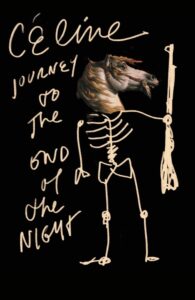
Louis-Ferdinand Celine's revulsion and anger at what he considered the idiocy and hypocrisy of society explodes from nearly every page of this novel. Filled with slang and obscenities and written in raw, colloquial language, Journey to the End of the Night is a literary symphony of violence, cruelty and obscene nihilism. This book shocked most critics when it was first published in France in 1932, but quickly became a success with the reading public in Europe, and later in America where it was first published by New Directions in 1952. The story of the improbable yet convincingly described travels of the petit-bourgeois (and largely autobiographical) antihero, Bardamu, from the trenches of World War I, to the African jungle, to New York and Detroit, and finally to life as a failed doctor in Paris, takes the readers by the scruff and hurtles them toward the novel's inevitable, sad conclusion.
Marcel Proust’s In Search of Lost Time is one of the most entertaining reading experiences in any language and arguably the finest novel of the twentieth century. But since its original prewar translation there has been no completely new version in English. Now, Penguin Classics brings Proust’s masterpiece to new audiences throughout the world, beginning with Lydia Davis’s internationally acclaimed translation of the first volume, Swann’s Way.