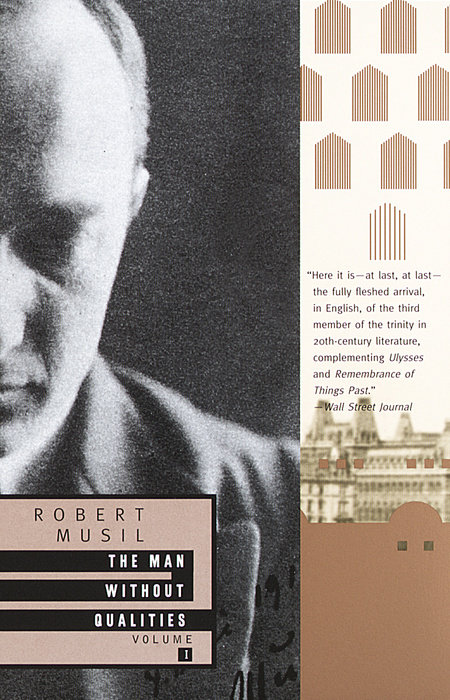
The Man Without Qualities: Volume I
A Sort of Introduction and Pseudo Reality Prevails
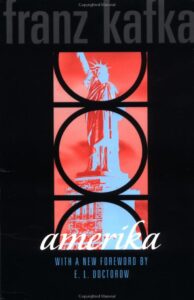
Kafka's first and funniest novel, Amerika tells the story of the young immigrant Karl Rossmann who, after an embarrassing sexual misadventure, finds himself "packed off to America" by his parents. Expected to redeem himself in this magical land of opportunity, young Karl is swept up instead in a whirlwind of dizzying reversals, strange escapades, and picaresque adventures.
Although Kafka never visited America, images of its vast landscape, dangers, and opportunities inspired this saga of the "golden land." Here is a startlingly modern, fantastic and visionary tale of America "as a place no one has yet seen, in a historical period that can't be identified," writes E. L. Doctorow in his new foreword. "Kafka made his novel from his own mind's mythic elements," Doctorow explains, "and the research data that caught his eye were bent like rays in a field of gravity."
Walter Faber is an emotionally detached engineer forced by a string of coincidences to embark on a journey through his past.
Biberkopf hat geschworen, er will anständig sein, und ihr habt gesehen, wie er wochenlang anständig ist, aber das war gewissermaßen nur eine Gnadenfrist. Das Leben findet das auf die Dauer zu fein und stellt ihm hinterlistig ein Bein. Die Geschichte des Transportarbeiters Franz Biberkopf, der, aus der Strafanstalt Berlin-Tegel entlassen, als ehrlicher Mann ins Leben zurückfinden möchte, ist der erste deutsche Großstadtroman von literarischem Rang. Das Berlin der Zwanziger Jahre ist der Schauplatz des Geschehens. Dabei wird die Großstadt selbst zum Gegenspieler des gutmütig-jähzornigen Franz Biberkopf, der dieser verlockenden, aber auch unerbittlichen Welt zu trotzen versucht. Mit Berlin Alexanderplatz vollzog Döblin die radikale Abkehr vom bürgerlich psychologischen Roman. Hier wurde kein Einzelschicksal analysiert. Das kollektive Geschehen, das Allgemeine einer menschlichen Situation erfuhr hier eine gültige dichterische Gestaltung. Der Roman zählt zu den großen Epen unserer Zeit.
Parallel German text and English translation.
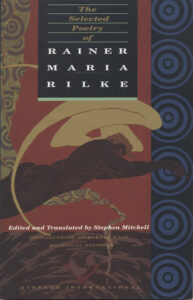
The influence and popularity of Rilke’s poetry in America have never been greater than they are today, more than fifty years after his death. Rilke is unquestionably the most significant and compelling poet of romantic transformation, of spiritual quest, that the twentieth century has known. His poems of ecstatic identification with the world exert a seemingly endless fascination for contemporary readers.
In Stephen Mitchell’s versions, many readers feel that they have discovered an English rendering that captures the lyric intensity, fluency, and reach of Rilke’s poetry more accurately and convincingly than has ever been done before.
Mr. Mitchell is impeccable in his adherence to Rilke’s text, to his formal music, and to the complexity of his thoughts; at the same time, his work has authority and power as poetry in its own right. Few translators of any poet have arrived at the delicate balance of fidelity and originality that Mr. Mitchell has brought off with seeming effortlessness.
Originally published: New York : Random House, 1982.
Steppenwolf is a poetical self-portrait of a man who felt himself to be half-human and half-wolf. This Faust-like and magical story is evidence of Hesse's searching philosophy and extraordinary sense of humanity as he tells of the humanization of a middle-aged misanthrope. Yet his novel can also be seen as a plea for rigorous self-examination and an indictment of the intellectual hypocrisy of the period. As Hesse himself remarked, "Of all my books Steppenwolf is the one that was more often and more violently misunderstood than any of the others".
Emil Sinclair ist ein Junge, der in einem als "Scheinwelt" beschrieben bürgerlichen Elternhaus aufgewachsen ist. Dies ist die dramatische Geschichte seiner Abstieg - gesteuert durch sein frühreifen Schulkamerad Max Demian - in eine geheime und gefährliche Welt der Kleinkriminalität und Revolte gegen Konvention und seiner Erwachen zu Selbstheit.
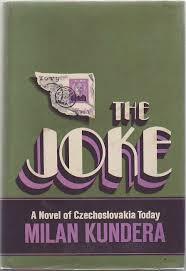
All too often, this brilliant novel of thwarted love and revenge miscarried has been read for its political implications. Now though, a quarter century after The Joke was first published, and several years after the collapse of the Soviet-imposed Czechoslovak regime, it becomes easier to put such implications into perspective in favor of valuing the book (and all Kundera 's work) as what it truly is: great, stirring literature, that sheds new light on the eternal themes of human existence.
The present edition provides English-language readers an important further means toward revaluation of The Joke. For reasons he describes in his Author's Note, Milan Kundera devoted much time to creating (with the assistance of his American publisher-editor) a completely revised translation that reflects his original as closely as any translation possibly can: reflects it in its fidelity not only to the words and syntax but also to the characteristic dictions and tonalities of the novel's narrators. The result is nothing less than the restoration of a classic.
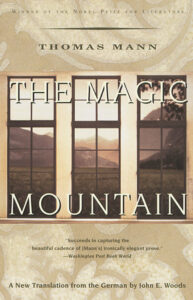
In this dizzyingly rich novel of ideas, Mann uses a sanatorium in the Swiss Alps, a community devoted exclusively to sickness, as a microcosm for Europe, which in the years before 1914 was already exhibiting the first symptoms of its own terminal irrationality.
The Magic Mountain is a monumental work of erudition and irony, sexual tension and intellectual ferment, a book that pulses with life in the midst of death.