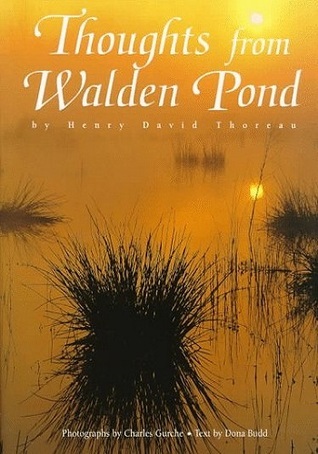
Henry David Thoreau (American, 1817 — 1862) extracted himself from the routines of employment and civilized sociability to spend two years in the woods. Walden, Thoreau’s book about his experience published in 1854, has become one of the most highly respected works in American literature.In Thoughts from Walden Pond, Charles Gurche’s brilliant photographs from the diverse regions of America are paired with excerpts from Thoreau’s masterpiece. The pictures with the text transport us to a state of heightened awareness and impart an almost cellular sense of the importance of wild places. Dona Budd’s introductory essay offers an engrossing biography of Thoreau along with her insightful reflections on Walden.
From acclaimed author Ursula K. Le Guin, and with an introduction by Karen Joy Fowler, a collection of thoughts—always adroit, often acerbic—on aging, belief, the state of literature, and the state of the nation.
Ursula K. Le Guin has taken readers to imaginary worlds for decades. Now she’s in the last great frontier of life, old age, and exploring new literary territory: the blog, a forum where her voice—sharp, witty, as compassionate as it is critical—shines. No Time to Spare collects the best of Ursula’s blog, presenting perfectly crystallized dispatches on what matters to her now, her concerns with this world, and her wonder at it.
On the absurdity of denying your age, she says, If I’m ninety and believe I’m forty-five, I’m headed for a very bad time trying to get out of the bathtub. On cultural perceptions of fantasy: The direction of escape is toward freedom. So what is ‘escapism’ an accusation of? On her new cat: He still won’t sit on a lap…I don’t know if he ever will. He just doesn’t accept the lap hypothesis. On breakfast: Eating an egg from the shell takes not only practice, but resolution, even courage, possibly willingness to commit crime. And on all that is unknown, all that we discover as we muddle through life: How rich we are in knowledge, and in all that lies around us yet to learn. Billionaires, all of us.
An exhilarating meditation on nature and its seasons—a personal narrative highlighting one year's exploration on foot in the author's own neighborhood in Tinker Creek, Virginia. In the summer, Dillard stalks muskrats in the creek and contemplates wave mechanics; in the fall she watches a monarch butterfly migration and dreams of Arctic caribou. She tries to con a coot; she collects pond water and examines it under a microscope. She unties a snake skin, witnesses a flood, and plays 'King of the Meadow' with a field of grasshoppers.
'What matters is to live everything. Live the questions for now.'
A hugely influential collection for writers and artists of all kinds, Rilke's profound and lyrical letters to a young friend advise on writing, love, sex, suffering and the nature of advice itself.
This landmark book is a founding work in the literature of black protest. W. E. B. Du Bois (1868–1963) played a key role in developing the strategy and program that dominated early 20th-century black protest in America. In this collection of essays, first published together in 1903, he eloquently affirms that it is beneath the dignity of a human being to beg for those rights that belong inherently to all mankind. He also charges that the strategy of accommodation to white supremacy advanced by Booker T. Washington, then the most influential black leader in America, would only serve to perpetuate black oppression. Publication of The Souls of Black Folk was a dramatic event that helped to polarize black leaders into two groups: the more conservative followers of Washington and the more radical supporters of aggressive protest. Its influence cannot be overstated. It is essential reading for everyone interested in African-American history and the struggle for civil rights in America.
Dedicated as few men have been to the life of reason, Bertrand Russell has always been concerned with the basic questions to which religion also addresses itself -- questions about man's place in the universe and the nature of the good life, questions that involve life after death, morality, freedom, education, and sexual ethics. He brings to his treatment of these questions the same courage, scrupulous logic, and lofty wisdom for which his other work as philosopher, writer, and teacher has been famous. These qualities make the essays included in this book perhaps the most graceful and moving presentation of the freethinker's position since the days of Hume and Voltaire.
"I am as firmly convinced that religions do harm as I am that they are untrue," Russell declares in his Preface, and his reasoned opposition to any system or dogma which he feels may shackle man's mind runs through all the essays in this book, whether they were written as early as 1899 or as late as 1954.
The book has been edited, with Lord Russell's full approval and cooperation, by Professor Paul Edwards of the Philosophy Department of New York University. In an Appendix, Professor Edwards contributes a full account of the highly controversial "Bertrand Russell Case" of 1940, in which Russell was judicially declared "unfit" to teach philosophy at the College of the City of New York.
Whether the reader shares or rejects Bertrand Russell's views, he will find this book an invigorating challenge to set notions, a masterly statement of a philosophical position, and a pure joy to read.
Why I am not a Christian -- Has religion made useful contributions to civilization? -- What I believe -- Do we survive death? -- Seems, madam? Nay, it is -- Free man's worship -- On Catholic and Protestant skeptics -- Life in the Middle Ages -- Fate of Thomas Paine -- Nice people -- New generation -- Our sexual ethics -- Freedom and the colleges -- Can religion cure our troubles? -- Religion and morals -- Appendix: How Bertrand Russell was prevented from teaching at the College of the City of New York
By one of the most profoundly influential thinkers of our century, The Rebel is a classic essay on revolution. For Albert Camus, the urge to revolt is one of the "essential dimensions" of human nature, manifested in man's timeless Promethean struggle against the conditions of his existence, as well as the popular uprisings against established orders throughout history. And yet, with an eye toward the French Revolution and its regicides and deicides, he shows how inevitably the course of revolution leads to tyranny, as old regimes throughout the world collapse, The Rebel resonates as an ardent, eloquent, and supremely rational voice of conscience for our tumultuous times.
In a volume that is penetrating, introspective, incisive, and laugh-out-loud funny, one of the great men of letters of this era—or any era—holds forth on life, art, sex, politics, and the state of America’s soul. Whether he is describing his coming of age in America, his formative war experiences, or his life as an artist, this is Vonnegut doing what he does best: being himself. Whimsically illustrated by the author, A Man Without a Country is intimate, tender, and brimming with the scope of Kurt Vonnegut’s passions.
One of the most influential works of this century, this is a crucial exposition of existentialist thought. Influenced by works such as Don Juan, and the novels of Kafka, these essays begin with a meditation on suicide: the question of living or not living in an absurd universe devoid of order or meaning. With lyric eloquence, Camus posits a way out of despair, reaffirming the value of personal existence, and the possibility of life lived with dignity and authenticity.
Welcome Back!
Track your reading progress and sync your library.