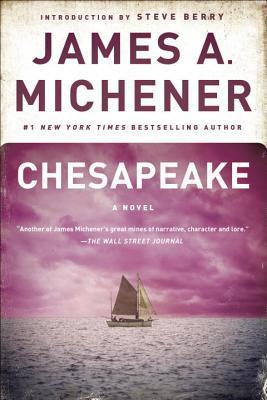
Once again James A. Michener brings history to life with this 400-year saga of America’s great bay and its Eastern Shore. Following Edmund Steed and his remarkable family, who parallel the settling and forming of the nation, CHESAPEAKE sweeps readers from the unspoiled world of the Native Americans to the voyages of Captain John Smith, the Revolutionary War, and right up to modern times.
Spanning four and a half centuries, James A. Michener’s monumental saga chronicles the epic history of Texas, from its Spanish roots in the age of the conquistadors to its current reputation as one of America’s most affluent, diverse, and provocative states. Among his finely drawn cast of characters, emotional and political alliances are made and broken, as the loyalties established over the course of each turbulent age inevitably collapse under the weight of wealth and industry. With Michener as our guide, Texas is a tale of patriotism and statesmanship, growth and development, violence and betrayal—a stunning achievement by a literary master.
Praise for Texas
“Fascinating.”—Time
“A book about oil and water, rangers and outlaws, frontier and settlement, money and power . . . [James A. Michener] manages to make history vivid.”—The Boston Globe
“A sweeping panorama . . . [Michener] grapples earnestly with the Texas character in a way that Texas’s own writers often don’t.”—The Washington Post Book World “Vast, sprawling, and eclectic in population and geography, the state has just the sort of larger-than-life history that lends itself to Mr. Michener’s taste for multigenerational epics.”—The New York Times
Gore Vidal's Narratives of Empire series spans the history of the United States from the Revolution to the post-World War II years. With their broad canvas and large cast of fictional and historical characters, the novels in this series present a panorama of the American political and imperial experience as interpreted by one of its most worldly, knowing, and ironic observers.
Burr is a portrait of perhaps the most complex and misunderstood of the Founding Fathers. In 1804, while serving as vice president, Aaron Burr fought a duel with his political nemesis, Alexander Hamilton, and killed him. In 1807, he was arrested, tried, and acquitted of treason. In 1833, Burr is newly married, an aging statesman considered a monster by many. Burr retains much of his political influence if not the respect of all. And he is determined to tell his own story. As his amanuensis, he chooses Charles Schermerhorn Schuyler, a young New York City journalist, and together they explore both Burr's past and the continuing political intrigues of the still young United States.
A novel about one of the largest land deals in history, the Alaska purchase.
In 1866, an assassination attempt against Alexander II unfolds a series of events that coerce him into selling Alaska to the United States an year later. Meanwhile, Native Alaskans are stuck between the changing order. Some try to fit in while others attempt to fight back. Further south, in a deeply polarized post-Civil War America, the plans of President Johnson conflict with his Security of State’s ambition to acquire Alaska. An approaching impeachment pressures Johnson to attempt to sabotage the deal. Behind closed doors, however, a powerful banking family is awaiting a long overdue payment from the Russians, but there is only so much gold to go around.
Written to commemorate the Bicentennial in 1976, James A. Michener’s magnificent saga of the Westis an enthralling celebration of the frontier. Brimming with the glory of America’s past, the story of Colorado—the Centennial State—is manifested through its people: Lame Beaver, the Arapaho chieftain and warrior, and his Comanche and Pawnee enemies; Levi Zendt, fleeing with his child bride from the Amish country; the cowboy, Jim Lloyd, who falls in love with a wealthy and cultured Englishwoman, Charlotte Seccombe. In Centennial, trappers, traders, homesteaders, gold seekers, ranchers, and hunters are brought together in the dramatic conflicts that shape the destiny of the legendary West—and the entire country.
1970s Afghanistan: Twelve-year-old Amir is desperate to win the local kite-fighting tournament and his loyal friend Hassan promises to help him. But neither of the boys can foresee what would happen to Hassan that afternoon, an event that is to shatter their lives. After the Russians invade and the family is forced to flee to America, Amir realises that one day he must return to an Afghanistan under Taliban rule to find the one thing that his new world cannot grant him: redemption.
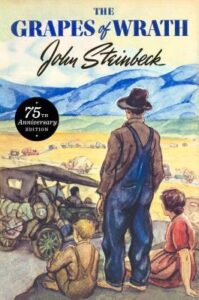
The Pulitzer Prize-winning epic of the Great Depression, a book that galvanized—and sometimes outraged—millions of readers.
First published in 1939, Steinbeck’s Pulitzer Prize-winning epic of the Great Depression chronicles the Dust Bowl migration of the 1930s and tells the story of one Oklahoma farm family, the Joads—driven from their homestead and forced to travel west to the promised land of California. Out of their trials and their repeated collisions against the hard realities of an America divided into Haves and Have-Nots evolves a drama that is intensely human yet majestic in its scale and moral vision, elemental yet plainspoken, tragic but ultimately stirring in its human dignity. A portrait of the conflict between the powerful and the powerless, of one man’s fierce reaction to injustice, and of one woman’s stoical strength, the novel captures the horrors of the Great Depression and probes into the very nature of equality and justice in America. At once a naturalistic epic, captivity narrative, road novel, and transcendental gospel, Steinbeck’s powerful landmark novel is perhaps the most American of American Classics.
Giants in the Earth (Norwegian: Verdens Grøde) is a novel by Norwegian-American author Ole Edvart Rølvaag. First published in Norway as two books in 1924 and 1925, the author collaborated with Minnesotan Lincoln Colcord on the English translation.
The novel follows a Norwegian family's struggles as they try to make a new life as pioneers in the Dakota territory. Rølvaag is interested in psychology and the human cost of empire building, at a time when other writers focused on the glamor and romance of the West. The book reflects his personal experiences as a settler as well as the immigrant homesteader experience of his wife’s family. Both the grim realities of pioneering and the gloomy fatalism of the Norse mind are captured in depictions of snow storms, locusts, poverty, hunger, loneliness, homesickness, the difficulty of fitting into a new culture, and the estrangement of immigrant children who grow up in a new land. It is a novel at once palpably European and distinctly American.
Giants in the Earth was turned into an opera by Douglas Moore and Arnold Sundgaard; it won the Pulitzer Prize for Music in 1951.
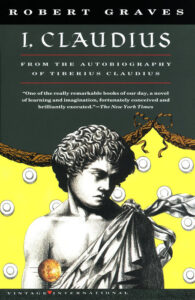
A modern classic of historical fiction written in the form of Claudius's autobiography.
Tiberius Claudius Drusus Nero Germanicus lived from 10 B.C. to 54 A.D. Despised as a weakling and dismissed as an idiot because of his physical infirmities, Claudius survived the intrigues and poisonings that marked the reigns of Augustus, Tiberius, and the mad Caligula to become emperor of Rome in 41 A.D. The first part of Robert Graves’s two-part account of the life of Tiberius Claudius, I, Claudius stands as a landmark historical novel of the 20th century from one of its great writers.
Welcome Back!
Track your reading progress and sync your library.