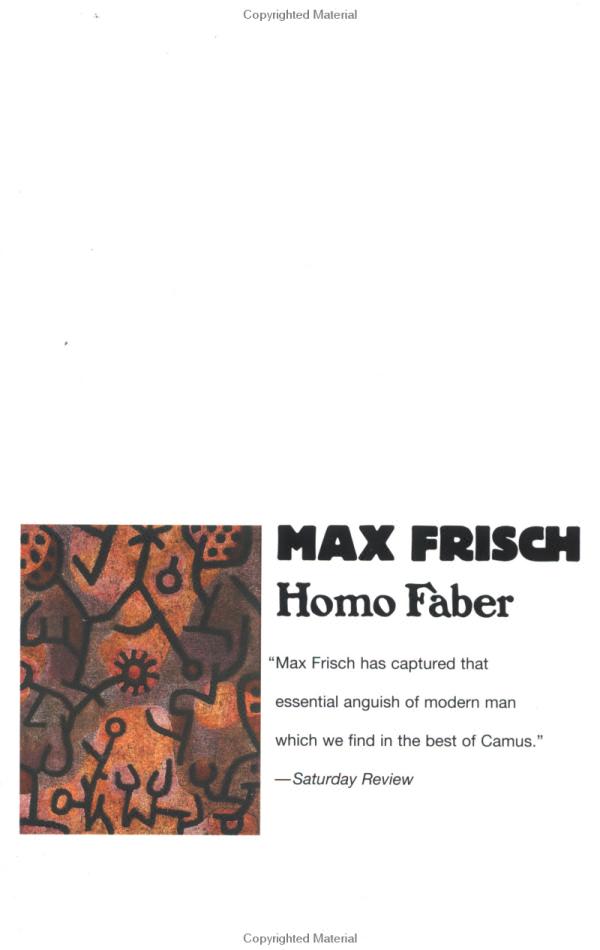
Homo Faber
Walter Faber is an emotionally detached engineer forced by a string of coincidences to embark on a journey through his past.
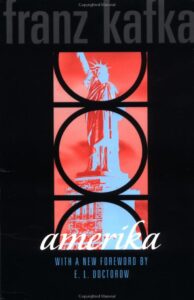
Kafka's first and funniest novel, Amerika tells the story of the young immigrant Karl Rossmann who, after an embarrassing sexual misadventure, finds himself "packed off to America" by his parents. Expected to redeem himself in this magical land of opportunity, young Karl is swept up instead in a whirlwind of dizzying reversals, strange escapades, and picaresque adventures.
Although Kafka never visited America, images of its vast landscape, dangers, and opportunities inspired this saga of the "golden land." Here is a startlingly modern, fantastic and visionary tale of America "as a place no one has yet seen, in a historical period that can't be identified," writes E. L. Doctorow in his new foreword. "Kafka made his novel from his own mind's mythic elements," Doctorow explains, "and the research data that caught his eye were bent like rays in a field of gravity."
Biberkopf hat geschworen, er will anständig sein, und ihr habt gesehen, wie er wochenlang anständig ist, aber das war gewissermaßen nur eine Gnadenfrist. Das Leben findet das auf die Dauer zu fein und stellt ihm hinterlistig ein Bein. Die Geschichte des Transportarbeiters Franz Biberkopf, der, aus der Strafanstalt Berlin-Tegel entlassen, als ehrlicher Mann ins Leben zurückfinden möchte, ist der erste deutsche Großstadtroman von literarischem Rang. Das Berlin der Zwanziger Jahre ist der Schauplatz des Geschehens. Dabei wird die Großstadt selbst zum Gegenspieler des gutmütig-jähzornigen Franz Biberkopf, der dieser verlockenden, aber auch unerbittlichen Welt zu trotzen versucht. Mit Berlin Alexanderplatz vollzog Döblin die radikale Abkehr vom bürgerlich psychologischen Roman. Hier wurde kein Einzelschicksal analysiert. Das kollektive Geschehen, das Allgemeine einer menschlichen Situation erfuhr hier eine gültige dichterische Gestaltung. Der Roman zählt zu den großen Epen unserer Zeit.
"Auto-da-Fé" is the story of Peter Kien, a distinguished, reclusive sinologist living in Vienna between the wars. With masterly precision, Canetti reveals Kien's character, displaying the flawed personal relationships which ultimately lead to his destruction.
Manipulated by his illiterate and grasping housekeeper, Therese, who has tricked him into marriage, and Benedikt Pfaff, a brutish concierge, Kien is forced out of his apartment - which houses his great library and one true passion - and into the underworld of the city. In this purgatory he is guided by a chess-playing dwarf of evil propensities, until he is eventually restored to his home. But on his return he is visited by his brother, an eminent psychiatrist who, by an error of diagnosis, precipitates the final crisis...
"Auto-da-Fé" was first published in Germany in 1935 as "Die Blendung" ("The Blinding" or "Bedazzlement") and later in Britain in 1947, where the publisher noted Canetti as a 'writer of strongly individual genius, which may prove influential', an observation borne out when the author was awarded the Nobel Prize for Literature in 1981. "Auto-da-Fé" still towers as one of the greatest novels of the twentieth century, and Canetti's incisive vision of an insular man battling agianst the outside world is as fresh and rewarding today as when first it appeared in print.
Thomas Mann's last great novel, first published in 1947 and now rendered into English by acclaimed translator John E. Woods, is a modern reworking of the Faust legend, in which Germany sells its soul to the Devil. Mann's protagonist, the composer Adrian Leverkühn, is the flower of German culture, a brilliant, isolated, overreaching figure, his radical new music a breakneck game played by art at the very edge of impossibility. In return for twenty-four years of unparalleled musical accomplishment, he bargains away his soul - and the ability to love his fellow man.
Leverkühn's life story is a brilliant allegory of the rise of the Third Reich, of Germany's renunciation of its own humanity and its embrace of ambition and its nihilism. It is also Mann's most profound meditation on the German genius - both national and individual - and the terrible responsibilities of the truly great artist.
Emil Sinclair ist ein Junge, der in einem als "Scheinwelt" beschrieben bürgerlichen Elternhaus aufgewachsen ist. Dies ist die dramatische Geschichte seiner Abstieg - gesteuert durch sein frühreifen Schulkamerad Max Demian - in eine geheime und gefährliche Welt der Kleinkriminalität und Revolte gegen Konvention und seiner Erwachen zu Selbstheit.
A classic of modern literature: Buddenbrooks is the story of four generations of a wealthy bourgeois family in northern Germany facing the advent of modernity; in an uncertain new world, the family’s bonds and traditions begin to disintegrate. With an introduction by T. J. Reed, and translated by John E. Woods.
As Mann charts the Buddenbrooks’ decline from prosperity to bankruptcy, from moral and psychic soundness to sickly piety, artistic decadence, and madness, he ushers the reader into a world of stunning vitality, pieced together from births and funerals, weddings and divorces, recipes, gossip, and earthy humor.
First published in Germany in 1901, when Mann was only twenty-six, Buddenbrooks surpasses all other modern family chronicles in its immensity of scope, richness of detail, and fullness of humanity. With remarkable fidelity to the original German text, this superb translation emphasizes the magnificent scale of Mann’s achievement in this riveting, tragic novel.
Set on the coast of England against the vivid background of the sea, The Waves introduces six characters—three men and three women—who are grappling with the death of a beloved friend, Percival. Instead of describing their outward expressions of grief, Virginia Woolf draws her characters from the inside, revealing them through their thoughts and interior soliloquies. As their understanding of nature’s trials grows, the chorus of narrative voices blends together in miraculous harmony, remarking not only on the inevitable death of individuals but on the eternal connection of everyone. The novel that most epitomizes Virginia Woolf’s theories of fiction in the working form, The Waves is an amazing book very much ahead of its time. It is a poetic dreamscape, visual, experimental, and thrilling.