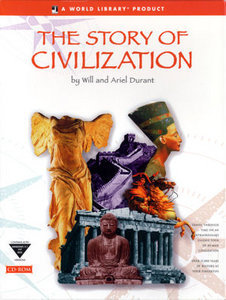
The Complete Story of Civilization by Will Durant represents the most comprehensive attempt in our times to embrace the vast panorama of man’s history and culture. This eleven-volume set Volume One – Our Oriental Heritage; Volume Two – The Life of Greece; Volume Three – Caesar and Christ; Volume Four – The Age of Faith; Volume Five – The Renaissance; Volume Six – The Reformation; Volume Seven – The Age of Reason Begins; Volume Eight – The Age of Louis XIV; Volume Nine – The Age of Voltaire; Volume Ten – Rousseau and Revolution; Volume Eleven – The Age of Napoleon
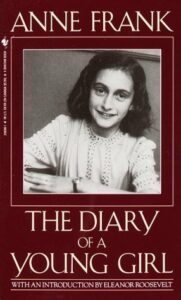
Discovered in the attic where she spent the final years of her life, Anne Frank’s Diary has become a timeless classic; a powerful reminder of the horrors of war and a moving testament to the resilience of the human spirit.
In 1942, as the Nazis occupied Holland, thirteen-year-old Anne Frank and her Jewish family fled their home in Amsterdam and went into hiding. For the next two years, until they were betrayed to the Gestapo, the Franks and another family lived in the cramped “Secret Annexe” of an old office building. Cut off from the outside world, they endured hunger, boredom, the strain of close quarters, and the constant fear of discovery and death.
Through it all, Anne documented her experiences in a diary filled with vivid observations. At times thoughtful, poignant, and even unexpectedly funny, her writing offers a remarkable window into the strength and vulnerability of the human spirit. It’s both a compelling self-portrait of a bright, spirited young woman and a heartbreaking glimpse of a life that should have been far longer.
A landmark volume in science writing by one of the great minds of our time, Stephen Hawking’s book explores such profound questions as: How did the universe begin—and what made its start possible? Does time always flow forward? Is the universe unending—or are there boundaries? Are there other dimensions in space? What will happen when it all ends?
Told in language we all can understand, A Brief History of Time plunges into the exotic realms of black holes and quarks, of antimatter and “arrows of time,” of the big bang and a bigger God—where the possibilities are wondrous and unexpected. With exciting images and profound imagination, Stephen Hawking brings us closer to the ultimate secrets at the very heart of creation.
The King James Version is an Early Modern English translation of the Christian Bible for the Church of England, which was commissioned in 1604 and published in 1611. The 80 books of the King James Version include 39 books of the Old Testament, 14 books of Apocrypha, and the 27 books of the New Testament.
Written in Greek by the only Roman emperor who was also a philosopher, without any intention of publication, the Meditations of Marcus Aurelius offer a remarkable series of challenging spiritual reflections and exercises developed as the emperor struggled to understand himself and make sense of the universe. While the Meditations were composed to provide personal consolation and encouragement, Marcus Aurelius also created one of the greatest of all works of philosophy: a timeless collection that has been consulted and admired by statesmen, thinkers and readers throughout the centuries.
In the shadow of Auschwitz, a flamboyant German industrialist grew into a living legend to the Jews of Cracow. He was a womaniser and a heavy drinker who enjoyed the good life, yet to them he became a saviour. Thomas Keneally's Booker Prize-winning novel recreates the story of Oskar Schindler, an Aryan who risked his life to protect Jews in Nazi-occupied Poland, who conrinually defied and outwitted the SS, and who was transformed by the war into an angel of mercy. It is an unforgettable tale, all the more extraordinary for being true.
A good book may have the power to change the way we see the world, but a great book actually becomes part of our daily consciousness, pervading our thinking to the point that we take it for granted, and we forget how provocative and challenging its ideas once were—and still are. The Structure of Scientific Revolutions is that kind of book. When it was first published in 1962, it was a landmark event in the history and philosophy of science. Fifty years later, it still has many lessons to teach.
With The Structure of Scientific Revolutions, Kuhn challenged long-standing linear notions of scientific progress, arguing that transformative ideas don’t arise from the day-to-day, gradual process of experimentation and data accumulation but that the revolutions in science, those breakthrough moments that disrupt accepted thinking and offer unanticipated ideas, occur outside of “normal science,” as he called it. Though Kuhn was writing when physics ruled the sciences, his ideas on how scientific revolutions bring order to the anomalies that amass over time in research experiments are still instructive in our biotech age.
This new edition of Kuhn’s essential work in the history of science includes an insightful introduction by Ian Hacking, which clarifies terms popularized by Kuhn, including paradigm and incommensurability, and applies Kuhn’s ideas to the science of today. Usefully keyed to the separate sections of the book, Hacking’s introduction provides important background information as well as a contemporary context. Newly designed, with an expanded index, this edition will be eagerly welcomed by the next generation of readers seeking to understand the history of our perspectives on science.
Darwin's theory of natural selection issued a profound challenge to orthodox thought and belief: no being or species has been specifically created; all are locked into a pitiless struggle for existence, with extinction looming for those not fitted for the task.
Yet The Origin of Species (1859) is also a humane and inspirational vision of ecological interrelatedness, revealing the complex mutual interdependencies between animal and plant life, climate and physical environment, and—by implication—within the human world.
Written for the general reader, in a style which combines the rigour of science with the subtlety of literature, The Origin of Species remains one of the founding documents of the modern age.
On August 6, 1945, Hiroshima was destroyed by the first atom bomb ever dropped on a city. This book, John Hersey's journalistic masterpiece, tells what happened on that day. Told through the memories of survivors, this timeless, powerful and compassionate document has become a classic "that stirs the conscience of humanity" (The New York Times).
Welcome Back!
Track your reading progress and sync your library.