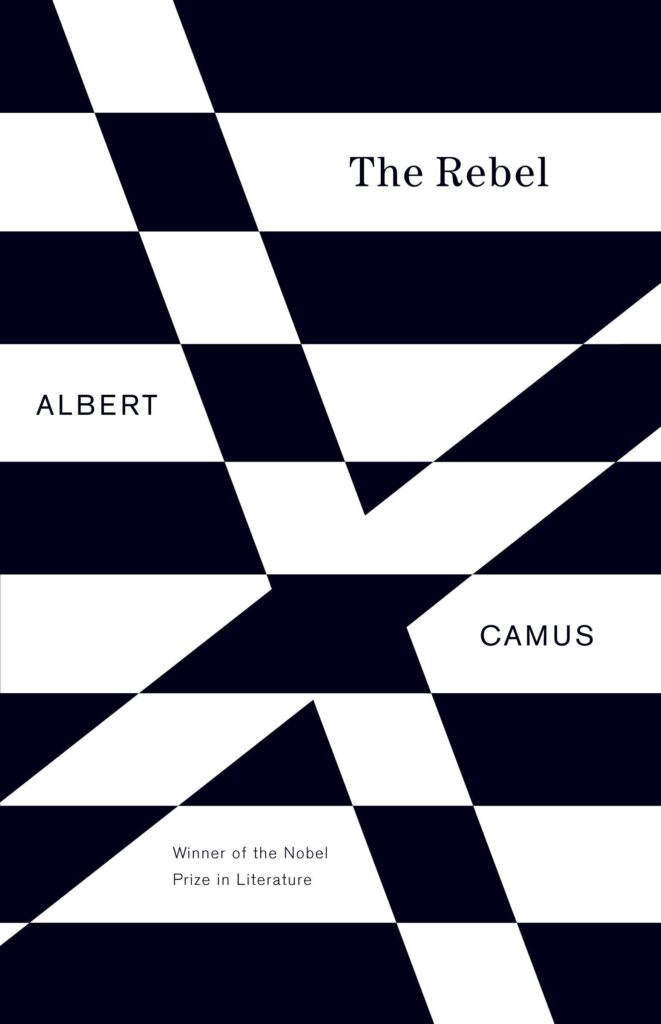
By one of the most profoundly influential thinkers of our century, The Rebel is a classic essay on revolution. For Albert Camus, the urge to revolt is one of the “essential dimensions” of human nature, manifested in man’s timeless Promethean struggle against the conditions of his existence, as well as the popular uprisings against established orders throughout history. And yet, with an eye toward the French Revolution and its regicides and deicides, he shows how inevitably the course of revolution leads to tyranny, as old regimes throughout the world collapse, The Rebel resonates as an ardent, eloquent, and supremely rational voice of conscience for our tumultuous times.
One of the most influential works of this century, this is a crucial exposition of existentialist thought. Influenced by works such as Don Juan, and the novels of Kafka, these essays begin with a meditation on suicide: the question of living or not living in an absurd universe devoid of order or meaning. With lyric eloquence, Camus posits a way out of despair, reaffirming the value of personal existence, and the possibility of life lived with dignity and authenticity.
A national bestseller when it first appeared in 1963, The Fire Next Time galvanized the nation and gave passionate voice to the emerging civil rights movement. At once a powerful evocation of James Baldwin’s early life in Harlem and a disturbing examination of the consequences of racial injustice, the book is an intensely personal and provocative document. It consists of two “letters,” written on the occasion of the centennial of the Emancipation Proclamation, that exhort Americans, both black and white, to attack the terrible legacy of racism. Described by The New York Times Book Review as “sermon, ultimatum, confession, deposition, testament, and chronicle…all presented in searing, brilliant prose,” The Fire Next Time stands as a classic of our literature.
O Ser e o Nada (1943), escrito durante a ocupação nazi, é um dos textos fundamentais do século XX. O livro que marcou como nenhum outro uma época a braços com o desmoronamento de uma civilização é ao mesmo tempo a bíblia do existencialismo e o último grande sistema filosófico.
Para Sartre, o sentido das nossas vidas não é predeterminado nem por Deus nem pela natureza, não há nenhuma essência que preceda a existê o que nos define não é dado a priori, mas decorre das escolhas que fizermos. Primeiro existimos, e só depois nos definimos. Não existe natureza humana à qual tenhamos irresistivelmente de estamos condenados a ser livres e somos os únicos responsáveis pelos nossos destinos.
No âmago destas posições, está a conceção sartriana de consciência, influenciada pela fenomenologia de Husserl e pela ontologia de Heidegger. Como a consciência é sempre consciência de alguma coisa, ela própria não é nada enquanto não visa algo fora de si. O ser-para-si, a consciência humana, caracteriza-se por ser permanente projeção para o exterior. Daí os conceitos filosóficos de angústia e de «má-fé», ilustrada pelo famoso exemplo do empregado de mesa, e a problemática relação com os demais, tipificada na investigação sobre o desejo sexual e o «olhar» do Outro.
Simply written, but powerful and unforgettable, The Man Who Planted Trees is a parable for modern times. In the foothills of the French Alps the narrator meets a shepherd who has quietly taken on the task of planting one hundred acorns a day in an effort to reforest his desolate region. Not even two world wars can keep the shepherd from continuing his solitary work. Gradually, this gentle, persistent man's work comes to the region is transformed; life and hope return; the world is renewed.
Few works of political and cultural theory have been as enduringly provocative as Guy Debord's The Society of the Spectacle. From its publication amid the social upheavals of the 1960s up to the present, the volatile theses of this book have decisively transformed debates on the shape of modernity, capitalism and everyday life in the late twentieth century. Now finally available in a superb English translation approved by the author, Debord's text remains as crucial as ever for understanding the contemporary effects of power, which are increasingly inseparable from the new virtual worlds of our rapidly changing image/information culture.
Jean-Baptiste Clamence is a soul in turmoil. Over several drunken nights in an Amsterdam bar, he regales a chance acquaintance with his story. From this successful former lawyer and seemingly model citizen a compelling, self-loathing catalogue of guilt, hypocrisy and alienation pours forth.
The Fall (French: La Chute) is a philosophical novel by Albert Camus. First published in 1956, it is his last complete work of fiction. The Fall explores themes of innocence, imprisonment, non-existence, and truth. In a eulogy to Albert Camus, existentialist philosopher Jean-Paul Sartre described the novel as "perhaps the most beautiful and the least understood" of Camus' books.
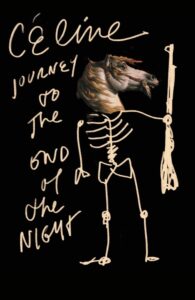
Louis-Ferdinand Celine's revulsion and anger at what he considered the idiocy and hypocrisy of society explodes from nearly every page of this novel. Filled with slang and obscenities and written in raw, colloquial language, Journey to the End of the Night is a literary symphony of violence, cruelty and obscene nihilism. This book shocked most critics when it was first published in France in 1932, but quickly became a success with the reading public in Europe, and later in America where it was first published by New Directions in 1952. The story of the improbable yet convincingly described travels of the petit-bourgeois (and largely autobiographical) antihero, Bardamu, from the trenches of World War I, to the African jungle, to New York and Detroit, and finally to life as a failed doctor in Paris, takes the readers by the scruff and hurtles them toward the novel's inevitable, sad conclusion.
Since its first publication in two volumes between 1918-1923, The Decline of the West has ranked as one of the most widely read and most talked about books of our time. In all its various editions, it has sold nearly 100,000 copies. A twentieth-century Cassandra, Oswald Spengler thoroughly probed the origin and "fate" of our civilization, and the result can be (and has been) read as a prophesy of the Nazi regime. His challenging views have led to harsh criticism over the years, but the knowledge and eloquence that went into his sweeping study of Western culture have kept The Decline of the West alive. As the face of Germany and Europe as a whole continues to change each day, The Decline of the West cannot be ignored.
The abridgment, prepared by the German scholar Helmut Werner, with the blessing of the Spengler estate, consists of selections from the original (translated into English by Charles Francis Atkinson) linked by explanatory passages which have been put into English by Arthur Helps. H. Stuart Hughes has written a new introduction for this edition.
In this engrossing and highly controversial philosophy of history, Spengler describes how we have entered into a centuries-long "world-historical" phase comparable to late antiquity. Guided by the philosophies of Goethe and Nietzsche, he rejects linear progression, and instead presents a world view based on the cyclical rise and decline of civilizations. He argues that a culture blossoms from the soil of a definable landscape and dies when it has exhausted all of its possibilities.
Despite Spengler's reputation today as an extreme pessimist, The Decline of the West remains essential reading for anyone interested in the history of civilization.
Welcome Back!
Track your reading progress and sync your library.