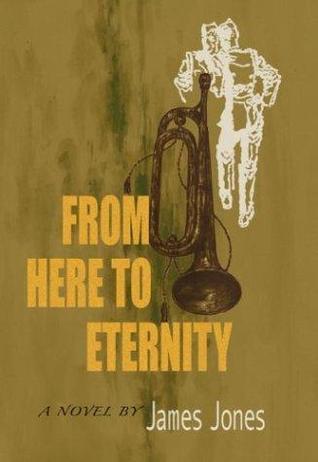
Diamond Head, Hawaii, 1941. Pvt. Robert E. Lee Prewitt is a champion welterweight and a fine bugler. But when he refuses to join the company’s boxing team, he gets “the treatment” that may break him or kill him.
First Sgt. Milton Anthony Warden knows how to soldier better than almost anyone, yet he’s risking his career to have an affair with the commanding officer’s wife.
Both Warden and Prewitt are bound by a common bond: the Army is their heart and blood… and, possibly, their death.
In this magnificent but brutal classic of a soldier’s life, James Jones portrays the courage, violence and passions of men and women who live by unspoken codes and with unutterable despair… in the most important American novel to come out of World War II, a masterpiece that captures as no other the honor and savagery of men.
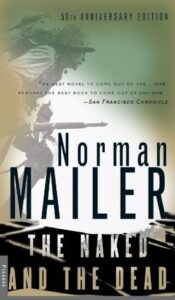
Hailed as one of the finest novels to come out of the Second World War, The Naked and the Dead received unprecedented critical acclaim upon its publication and has since become part of the American canon. This fiftieth anniversary edition features a new introduction created especially for the occasion by Norman Mailer.
Written in gritty, journalistic detail, the story follows an army platoon of foot soldiers who are fighting for the possession of the Japanese-held island of Anopopei. Composed in 1948, The Naked and the Dead is representative of the best in twentieth-century American writing.
Winter of the World picks up right where the first book left off, as its five interrelated families—American, German, Russian, English, Welsh—enter a time of enormous social, political, and economic turmoil, beginning with the rise of the Third Reich, through the Spanish Civil War and the great dramas of World War II, up to the explosions of the American and Soviet atomic bombs.
Carla von Ulrich, born of German and English parents, finds her life engulfed by the Nazi tide until she commits a deed of great courage and heartbreak. . . . American brothers Woody and Chuck Dewar, each with a secret, take separate paths to momentous events, one in Washington, the other in the bloody jungles of the Pacific. . . . English student Lloyd Williams discovers in the crucible of the Spanish Civil War that he must fight Communism just as hard as Fascism. . . . Daisy Peshkov, a driven American social climber, cares only for popularity and the fast set, until the war transforms her life, not just once but twice, while her cousin Volodya carves out a position in Soviet intelligence that will affect not only this war—but the war to come.
These characters and many others find their lives inextricably entangled as their experiences illuminate the cataclysms that marked the century. From the drawing rooms of the rich to the blood and smoke of battle, their lives intertwine, propelling the reader into dramas of ever-increasing complexity.
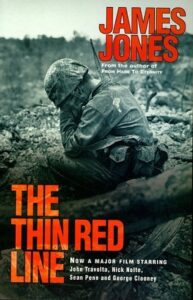
"When compared to the fact that he might very well be dead by this time tomorrow, whether he was courageous or not today was pointless, empty. When compared to the fact that he might be dead tomorrow, everything was pointless. Life was pointless. Whether he looked at a tree or not was pointless. It just didn't make any difference. It was pointless to the tree, it was pointless to every man in his outfit, pointless to everybody in the whole world. Who cared? It was not pointless only to him; and when he was dead, when he ceased to exist, it would be pointless to him too. More important: Not only would it be pointless, it would have been pointless, all along."
Such is the ultimate significance of war in The Thin Red Line (1962), James Jones's fictional account of the battle between American and Japanese troops on the island of Guadalcanal. The narrative shifts effortlessly among multiple viewpoints within C-for-Charlie Company, from commanding officer Capt. James Stein, his psychotic first sergeant Eddie Welsh, and the young privates they send into battle. The descriptions of combat conditions—and the mental states it induces—are unflinchingly realistic, including the dialog (in which a certain word Norman Mailer rendered as "fug" 15 years earlier in The Naked and the Dead appears properly spelled on numerous occasions). This is more than a classic of combat fiction; it is one of the most significant explorations of male identity in American literature, establishing Jones as a novelist of the caliber of Herman Melville and Stephen Crane.
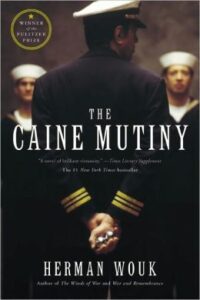
The novel that inspired the now-classic film The Caine Mutiny and the hit Broadway play The Caine Mutiny Court-Martial, Herman Wouk's boldly dramatic, brilliantly entertaining novel of life-and mutiny-on a Navy warship in the Pacific theater was immediately embraced, upon its original publication in 1951, as one of the first serious works of American fiction to grapple with the moral complexities and the human consequences of World War II. In the intervening half century, The Caine Mutiny has become a perennial favorite of readers young and old, has sold millions of copies throughout the world, and has achieved the status of a modern classic.
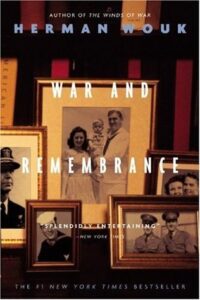
War and Remembrance is a historical romance. The subject is World War II, the viewpoint American. A prologue, The Winds of War, published in 1971, set the historical frame for this work by picturing the events leading up to Pearl Harbor. This is a novel of America at war, from Pearl Harbor to Hiroshima.
Three stories are told: a young Southerner wants to become a writer; a turbulent love-hate affair between a brilliant Jew and a beautiful Polish woman; and of an awful wound in that woman's past--one that impels both Sophie and Nathan toward destruction.
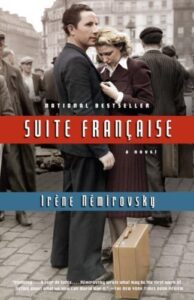
The first two stories of a masterwork once thought lost, written by a pre-WWII bestselling author who was deported to Auschwitz and died before her work could be completed.
By the early l940s, when Ukrainian-born Irène Némirovsky began working on what would become Suite Française—the first two parts of a planned five-part novel—she was already a highly successful writer living in Paris. But she was also a Jew, and in 1942 she was arrested and deported to Auschwitz: a month later she was dead at the age of thirty-nine. Two years earlier, living in a small village in central France—where she, her husband, and their two small daughters had fled in a vain attempt to elude the Nazis—she'd begun her novel, a luminous portrayal of a human drama in which she herself would become a victim. When she was arrested, she had completed two parts of the epic, the handwritten manuscripts of which were hidden in a suitcase that her daughters would take with them into hiding and eventually into freedom. Sixty-four years later, at long last, we can read Némirovsky's literary masterpiece
The first part, "A Storm in June," opens in the chaos of the massive 1940 exodus from Paris on the eve of the Nazi invasion during which several families and individuals are thrown together under circumstances beyond their control. They share nothing but the harsh demands of survival—some trying to maintain lives of privilege, others struggling simply to preserve their lives—but soon, all together, they will be forced to face the awful exigencies of physical and emotional displacement, and the annihilation of the world they know. In the second part, "Dolce," we enter the increasingly complex life of a German-occupied provincial village. Coexisting uneasily with the soldiers billeted among them, the villagers—from aristocrats to shopkeepers to peasants—cope as best they can. Some choose resistance, others collaboration, and as their community is transformed by these acts, the lives of these these men and women reveal nothing less than the very essence of humanity.
Suite Française is a singularly piercing evocation—at once subtle and severe, deeply compassionate, and fiercely ironic—of life and death in occupied France, and a brilliant, profoundly moving work of art.
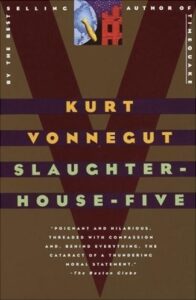
Slaughterhouse-Five, an American classic, is one of the world’s great antiwar books. Centering on the infamous World War II firebombing of Dresden, the novel is the result of what Kurt Vonnegut described as a twenty-three-year struggle to write a book about what he had witnessed as an American prisoner of war. It combines historical fiction, science fiction, autobiography, and satire in an account of the life of Billy Pilgrim, a barber’s son turned draftee turned optometrist turned alien abductee. As Vonnegut had, Billy experiences the destruction of Dresden as a POW. Unlike Vonnegut, he experiences time travel, or coming “unstuck in time.”
An instant bestseller, Slaughterhouse-Five made Kurt Vonnegut a cult hero in American literature, a reputation that only strengthened over time, despite his being banned and censored by some libraries and schools for content and language. But it was precisely those elements of Vonnegut’s writing—the political edginess, the genre-bending inventiveness, the frank violence, the transgressive wit—that have inspired generations of readers not just to look differently at the world around them but to find the confidence to say something about it.
Fifty years after its initial publication at the height of the Vietnam War, Vonnegut's portrayal of political disillusionment, PTSD, and postwar anxiety feels as relevant, darkly humorous, and profoundly affecting as ever, an enduring beacon through our own era’s uncertainties.
Welcome Back!
Track your reading progress and sync your library.