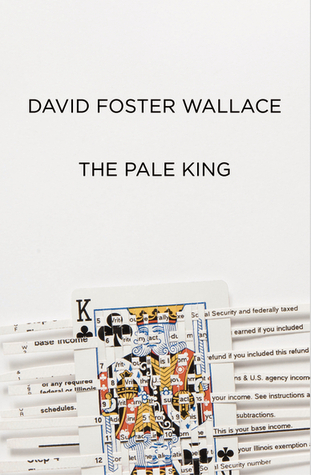
The agents at the IRS Regional Examination Center in Peoria, Illinois, appear ordinary enough to newly arrived trainee David Foster Wallace. But as he immerses himself in a routine so tedious and repetitive that new employees receive boredom-survival training, he learns of the extraordinary variety of personalities drawn to this strange calling. And he has arrived at a moment when forces within the IRS are plotting to eliminate even what little humanity and dignity the work still has.
The Pale King remained unfinished at the time of David Foster Wallace’s death, but it is a deeply compelling and satisfying novel, hilarious and fearless and as original as anything Wallace ever undertook. It grapples directly with ultimate questions–questions of life’s meaning and of the value of work and society–through characters imagined with the interior force and generosity that were Wallace’s unique gifts. Along the way it suggests a new idea of heroism and commands infinite respect for one of the most daring writers of our time.
Zeroville begins in 1969 on Hollywood Boulevard, when a Greyhound bus drops off a film-obsessed ex-seminarian with images of Elizabeth Taylor and Montgomery Clift tattooed on his head. Vikar Jerome steps into the vortex of a cultural transformation: rock ’n’ roll, sex, drugs, and — far more important to him — the decline of the movie studios and the rise of the independent director. Jerome will become a film editor of astonishing vision. Then through encounters with former starlets, burglars, political guerillas, punk musicians, and veteran filmmakers, he discovers the astonishing secret that lies in every movie ever made.
“The first of my father’s illusions was that bears could survive the life lived by human beings, and the second was that human beings could survive a life led in hotels.” So says John Berry, son of a hapless dreamer, brother to a cadre of eccentric siblings, and chronicler of the lives lived, the loves experienced, the deaths met, and the myriad strange and wonderful times encountered by the family Berry. Hoteliers, pet-bear owners, friends of Freud (the animal trainer and vaudevillian, that is), and playthings of mad fate, they “dream on” in a funny, sad, outrageous, and moving novel by the remarkable author of A Prayer for Owen Meany and Last Night in Twisted River.
The National Book Award-winning classic from the author of Underworld and Libra, now a Netflix film starring Adam Driver, Don Cheadle, and Greta Gerwig
White Noise tells the story of Jack Gladney, his fourth wife, Babette, and four ultramodern offspring as they navigate the rocky passages of family life to the background babble of brand-name consumerism. When an industrial accident unleashes an "airborne toxic event," a lethal black chemical cloud floats over their lives. The menacing cloud is a more urgent and visible version of the "white noise" engulfing the Gladneys—radio transmissions, sirens, microwaves, ultrasonic appliances, and TV murmurings—pulsing with life, yet suggesting something ominous.
Part of the Penguin Orange Collection, a limited-run series of twelve influential and beloved American classics in a bold series design offering a modern take on the iconic Penguin paperback
Winner of the 2016 AIGA + Design Observer 50 Books | 50 Covers competition
It is a stunningly eventful day in the life of Eric Packer, a multi-billionaire who has recently married the heiress of a vast European fortune. A violent protest is being staged by anti-globalist groups and Eric fears that he may be a target. He is very much the target - but not by the protestors.
There is no more decorated American writer living today than Philip Roth, the New York Times best-selling author of American Pastoral, The Human Stain, and The Plot Against America. He has won a Pulitzer Prize, two National Book Awards, two National Book Critics Circle Awards, two PEN/Faulkner Awards, and numerous other distinctions.
The hero of Everyman is obsessed with mortality. As he reminds himself at one point, "I'm 34! Worry about oblivion when you're 75." But he cannot help himself. He is the ex-husband in three marriages gone wrong. He is the father of two sons who detest him, despite a daughter who adores him. And as his health worsens, he is the envious brother of a much fitter man. A masterful portrait of one man's inner struggles, Everyman is a brilliant showcase for one of the world's most distinguished novelists.
There is September 11 and then there are the days after, and finally the years.
Falling Man is a magnificent, essential novel about the event that defines turn-of-the-century America. It begins in the smoke and ash of the burning towers and tracks the aftermath of this global tremor in the intimate lives of a few people.
First there is Keith, walking out of the rubble into a life that he'd always imagined belonged to everyone but him. Then Lianne, his estranged wife, memory-haunted, trying to reconcile two versions of the same shadowy man. And their small son Justin, standing at the window, scanning the sky for more planes.
These are lives choreographed by loss, grief and the enormous force of history.
Patty and Walter Berglund were the new pioneers of old St. Paul—the gentrifiers, the hands-on parents, the avant-garde of the Whole Foods generation. Patty was the ideal sort of neighbor, who could tell you where to recycle your batteries and how to get the local cops to actually do their job. She was an enviably perfect mother and the wife of Walter's dreams. Together with Walter—environmental lawyer, commuter cyclist, total family man—she was doing her small part to build a better world.
But now, in the new millennium, the Berglunds have become a mystery. Why has their teenage son moved in with the aggressively Republican family next door? Why has Walter taken a job working with Big Coal? What exactly is Richard Katz—outré rocker and Walter's college best friend and rival—still doing in the picture? Most of all, what has happened to Patty? Why has the bright star of Barrier Street become "a very different kind of neighbor," an implacable Fury coming unhinged before the street's attentive eyes?
In his first novel since The Corrections, Jonathan Franzen has given us an epic of contemporary love and marriage. Freedom comically and tragically captures the temptations and burdens of liberty: the thrills of teenage lust, the shaken compromises of middle age, the wages of suburban sprawl, the heavy weight of empire. In charting the mistakes and joys of Freedom's characters as they struggle to learn how to live in an ever more confusing world, Franzen has produced an indelible and deeply moving portrait of our time. (jacket)
Thomas Pynchon brings us to New York in the early days of the internet
It is 2001 in New York City, in the lull between the collapse of the dot-com boom and the terrible events of September 11th. Silicon Alley is a ghost town, Web 1.0 is having adolescent angst, Google has yet to IPO, Microsoft is still considered the Evil Empire. There may not be quite as much money around as there was at the height of the tech bubble, but there’s no shortage of swindlers looking to grab a piece of what’s left.
Maxine Tarnow is running a nice little fraud investigation business on the Upper West Side, chasing down different kinds of small-scale con artists. She used to be legally certified but her license got pulled a while back, which has actually turned out to be a blessing because now she can follow her own code of ethics—carry a Beretta, do business with sleazebags, hack into people’s bank accounts—without having too much guilt about any of it. Otherwise, just your average working mom—two boys in elementary school, an off-and-on situation with her sort of semi-ex-husband Horst, life as normal as it ever gets in the neighborhood—till Maxine starts looking into the finances of a computer-security firm and its billionaire geek CEO, whereupon things begin rapidly to jam onto the subway and head downtown. She soon finds herself mixed up with a drug runner in an art deco motorboat, a professional nose obsessed with Hitler’s aftershave, a neoliberal enforcer with footwear issues, plus elements of the Russian mob and various bloggers, hackers, code monkeys, and entrepreneurs, some of whom begin to show up mysteriously dead. Foul play, of course.
With occasional excursions into the DeepWeb and out to Long Island, Thomas Pynchon, channeling his inner Jewish mother, brings us a historical romance of New York in the early days of the internet, not that distant in calendar time but galactically remote from where we’ve journeyed to since.
Will perpetrators be revealed, forget about brought to justice? Will Maxine have to take the handgun out of her purse? Will she and Horst get back together? Will Jerry Seinfeld make an unscheduled guest appearance? Will accounts secular and karmic be brought into balance?
Hey. Who wants to know?
Welcome Back!
Track your reading progress and sync your library.