
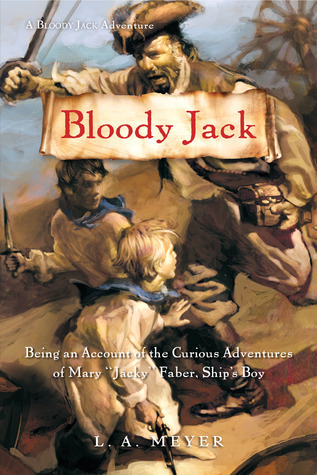
Being an Account of the Curious Adventures of Mary “Jacky” Faber, Ship’s Boy
Life as a ship’s boy aboard HMS Dolphin is a dream come true for Jacky Faber. Gone are the days of scavenging for food and fighting for survival on the streets of eighteenth-century London. Instead, Jacky is becoming a skilled and respected sailor as the crew pursues pirates on the high seas.
There’s only one problem: Jacky is a girl. And she will have to use every bit of her spirit, wit, and courage to keep the crew from discovering her secret. This could be the adventure of her life–if only she doesn’t get caught. . . .
Nancy Kington, daughter of a rich merchant, suddenly orphaned when her father dies, is sent to live on her family's plantation in Jamaica. Disgusted by the treatment of the slaves and her brother's willingness to marry her off, she and one of the slaves, Minerva, run away and join a band of pirates.
For both girls the pirate life is their only chance for freedom in a society where both are treated like property, rather than individuals. Together they go in search of adventure, love, and a new life that breaks all restrictions of gender, race, and position. Told through Nancy's writings, their adventures will appeal to readers across the spectrum and around the world.
At the edge of the Russian wilderness, winter lasts most of the year and the snowdrifts grow taller than houses. But Vasilisa doesn't mind—she spends the winter nights huddled around the embers of a fire with her beloved siblings, listening to her nurse's fairy tales. Above all, she loves the chilling story of Frost, the blue-eyed winter demon, who appears in the frigid night to claim unwary souls. Wise Russians fear him, her nurse says, and honor the spirits of house and yard and forest that protect their homes from evil.
After Vasilisa's mother dies, her father goes to Moscow and brings home a new wife. Fiercely devout, city-bred, Vasilisa's new stepmother forbids her family from honoring the household spirits. The family acquiesces, but Vasilisa is frightened, sensing that more hinges upon their rituals than anyone knows.
And indeed, crops begin to fail, evil creatures of the forest creep nearer, and misfortune stalks the village. All the while, Vasilisa's stepmother grows ever harsher in her determination to groom her rebellious stepdaughter for either marriage or confinement in a convent.
As danger circles, Vasilisa must defy even the people she loves and call on dangerous gifts she has long concealed—this, in order to protect her family from a threat that seems to have stepped from her nurse's most frightening tales.
The Bear and the Nightingale is a magical debut novel from a gifted and gorgeous voice. It spins an irresistible spell as it announces the arrival of a singular talent.
This is the story of the making of England in the 9th and 10th centuries, the years in which King Alfred the Great, his son and grandson defeated the Danish Vikings who had invaded and occupied three of England’s four kingdoms.
The story is seen through the eyes of Uhtred, a dispossessed nobleman, who is captured as a child by the Danes and then raised by them so that, by the time the Northmen begin their assault on Wessex (Alfred’s kingdom and the last territory in English hands) Uhtred almost thinks of himself as a Dane. He certainly has no love for Alfred, whom he considers a pious weakling and no match for Viking savagery, yet when Alfred unexpectedly defeats the Danes and the Danes themselves turn on Uhtred, he is finally forced to choose sides. By now he is a young man, in love, trained to fight and ready to take his place in the dreaded shield wall. Above all, though, he wishes to recover his father’s land, the enchanting fort of Bebbanburg by the wild northern sea.
This thrilling adventure—based on existing records of Bernard Cornwell’s ancestors—depicts a time when law and order were ripped violently apart by a pagan assault on Christian England, an assault that came very close to destroying England.
While the Titanic and Lusitania are both well-documented disasters, the single greatest tragedy in maritime history is the little-known January 30, 1945 sinking in the Baltic Sea by a Soviet submarine of the Wilhelm Gustloff, a German cruise liner that was supposed to ferry wartime personnel and refugees to safety from the advancing Red Army. The ship was overcrowded with more than 10,500 passengers — the intended capacity was approximately 1,800 — and more than 9,000 people, including 5,000 children, lost their lives.
Sepetys (writer of 'Between Shades of Gray') crafts four fictionalized but historically accurate voices to convey the real-life tragedy. Joana, a Lithuanian with nursing experience; Florian, a Prussian soldier fleeing the Nazis with stolen treasure; and Emilia, a Polish girl close to the end of her pregnancy, converge on their escape journeys as Russian troops advance; each will eventually meet Albert, a Nazi peon with delusions of grandeur, assigned to the Gustloff decks.
After Englishman John Blackthorne is lost at sea, he awakens in a place few Europeans know of and even fewer have seen--Nippon. Thrust into the closed society that is seventeenth-century Japan, a land where the line between life and death is razor-thin, Blackthorne must negotiate not only a foreign people, with unknown customs and language, but also his own definitions of morality, truth, and freedom. As internal political strife and a clash of cultures lead to seemingly inevitable conflict, Blackthorne's loyalty and strength of character are tested by both passion and loss, and he is torn between two worlds that will each be forever changed.
Powerful and engrossing, capturing both the rich pageantry and stark realities of life in feudal Japan, Shōgun is a critically acclaimed powerhouse of a book. Heart-stopping, edge-of-your-seat action melds seamlessly with intricate historical detail and raw human emotion. Endlessly compelling, this sweeping saga captivated the world to become not only one of the best-selling novels of all time but also one of the highest-rated television miniseries, as well as inspiring a nationwide surge of interest in the culture of Japan. Shakespearean in both scope and depth, Shōgun is, as the New York Times put it, "...not only something you read--you live it." Provocative, absorbing, and endlessly fascinating, there is only Shōgun.
Ada and her younger brother, Jamie, now have a permanent home with their loving legal guardian, Susan Smith. Although Jamie adapts more easily, Ada still struggles with the aftermath of her old life, and how to fit into her new life.
World War II continues, and forces the small community to come together and rely on one another. Ada has never been interested in getting to know her friend’s family—especially Maggie’s mother, the formidable Lady Thorton. However, circumstances bring them in close proximity along with other unexpected characters.
Ada comes face to face with another German! This time she isn’t sure what she should do. How can she help the ones she loves and keep them safe?
Ada’s first story, The War that Saved My Life, won a Newbery Honor, the Schneider Family Book Award, and the Josette Frank Award, in addition to appearing on multiple best-of-the-year lists. This second, marvelous volume continues Ada’s powerful, uplifting story.
After inheriting her uncle's homesteading claim in Montana, 16-year-old orphan Hattie Brooks travels from Iowa in 1917 to make a home for herself and encounters some unexpected problems related to the war being fought in Europe.
The summer of 1963 begins like any other for nine-year-old Starla Claudelle. Born to teenage parents in Mississippi, Starla is being raised by a strict paternal grandmother, Mamie, whose worst fear is that Starla will turn out like her mother. Starla hasn’t seen her momma since she was three, but is convinced that her mother will keep her promise to take Starla and her daddy to Nashville, where her mother hopes to become a famous singer—and that one day her family will be whole and perfect.
When Starla is grounded on the Fourth of July, she sneaks out to see the parade. After getting caught, Starla’s fear that Mamie will make good on her threats and send her to reform school cause her to panic and run away from home. Once out in the country, Starla is offered a ride by a black woman, Eula, who is traveling with a white baby. She happily accepts a ride, with the ultimate goal of reaching her mother in Nashville.
As the two unlikely companions make their long and sometimes dangerous journey, Starla’s eyes are opened to the harsh realities of 1963 southern segregation. Through talks with Eula, reconnecting with her parents, and encountering a series of surprising misadventures, Starla learns to let go of long-held dreams and realizes family is forged from those who will sacrifice all for you, no matter if bound by blood or by the heart.
Welcome Back!
Track your reading progress and sync your library.