At the onset of the tenth century, England is in turmoil. Alfred the Great is dead and Edward his son reigns as king. Wessex survives but peace cannot hold: the Danes in the north, led by Viking Cnut Longsword, stand ready to invade and will never rest until the emerald crown is theirs.
Uhtred, once Alfred’s great warrior but now out of favor with the new king, must lead a band of outcasts north to recapture his old family home, that great Northumbrian fortress, Bebbanburg.
Loyalties will be divided and men will fall, as every Saxon kingdom is drawn into the bloodiest battle yet with the Danes; a war which will decide the fate of every king, and the entire English nation.
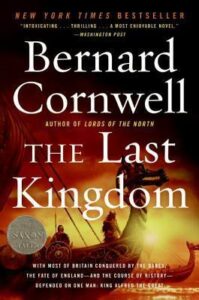
This is the story of the making of England in the 9th and 10th centuries, the years in which King Alfred the Great, his son and grandson defeated the Danish Vikings who had invaded and occupied three of England’s four kingdoms.
The story is seen through the eyes of Uhtred, a dispossessed nobleman, who is captured as a child by the Danes and then raised by them so that, by the time the Northmen begin their assault on Wessex (Alfred’s kingdom and the last territory in English hands) Uhtred almost thinks of himself as a Dane. He certainly has no love for Alfred, whom he considers a pious weakling and no match for Viking savagery, yet when Alfred unexpectedly defeats the Danes and the Danes themselves turn on Uhtred, he is finally forced to choose sides. By now he is a young man, in love, trained to fight and ready to take his place in the dreaded shield wall. Above all, though, he wishes to recover his father’s land, the enchanting fort of Bebbanburg by the wild northern sea.
This thrilling adventure—based on existing records of Bernard Cornwell’s ancestors—depicts a time when law and order were ripped violently apart by a pagan assault on Christian England, an assault that came very close to destroying England.
Librarian's note: An alternate cover edition can be found here
World Without End takes place in the same town of Kingsbridge, two centuries after the townspeople finished building the exquisite Gothic cathedral that was at the heart of The Pillars of the Earth. The cathedral and the priory are again at the center of a web of love and hate, greed and pride, ambition and revenge, but this sequel stands on its own. This time the men and women of an extraordinary cast of characters find themselves at a crossroads of new ideas—about medicine, commerce, architecture, and justice. In a world where proponents of the old ways fiercely battle those with progressive minds, the intrigue and tension quickly reach a boiling point against the devastating backdrop of the greatest natural disaster ever to strike the human race—the Black Death.
Agincourt is one of the epic battles of history. It was fought by two badly matched armies that met in atrocious conditions on St Crispin's Day 1415, and resulted in an extraordinary victory that was celebrated in England long before Shakespeare immortalised it in Henry V. It has always been held to be the triumph of the longbow against the armoured knight, and of the common man against the feudal aristocrat, but those are history's myths. Bernard Cornwell, who has long wanted to write this story, depicts the reality behind the myths.
Nicholas Hook is an English archer. He seems born to trouble and, when his lord orders him to London as part of a force sent to quell an expected Lollard uprising, Nick's headstrong behaviour leads to him being proscribed an outlaw. He finds refuge across the Channel, part of an English mercenary force protecting the town of Soissons against the French. What happened at the Siege of Soissons shocked all Europe, and propels Nick back to England where he is enrolled in the archer companyof the doughty Sir John Cornwaille, a leader of Henry V's army. The army was superb, but sickness and the unexpected French defiance at Harfleur, reduce it to near-shambolic condition. Henry stubbornly refuses to accept defeat and, in appalling weather, leads his shrunken force to what appears to be inevitable disaster.
Azincourt culminates in the battle. Seen from several points of view on the English side, but also from the French ranks, the scene is vivid, convincing and compelling. Bernard Cornwell has a great understanding of men at war and battlefields and this is his masterpiece. This is what it must have been like to fight at Agincourt.
The thrilling and addictive prequel to The Pillars of the Earth--set in England at the dawn of a new era: the Middle Ages
It is 997 CE, the end of the Dark Ages. England is facing attacks from the Welsh in the west and the Vikings in the east. Those in power bend justice according to their will, regardless of ordinary people and often in conflict with the king. Without a clear rule of law, chaos reigns.
In these turbulent times, three characters find their lives intertwined. A young boatbuilder's life is turned upside down when his home is raided by Vikings, forcing him and his family to move and start their lives anew in a small hamlet where he does not fit in. . . . A Norman noblewoman marries for love, following her husband across the sea to a new land, but the customs of her husband's homeland are shockingly different, and it soon becomes clear to her that a single misstep could be catastrophic. . . . A monk dreams of transforming his humble abbey into a center of learning that will be admired throughout Europe. And each in turn comes into dangerous conflict with a clever and ruthless bishop who will do anything to increase his wealth and power.
Thirty years ago, Ken Follett published his most popular novel, The Pillars of the Earth. Now, Follett's masterful new prequel The Evening and the Morning takes us on an epic journey into a historical past rich with ambition and rivalry, death and birth, love and hate, that will end where The Pillars of the Earth begins.
879 AD, Norway. Halvdan , son of Ragnar Lothbrok and King of Dublin, is locked in a savage war with Irish Dubgaill warriors in a battle for supremacy of Ireland’s coastal strongholds.
Hundr , a Northman with a dog's name… Viking warships flying the raven banner… and the echo of Ivar the Boneless .
Hundr and Einar the Brawler are drawn into a search for the son of Bjorn Ironside , lost during the war for Ireland’s future. Old enemies seething with vengeful fury emerge to throw Hundr and Einar into the most dangerous fight of their lives.
Hundr must join the war between the Finngaill and the Dubgaill and decide the fate of Dublin. Can he survive brutal betrayal and vicious shield wall battles in this fast paced Viking adventure with striking characters and bloodthirsty action?
The Raven and the Nine continues the unmissable Viking historical fiction saga series which began with Award Winning Author Peter Gibbons' debut novel Viking Blood and Blade.
Cristabel Seagrave has always wanted her life to be a story, but there are no girls in the books in her dusty family library. For an unwanted orphan who grows into an unmarriageable young woman, there is no place at all for her in a traditional English manor. But from the day that a whale washes up on the beach at the Chilcombe estate in Dorset, and twelve-year-old Cristabel plants her flag and claims it as her own, she is determined to do things differently.
With her step-parents blithely distracted by their endless party guests, Cristabel and her siblings, Flossie and Digby, scratch together an education from the plays they read in their freezing attic, drunken conversations eavesdropped through oak-panelled doors, and the esoteric lessons of Maudie their maid.
But as the children grow to adulthood and war approaches, jolting their lives on to very different tracks, it becomes clear that the roles they are expected to play are no longer those they want. As they find themselves drawn into the conflict, they must each find a way to write their own story...
This is the story of an old English manor house by the sea, with crumbling chimneys, draping ivy and a library full of dusty hardbacks. It's the story of the three children who grow up there, and the adventures they create for themselves while the grown-ups entertain endless party guests: the worlds they imagine from books they aren't supposed to read, and the lessons they learn from eavesdropping through oak-panelled doors.
This is the story of a whale that washes up on a beach, whose bones are claimed by a twelve-year-old girl with big ambitions and an even bigger imagination. An unwanted orphan who grows into an unmarriageable young woman, chafing under the confines of her traditional upbringing and fiercely determined to do things differently.
Chava is a golem, a creature made of clay, brought to life by a disgraced rabbi who dabbles in dark Kabbalistic magic, created to be the wife of a man who dies at sea on the voyage from Poland. Chava is unmoored and adrift as the ship arrives in New York harbor in 1899.
Ahmad is a jinni, a being of fire born in the ancient Syrian desert, trapped in an old copper flask, and released in New York City, though still not entirely free.
Ahmad and Chava become unlikely friends and soul mates with a mystical connection. Marvelous and compulsively readable, Helene Wecker's debut novel The Golem and the Jinni weaves strands of Yiddish and Middle Eastern literature, historical fiction and magical fable, into a wondrously inventive and unforgettable tale.
A big, powerful saga of men in combat, written over the course of thirty-five years by a highly decorated Vietnam veteran.
Intense, powerful, and compelling, Matterhorn is an epic war novel in the tradition of Norman Mailer's The Naked and the Dead and James Jones's The Thin Red Line. It is the timeless story of a young Marine lieutenant, Waino Mellas, and his comrades in Bravo Company, who are dropped into the mountain jungle of Vietnam as boys and forced to fight their way into manhood. Standing in their way are not merely the North Vietnamese but also monsoon rain and mud, leeches and tigers, disease and malnutrition. Almost as daunting, it turns out, are the obstacles they discover between each other: racial tension, competing ambitions, and duplicitous superior officers. But when the company finds itself surrounded and outnumbered by a massive enemy regiment, the Marines are thrust into the raw and all-consuming terror of combat. The experience will change them forever.
Written over the course of thirty years by a highly decorated Vietnam veteran, Matterhorn is a visceral and spellbinding novel about what it is like to be a young man at war. It is an unforgettable novel that transforms the tragedy of Vietnam into a powerful and universal story of courage, camaraderie, and sacrifice: a parable not only of the war in Vietnam but of all war, and a testament to the redemptive power of literature.
A graduate of Yale University and a Rhodes Scholar at Oxford University, Karl Marlantes served as a Marine in Vietnam, where he was awarded the Navy Cross, the Bronze Star, two Navy Commendation Medals for valor, two Purple Hearts, and ten air medals. This is his first novel. He lives in rural Washington State.
Welcome Back!
Track your reading progress and sync your library.