The Call of Cthulhu
One of the feature stories of the Cthulhu Mythos, H.P. Lovecraft’s The Call of Cthulhu is a harrowing tale of the weakness of the human mind when confronted by powers and intelligences from beyond our world.
'It was a monstrous constellation of unnatural light, like a glutted swarm of corpse-fed fireflies dancing hellish sarabands over an accursed marsh...'
H.P. Lovecraft was perhaps the greatest twentieth century practitioner of the horror story, introducing to the genre a new evil, monstrous, pervasive and unconquerable. At the heart of these three stories are terrors unthinkable and strange: a crash-landing meteorite, the wretched inhabitant of an ancient castle and a grave-robber's curse. This book includes "The Colour Out Of Space", "The Outsider" and "The Hound".
A complete short novel, AT THE MOUNTAINS OF MADNESS is a tale of terror unilke any other. The Barren, windswept interior of the Antarctic plateau was lifeless--or so the expedition from Miskatonic University thought. Then they found the strange fossils of unheard-of creatures...and the carved stones tens of millions of years old...and, finally, the mind-blasting terror of the City of the Old Ones. Three additional strange tales, written as only H.P. Lovecraft can write, are also included in this macabre collection of the strange and the weird.
Table of Contents:
At the Mountains of Madness • [Cthulhu Mythos] • (1936) • novel by H. P. Lovecraft
The Dreams in the Witch-House • [Cthulhu Mythos] • (1933) • novelette by H. P. Lovecraft
The Shunned House • (1928) • novelette by H. P. Lovecraft
The Statement of Randolph Carter • [Randolph Carter] • (1920) • shortstory by H. P. Lovecraft
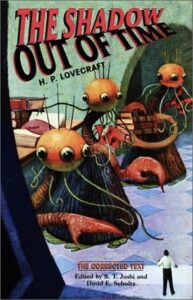
Voted one of the top ten Science Fiction and Fantasy Books of 2001 by Cinescape Magazine. " The Shadow out of Time " is H. P. Lovecraft's last major story. It was first published in Astounding Stories for June 1936. And yet, this text has never been published as Lovecraft wrote it—until now. The recent discovery of Lovecraft's handwritten manuscript allows readers to appreciate this magnificently cosmic story exactly as originally written. All previous editions of the story contain hundreds of serious errors, including errors in paragraphing, omissions and mistranscriptions of many words and passages, and erroneous punctuation. Leading Lovecraft scholars S. T. Joshi and David E. Schultz have provided an exhaustive introduction and commentary on the story, elucidating names, places and other elements in this richly evocative story. A must for all devotees of Lovecraft and weird fiction!
In a thirtieth anniversary edition of the classic, the Harlequin, a rebel, inhabits a world where conformity and punctuality are top priorities, and the Ticktockman cannot accept the Harlequin's presence in his perfectly ordered world. 25,000 first printing. IP.
A man, newly arrived in New York, learns that a reclusive doctor lives in the apartment above his own. While suffering a heart attack, he is taken to the doctor’s door, and soon becomes friends with the bizarre and isolated man who claims he must live in a refrigerated environment for his health. But as the man spends more time with the doctor, he begins to understand the horrifying truth about his friend’s strange medical condition.
The story is told by Albert N. Wilmarth, an instructor of literature at Miskatonic University in Arkham. When local newspapers report strange things seen floating in rivers during a historic Vermont flood, Wilmarth becomes embroiled in a controversy about the reality and significance of the sightings, though he sides with the skeptics. Wilmarth uncovers old legends about monsters living in the uninhabited hills who abduct people who venture or settle too close to their territory.
Beyond the Wall of Sleep" is a short story by American writer H. P. Lovecraft written in 1919 and first published in the amateur publication Pine Cones in October 1919. Inspiration Lovecraft said the story was inspired by an April 27, 1919 article in the New York Tribune. Reporting on the New York state police, the article cited a family named Slater or Slahter as representative of the backwards Catskills population. The nova mentioned at the end of Lovecraft's story is a real star, known as GK Persei; the quotation is from Garrett P. Serviss' Astronomy with the Naked Eye (1908). The title of the story may have been influenced by Ambrose Bierce's "Beyond the Wall"; Lovecraft was known to be reading Bierce in 1919. Jack London's 1906 novel Before Adam, which concerns the concept of hereditary memory, contains the passage, "Nor...did any of my human kind ever break through the wall of my sleep.
a selection from the beginning of the story:
The horrible conclusion which had been gradually intruding itself upon my confused and reluctant mind was now an awful certainty. I was lost, completely, hopelessly lost in the vast and labyrinthine recess of the Mammoth Cave. Turn as I might, in no direction could my straining vision seize on any object capable of serving as a guidepost to set me on the outward path. That nevermore should I behold the blessed light of day, or scan the pleasant hills and dales of the beautiful world outside, my reason could no longer entertain the slightest unbelief. Hope had departed. Yet, indoctrinated as I was by a life of philosophical study, I derived no small measure of satisfaction from my unimpassioned demeanour; for although I had frequently read of the wild frenzies into which were thrown the victims of similar situations, I experienced none of these, but stood quiet as soon as I clearly realised the loss of my bearings.
Nor did the thought that I had probably wandered beyond the utmost limits of an ordinary search cause me to abandon my composure even for a moment. If I must die, I reflected, then was this terrible yet majestic cavern as welcome a sepulchre as that which any churchyard might afford, a conception which carried with it more of tranquillity than of despair.
Starving would prove my ultimate fate; of this I was certain. Some, I knew, had gone mad under circumstances such as these, but I felt that this end would not be mine. My disaster was the result of no fault save my own, since unknown to the guide I had separated myself from the regular party of sightseers; and, wandering for over an hour in forbidden avenues of the cave, had found myself unable to retrace the devious windings which I had pursued since forsaking my companions.
Already my torch had begun to expire; soon I would be enveloped by the total and almost palpable blackness of the bowels of the earth. As I stood in the waning, unsteady light, I idly wondered over the exact circumstances of my coming end. I remembered the accounts which I had heard of the colony of consumptives, who, taking their residence in this gigantic grotto to find health from the apparently salubrious air of the underground world, with its steady, uniform temperature, pure air, and peaceful quiet, had found, instead, death in strange and ghastly form. I had seen the sad remains of their ill-made cottages as I passed them by with the party, and had wondered what unnatural influence a long sojourn in this immense and silent cavern would exert upon one as healthy and vigorous as I. Now, I grimly told myself, my opportunity for settling this point had arrived, provided that want of food should not bring me too speedy a departure from this life.