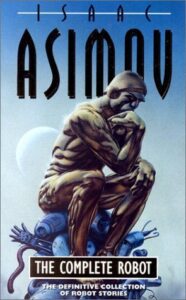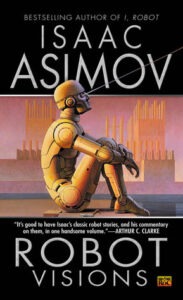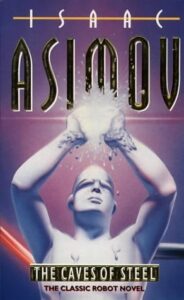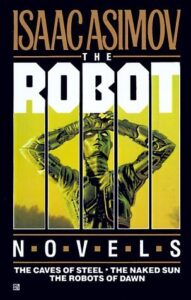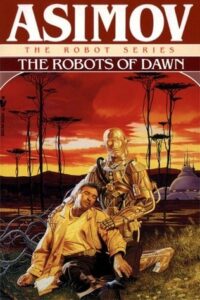
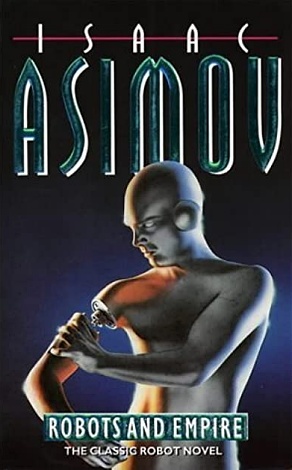
Long after his humiliating defeat at the hands of Earthman Elijah Baley, Keldon Amadiro embarked on a plan to destroy planet Earth. But even after his death, Baley’s vision continued to guide his robot partner, R. Daneel Olivaw, who had the wisdom of a great man behind him and an indestructable will to win….
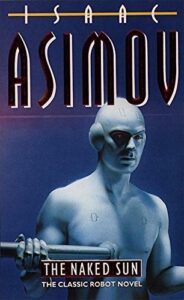
A millennium into the future two advancements have altered the course of human history: the colonization of the galaxy and the creation of the positronic brain. Isaac Asimov's Robot novels chronicle the unlikely partnership between a New York City detective and a humanoid robot who must learn to work together. Like most people left behind on an over-populated Earth, New York City police detective Elijah Baley had little love for either the arrogant Spacers or their robotic companions. But when a prominent Spacer is murdered under mysterious circumstances, Baley is ordered to the Outer Worlds to help track down the killer. The relationship between Life and his Spacer superiors, who distrusted all Earthmen, was strained from the start. Then he learned that they had assigned him a partner: R. Daneel Olivaw. Worst of all was that the "R" stood for robot--and his positronic partner was made in the image and likeness of the murder victim!
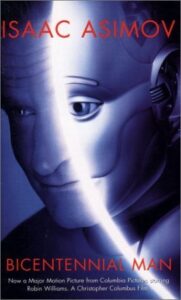
Andrew was one of Earth's first house robot domestic servants—smoothly designed and functional. But when Andrew started to develop special talents which exceeded the confines of his allotted positronic pathways, he abandoned his domestic duties in favour of more intellectual pursuits. As time passed, Andrew acquired knowledge, feelings and ambitions way beyond anything ever experienced by any other mechanical men. And he found himself launched on to a career which would bring him fame fortune — and danger. For a robot who wants to be human must also be prepared to die...
In the Bicentennial Man, Isaac Asimov returns to his first and most enduring love — robotics. The result is a brilliant book of first-class entertainment and mind-spinning ideas which confirm Asimov's supreme status as Grand Master of science fiction.
Content
"Feminine Intuition" (1969) "Waterclap" (1970) "That Thou Art Mindful of Him" (1974) "Stranger in Paradise" (1974) "The Life and Times of Multivac" (1975) "The Winnowing" (1976) "The Bicentennial Man" (1976) "Marching In" (1976) "Old-Fashioned" (1976) "The Tercentenary Incident" (1976) "Birth of a Notion" (1976)
After a twenty-first-century colony ship is mysteriously rerouted from its original destination, its crew becomes increasingly alarmed when their leaders, who know the truth, are unwilling to discuss the matter. Reissue.
Glen Runciter está muerto. ¿O lo están todos los demás? Lo que es seguro es que alguien ha muerto en una explosión organizada por los competidores de Runciter. De hecho, sus empleados asisten a un funeral. Pero durante el duelo comienzan a recibir mensajes descorcentantes, e incluso morbosos, de su jefe. Y el mundo a su alrededor comienza a desmoronarse de un modo que sugiere que a ellos tampoco les queda mucho tiempo.
Esta mordaz comedia metafísica de muerte y salvación (que podrá llevar un cómodo envase) es un tour de force de amenaza paranoica y comedia absurda, en la cual los muertos ofrecen consejos comerciales, compran su siguiente reencarnación y corren el riesgo continuo de volver a morir.
Substance D is not known as Death for nothing. It is the most toxic drug ever to find its way on to the streets of LA. It destroys the links between the brain's two hemispheres, causing, first, disorientation and then complete and irreversible brain damage.
The undercover narcotics agent who calls himself Bob Arctor is desperate to discover the ultimate source of supply. But to find any kind of lead he has to pose as a user and, inevitably, without realising what is happening, Arctor is soon as addicted as the junkies he works among...
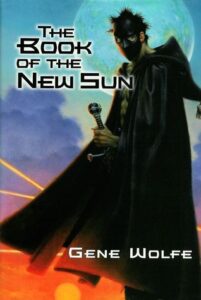
Recently voted the greatest fantasy of all time, after The Lord of the Rings and The Hobbit, Gene Wolfe's The Book of the New Sun is an extraordinary epic, set a million years in the future, on an Earth transformed in mysterious and wondrous ways, in a time when our present culture is no longer even a memory. Severian, the central character, is a torturer, exiled from his guild after falling in love with one of his victims, and journeying to the distant city of Thrax, armed with his ancient executioner's sword, Terminus Est. This edition contains the first four volumes of the series.
At first, only a few things are known about the celestial object that astronomers dub Rama. It is huge, weighing more than ten trillion tons. And it is hurtling through the solar system at an inconceivable speed. Then a space probe confirms the unthinkable: Rama is no natural object. It is, incredibly, an interstellar spacecraft. Space explorers and planet-bound scientists alike prepare for mankind's first encounter with alien intelligence. It will kindle their wildest dreams... and fan their darkest fears. For no one knows who the Ramans are or why they have come. And now the moment of rendezvous awaits — just behind a Raman airlock door.
When the Time Traveller courageously stepped out of his machine for the first time, he found himself in the year 802,700--and everything had changed. In this unfamiliar, utopian age creatures seemed to dwell together in perfect harmony. The Time Traveller thought he could study these marvelous beings--unearth their secret and then return to his own time--until he discovered that his invention, his only avenue of escape, had been stolen.
H. G. Wells's famous novel of one man's astonishing journey beyond the conventional limits of the imagination first appeared in 1895. It won him immediate recognition and has been regarded ever since as one of the great masterpieces in the literature of science fiction.
The War of the Worlds
H. G. Wells's science fiction classic, the first novel to explore the possibilities of intelligent life from other planets, is still startling and vivid nearly a century after its appearance, and a half century after Orson Welles's infamous 1938 radio adaptation.
This daring portrayal of aliens landing on English soil, with its themes of interplanetary imperialism, technological holocaust, and chaos, is central to the career of H. G. Wells, who died at the dawn of the atomic age. The survival of mankind in the face of "vast and cool and unsympathetic" scientific powers spinning out of control was a crucial theme throughout his work. Visionary, shocking, and chilling, The War of the Worlds has lost none of its impact since its first publication in 1898.
Welcome Back!
Track your reading progress and sync your library.