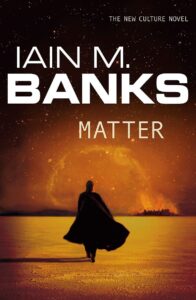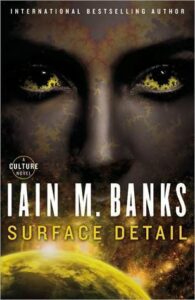
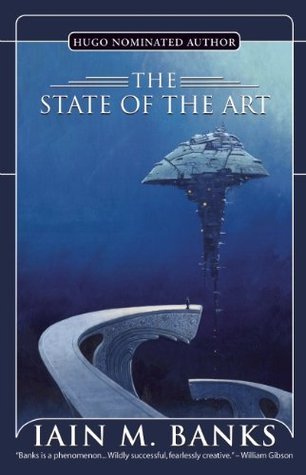
The first ever collection of Iain Banks’ short fiction, this volume includes the acclaimed novella, The State of the Art. This is a striking addition to the growing body of Culture lore, and adds definition and scale to the previous works by using the Earth of 1977 as contrast. The other stories in the collection range from science fiction to horror, dark-coated fantasy to morality tale. All bear the indefinable stamp of Iain Banks’ staggering talent.
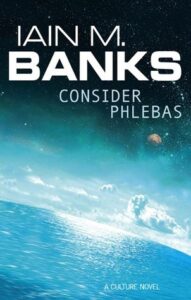
Special Circumstances had always been the Contact section's moral espionage weapon, the very cutting edge of the Culture's interfering diplomatic policy, the élite of the élite in a society which abhorred élitism. The man known as Cheradenine Zakalwe was one of SC's foremost agents, changing the destiny of planets to suit the Culture through intrigue, dirty tricks or military action.
The woman known as Diziet Sma had plucked him from obscurity and pushed him towards his present eminence, but despite all their dealings she did not know him as well as she thought.
The drone known as Skaffen-Amtiskaw knew both of these people. It had once saved the woman's life by massacring her attackers in a particularly bloody manner. It believed the man to be a burnt-out case. But not even its machine intelligence could see the horrors in his past.
In this brilliant, multilayered book, Iain Banks explores once again the universe of the Culture, which he has previously visited in Consider Phlebas and The Player of Games. Ferociously intelligent, both witty and horrific, Use of Weapons leaves no doubt that Banks is now the outstanding writer of science fiction in Britain.
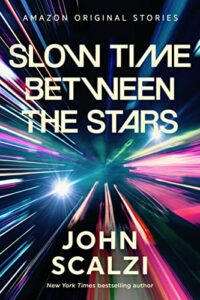
An artificial intelligence on a star-spanning mission explores the farthest horizons of human potential—and its own purpose—in a mind-bending short story by New York Times bestselling author John Scalzi.
Equipped with the entirety of human knowledge, a sentient ship is launched on a last-ditch journey to find a new home for civilization. Trillions of miles. Tens of thousands of years. In the space between, the AI has plenty of time to think about life, the vastness of the universe, everything it was meant to do, and—with a perspective created but not limited by humans—what it should do.
John Scalzi’s Slow Time Between the Stars is part of The Far Reaches, a collection of science-fiction stories that stretch the imagination and open the heart. They can be read or listened to in one sitting.
Following the events of The Last Colony, John Scalzi tells the story of the fight to maintain the unity of the human race.
The people of Earth now know that the human Colonial Union has kept them ignorant of the dangerous universe around them. For generations the CU had defended humanity against hostile aliens, deliberately keeping Earth an ignorant backwater and a source of military recruits. Now the CU's secrets are known to all. Other alien races have come on the scene and formed a new alliance—an alliance against the Colonial Union. And they've invited the people of Earth to join them. For a shaken and betrayed Earth, the choice isn't obvious or easy.
Against such possibilities, managing the survival of the Colonial Union won't be easy, either. It will take diplomatic finesse, political cunning…and a brilliant "B Team," centered on the resourceful Lieutenant Harry Wilson, that can be deployed to deal with the unpredictable and unexpected things the universe throws at you when you're struggling to preserve the unity of the human race.
Being published online from January to April 2013 as a three-month digital serial, The Human Division will appear as a full-length novel of the Old Man's War universe, plus—for the first time in print—the first tale of Lieutenant Harry Wilson, and a coda that wasn't part of the digital serialization.
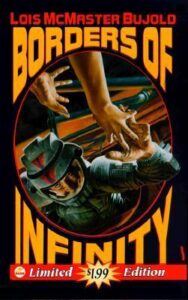
The popular adventures of Miles Vorkosigan, a clever and outlandish science fiction hero for the modern era, continue in these three tales. In The Mountains of Mourning, Miles is dispatched to a back-country region of Barrayar, where he must act as detective, judge, and executioner in a controversial murder case.
In Labyrinth, Miles adopts his alternate persona as Dendarii Mercenary Admiral Naismith for an undercover mission to rescue an important research geneticist from Jackson’s Whole. And in the title story, Miles infiltrates an escape-proof Cetagandan POW camp and plays hero to the most deeply distressed damsel of his colorful career.
Contents: Frame story that follows Miles' time on Earth in Brothers in Arms The Mountains of Mourning (1989) Labyrinth (1989) The Borders of Infinity (1987)
Isaac Asimov's I, Robot launches readers on an adventure into a not-so-distant future where man and machine , struggle to redefinelife, love, and consciousness—and where the stakes are nothing less than survival. Filled with unforgettable characters, mind-bending speculation, and nonstop action, I, Robot is a powerful reading experience from one of the master storytellers of our time.
I, ROBOT
They mustn't harm a human being, they must obey human orders, and they must protect their own existence...but only so long as that doesn't violate rules one and two. With these Three Laws of Robotics, humanity embarked on perhaps its greatest adventure: the invention of the first positronic man. It was a bold new era of evolution that would open up enormous possibilities—and unforeseen risks. For the scientists who invented the earliest robots weren't content that their creations should ' remain programmed helpers, companions, and semisentient worker-machines. And soon the robots themselves; aware of their own intelligence, power, and humanity, aren't either.
As humans and robots struggle to survive together—and sometimes against each other—on earth and in space, the future of both hangs in the balance. Human men and women confront robots gone mad, telepathic robots, robot politicians, and vast robotic intelligences that may already secretly control the world. And both are asking the same questions: What is human? And is humanity obsolete?
In l, Robot Isaac Asimov changes forever our perception of robots, and human beings and updates the timeless myth of man's dream to play god. with all its rewards—and terrors. --front flap
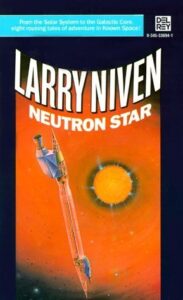
Come to Larry Niven's Universe and meet all the Thrints, Bandersnatchi, Puppeteers -- and a host of other wonderfully created characters. Visit Lookitthat, Down, and Jinx -- indeed, an entire galaxy of planets found only in these stories that trace man's expansion and colonization throughout Known Space. A spectacular cycle of the future . . . a 10,000-year history of man on Earth and in space!
Many thousands of readers consider Philip K. Dick the greatest science fiction mind on any planet. Since his untimely death in 1982, interest in Dick's works has continued to mount and his reputation has been further enhanced by a growing body of critical attention. The Philip K. Dick Award is now given annually to a distinguished work of science fiction, and the Philip K. Dick Society is devoted to the study and promulgation of his works.
This collection includes all of the writer's earliest short and medium-length fiction (including some previously unpublished stories) covering the years 1954-1964.
"A useful acquisition for any serious SF library or collection" -- Kirkus
"The collected stories of Philip K. Dick is awe inspiring". -- The Washington Post
"More than anyone else in the field, Mr. Dick really puts you inside people's minds". -- Wall Street Journal
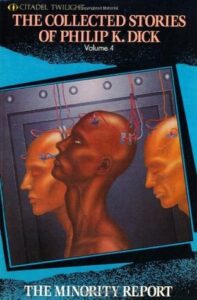
Volume 4/5. Includes stories from 1954-1964: - Autofac (1955) - Service Call (1955) - Captive Market (1955) - The Mold of Yancy (1955) - The Minority Report (1956) - Recall Mechanism (1959) - The Unreconstructed M (1957) - Explorers We (1959) - War Game (1959) - If There Were No Benny Cemoli (1963) - Novelty Act (1964) - Waterspider (1964) - What the Dead Men Say (1964) - Orpheus with Clay Feet (1987) - The Days of Perky Pat (1963) - Stand-By (1963) - What'll We Do with Ragland Park? (1963) - Oh, to Be a Blobel! (1964)
Other editions of this volume have the same stories, and were published under these titles: - The Days of Perky Pat, - The Minority Report, - The Minority Report and Other Classic Stories.
"By His Bootstraps" is a science fiction novella by American writer Robert A. Heinlein. It plays with some of the inherent paradoxes that would be caused by time travel.
The story was published in the October 1941 issue of Astounding Science Fiction under the pen name Anson MacDonald; the same issue has "Common Sense" under Heinlein's name. "By His Bootstraps" was reprinted in Heinlein's 1959 collection The Menace From Earth, and in several subsequent anthologies.
Welcome Back!
Track your reading progress and sync your library.