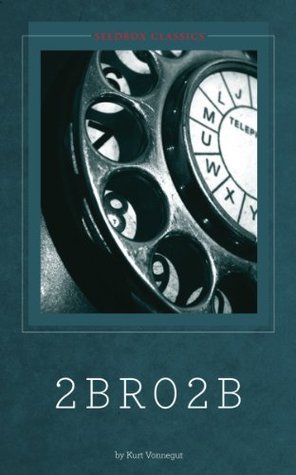
This Seedbox Classics edition of 2 B R 0 2 B or 2BR02B includes illustrations.
2 B R 0 2 B by Kurt Vonnegut is a science fiction story that focuses on a society where individuals have an indefinite lifespan and the population of the United States is limited to forty million.
In order for a new birth to take place, someone else must die. The suspense builds as two parents wait for someone to dial 2 B R 0 2 B, which is the telephone number to dial for an assisted suicide with the Federal Bureau of Termination.
The Machine Stops is a science fiction short story (12,300 words) by E. M. Forster. After initial publication in The Oxford and Cambridge Review (November 1909), the story was republished in Forster's The Eternal Moment and Other Stories in 1928.
After being voted one of the best novellas up to 1965, it was included that same year in the populist anthology Modern Short Stories. In 1973 it was also included in The Science Fiction Hall of Fame, Volume Two.
The book is particularly notable for predicting new technologies such as instant messaging and the internet.
¿Es posible revertir el inevitable final del Universo, o el mundo debe acabar de todas formas? es la pregunta que desde un día del siglo XXI, hasta generaciones y generaciones posteriores en el tiempo, hacen los humanos a los ordenadores.
En un relato aparentemente sencillo sobre un asunto sobrecogedor, el fin de los días, Asimov demuestra, una vez más, una mente preclara y una mano maestra para sobrecoger al lector y dejarlo en vilo, incluso después de la lectura.
Clarke's masterful evocation of the far future of humanity, considered his finest novel.
Men had built cities before, but never such a city as Diaspar. For millennia its protective dome shut out the creeping decay and danger of the world outside. Once, it held powers that rule the stars.
But then, as legend has it, the invaders came, driving humanity into this last refuge. It takes one man, a Unique, to break through Diaspar's stifling inertia, to smash the legend and discover the true nature of the Invaders.
Ijon Tichy travels undercover to a robot world, joining an organization to clean up world history thru time travel.
Things go crazy immediately. His spaceship runs into gravitational vortices at relativistic speeds, resulting in massive time anomalies. It may be a blessing in disguise. The reason he couldn’t get out of the way was that a meteor had shattered the drive regulator & rudder. He could no longer steer his ship. He had a spare rudder, but couldn’t install it. It was a two-man job & he was alone. So when other versions of him start appearing, all he should need do is team up with one of them, fix the rudder & leave the gravitational vortex field.
After that gets straightened out, he goes undercover. A ship’s computer has mutineed & started its own colony, reproducing itself on a previously uninhabited planet. The insurance company paid the shipowner’s claim, & now believes that the ship, it’s computer & all its progeny belong to them. Tichy disguises himself as a robot & goes to investigate.
On another voyage, he heads to a planet where the government irrigation agency has irrigated beyond all need & refused to give up power. People live in water & are jailed in dry cells if they violate the love of water.
After his modern voyages, he comes back from 2166 to recruit himself as a member of THEOHIPPIP, the Teleotelechronistic-Historical Engineering to Optimize the Hyperputerized Implementation of Paleological Programming & Interplanetary Planning. History is in a mess because of all the time travelers. THEOHIPPIP's mission is: “For World History to be regulated, cleaned up, straightened out, adjusted & perfected, all in accordance with the principles of humanitarianism, rationalism & general esthetics. You can understand, surely, that with such a shambles & slaughterhouse in one’s family tree it’s awkward to go calling on important cosmic civilizations!...If need be, alterations will be made even before the rise of man, so that he arises better.”
Andrew was one of Earth's first house robot domestic servants—smoothly designed and functional. But when Andrew started to develop special talents which exceeded the confines of his allotted positronic pathways, he abandoned his domestic duties in favour of more intellectual pursuits. As time passed, Andrew acquired knowledge, feelings and ambitions way beyond anything ever experienced by any other mechanical men. And he found himself launched on to a career which would bring him fame fortune — and danger. For a robot who wants to be human must also be prepared to die...
In the Bicentennial Man, Isaac Asimov returns to his first and most enduring love — robotics. The result is a brilliant book of first-class entertainment and mind-spinning ideas which confirm Asimov's supreme status as Grand Master of science fiction.
Content
"Feminine Intuition" (1969) "Waterclap" (1970) "That Thou Art Mindful of Him" (1974) "Stranger in Paradise" (1974) "The Life and Times of Multivac" (1975) "The Winnowing" (1976) "The Bicentennial Man" (1976) "Marching In" (1976) "Old-Fashioned" (1976) "The Tercentenary Incident" (1976) "Birth of a Notion" (1976)
“An extraordinary real picture of human beings numbed by catastrophe but still driven by the unconquerable determination of living creatures to keep on being alive.” — The New Yorker The classic apocalyptic novel by Pat Frank, first published in 1959 at the height of the Cold War, with an introduction by award-winning science fiction writer and scientist David Brin. “Alas, Babylon.” Those fateful words heralded the end. When the unthinkable nightmare of nuclear holocaust ravaged the United States, it was instant death for tens of millions of people; for survivors, it was a nightmare of hunger, sickness, and brutality. Overnight, a thousand years of civilization were stripped away. But for one small Florida town, miraculously spared against all the odds, the struggle was only just beginning, as the isolated survivors—men and women of all ages and races—found the courage to come together and confront the harrowing darkness.
In a thirtieth anniversary edition of the classic, the Harlequin, a rebel, inhabits a world where conformity and punctuality are top priorities, and the Ticktockman cannot accept the Harlequin's presence in his perfectly ordered world. 25,000 first printing. IP.
“An extraordinary real picture of human beings numbed by catastrophe but still driven by the unconquerable determination of living creatures to keep on being alive.” — The New Yorker The classic apocalyptic novel by Pat Frank, first published in 1959 at the height of the Cold War, with an introduction by award-winning science fiction writer and scientist David Brin. “Alas, Babylon.” Those fateful words heralded the end. When the unthinkable nightmare of nuclear holocaust ravaged the United States, it was instant death for tens of millions of people; for survivors, it was a nightmare of hunger, sickness, and brutality. Overnight, a thousand years of civilization were stripped away. But for one small Florida town, miraculously spared against all the odds, the struggle was only just beginning, as the isolated survivors—men and women of all ages and races—found the courage to come together and confront the harrowing darkness.
Welcome Back!
Track your reading progress and sync your library.