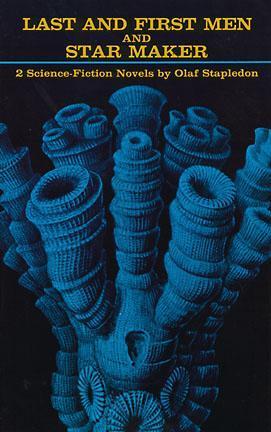
The greatest future histories in science fiction. In Last and First Men the protagonist is “mankind” in an ultimate definition — intelligence. Star Maker , in a sense its sequel, is concerned with the history of intelligence in the entire cosmos.
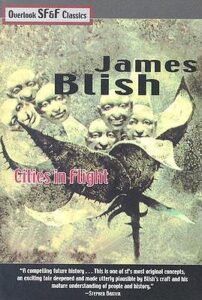
Originally published in four volumes nearly fifty years ago, Cities in Flight brings together the famed "Okie novels" of science fiction master James Blish. Named after the migrant workers of America's Dust Bowl, these novels convey Blish's "history of the future," a brilliant and bleak look at a world where cities roam the Galaxy looking for work and a sustainable way of life.
In the first novel, They Shall Have Stars, man has thoroughly explored the Solar System, yet the dream of going even further seems to have died in all but one man. His battle to realize his dream results in two momentous discoveries anti-gravity and the secret of immortality. In A Life for the Stars, it is centuries later and anti-gravity generations have enabled whole cities to lift off the surface of the earth to become galactic wanderers. In Earthman, Come Home, the nomadic cities revert to barbarism and marauding rogue cities begin to pose a threat to all civilized worlds. In the final novel, The Triumph of Time, history repeats itself as the cities once again journey back in to space making a terrifying discovery which could destroy the entire Universe. A serious and haunting vision of our world and its limits, Cities in Flight marks the return to print of one of science fiction's most inimitable writers.
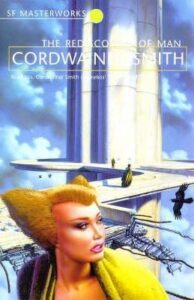
Cordwainer Smith was one of the original visionaries to think of humanity in terms of thousands of years in the future, spread out across the universe. This brilliant collection, often cited as the first of its kind, explores fundamental questions about ourselves and our treatment of the universe (and other beings) around us and ultimately what it means to be human. Contents: * Cordwainer Smith: The Shaper of Myths (1975) • essay by John J. Pierce [as by J. J. Pierce] * The Instrumentality of Mankind (timeline) (1975) • essay by John J. Pierce * Scanners Live in Vain [The Instrumentality of Mankind] (1950) / novelette by Cordwainer Smith: meet Martel, a human altered to be part machine-a scanner-to be able withstand the trauma space travel has on the body. Despite the stigma placed on him and his kind, he is able to regrasp his humanity to save another; Fantasy Book #6 ’50 * The Lady Who Sailed The Soul [The Instrumentality of Mankind] (1960) / novelette by Cordwainer Smith, Genevieve Linebarger; Galaxy Apr ’60 * The Game of Rat and Dragon [The Instrumentality of Mankind] (1955) / short story by Cordwainer Smith; Galaxy Oct ’55 * The Burning of the Brain [The Instrumentality of Mankind] (1958) / short story by Cordwainer Smith; If Oct ’58 * Golden the Ship Was - Oh! Oh! Oh! [The Instrumentality of Mankind] (1959) / short story by Cordwainer Smith, Genevieve Linebarger; Amazing Apr ’59 * The Crime and the Glory of Commander Suzdal [The Instrumentality of Mankind] (1964) / short story by Cordwainer Smith; Amazing May ’64 * The Dead Lady of Clown Town [The Instrumentality of Mankind] (1964) / novella by Cordwainer Smith: get to know the underpeople-animals genetically altered to exist in human form, to better serve their human owners-and meet D'Joan, a dog-woman who will make readers question who is more human: the animals who simply want to be recognized as having the same right to life, or the people who created them to be inferior; Galaxy Aug ’64 * Under Old Earth [The Instrumentality of Mankind] (1966) / novelette by Cordwainer Smith; Galaxy Feb ’66 * Mother Hitton's Littul Kittons [The Instrumentality of Mankind] (1961) / novelette by Cordwainer Smith; Galaxy Jun ’61 * Alpha Ralpha Boulevard [The Instrumentality of Mankind] (1961) / novelette by Cordwainer Smith; Galaxy Jun ’61 * The Ballad of Lost C'mell [The Instrumentality of Mankind] (1962) / novelette by Cordwainer Smith: the notion of love being the most important equalizer there is, is put into action when an underperson, C'mell, falls in love with Lord Jestocost. Who is to say her love for him is not as valid as any true-born human? She might be of cat descent, but she is all woman!; Galaxy Oct ’62 * A Planet Named Shayol [The Instrumentality of Mankind] (1961) / novelette by Cordwainer Smith: it is an underperson of bull descent, and beings so mutilated and deformed from their original human condition to be now considered demons of a hellish land, who retain and display the most humanity when Mankind commits the most inhumane action of all; Galaxy Oct ’61
aka: Paul M. A. Linebarger, Paul Myron Anthony Linebarger, Paul Linebarger, Felix C. Forrest, Carmichael Smith, Kordvejner Smit. .
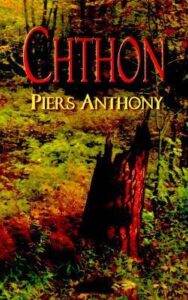
Chthon was Piers Anthony’s first published novel in 1967, written over the course of seven years. He started it when he was in the US Army, so it has a long prison sequence that is reminiscent of that experience, being dark and grim. It features Aton Five, a space man who commits the crime of falling in love with the dangerous alluring Minionette and is therefore condemned to death in the subterranean prison of Chthon. It uses flashbacks to show how he came to know the Minionette, and flashforwards to show how he dealt with her after his escape from prison. The author regards this as perhaps the most intricately structured novel the science fantasy genre has seen. It was a contender for awards, but not a winner.
AND I AWOKE AND FOUND ME HERE ON THE COLD HILL'S SIDE Man seeks to get into bed with anything new and different, or die trying. But when the new and different was not human...would he die trying?
THE MAN WHO WALKED HOME - The first-time astronaut, stuck in the far future, slid ever so slowly toward a present whose past was his future and whose future was his past...
I'M TOO BIG BUT I LOVE TO PLAY - If genuine aliens are to communicate meaningfully, one must make himself into an analogue of the other. But how can you tell the difference between what is human - and what is merely identical?
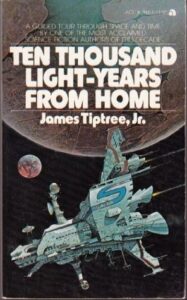
Contents: And I Awoke and Found Me Here on the Cold Hill's Side (1972) The Snows Are Melted, the Snows Are Gone (1969) The Peacefulness of Vivyan (1971) Mamma Come Home (1968) Help (1968) Painwise (1972) Faithful to Thee, Terra, in Our Fashion (1969) The Man Doors Said Hello To (1970) The Man Who Walked Home (1972) Forever to a Hudson Bay Blanket (1972) I'll Be Waiting for You When the Swimming Pool Is Empty (1971) I'm Too Big but I Love to Play (1970) Birth of a Salesman (1968) Mother in the Sky with Diamonds (1971) Beam Us Home (1969)
The Shadow of the Torturer is the tale of young Severian, an apprentice in the Guild of Torturers on the world called Urth, exiled for committing the ultimate sin of his profession -- showing mercy toward his victim.
The Claw of the Conciliator continues the saga of Severian, banished from his home, as he undertakes a mythic quest to discover the awesome power of an ancient relic, and learn the truth about his hidden destiny.
The Book of the New Sun is unanimously acclaimed as Gene Wolfe's most remarkable work, hailed as "a masterpiece of science fantasy comparable in importance to the major works of Tolkien and Lewis" by Publishers Weekly, and "one of the most ambitious works of speculative fiction in the twentieth century" by The Magazine of Fantasy and Science Fiction. Shadow & Claw brings together the first two books of the tetralogy in one volume.
In the overcrowded world and cramped space colonies of the late 21st century, tedium can be endured through the drug Can-D, which enables users to inhabit a shared illusory world. When industrialist Palmer Eldritch returns from an interstellar trip, he brings with him a new drug, Chew-Z. It is far more potent than Can-D, but threatens to plunge the world into a permanent state of drugged illusion controlled by the mysterious Eldritch.
Ragle Gumm is an ordinary man leading an ordinary life, except that he makes his living by entering a newspaper contest every day - and winning, every day.
But he gradually begins to suspect that his life - indeed his whole world - is an illusion, constructed around him for the express purpose of keeping him docile and happy. But if that is the case, what is his real world like, and what is he actually doing every day when he thinks he is guessing 'Where Will The Little Green Man Be Next?'
In this genre-bending novel—among the first to have launched sci-fi into the arena of literature—one of the great imaginers of the twentieth century tells a story as mind-blowing as any controlled substance and as affecting as a glimpse into a stranger's soul.
There's Lone, the simpleton who can hear other people's thoughts and make a man blow his brains out just by looking at him. There's Janie, who moves things without touching them, and there are the teleporting twins, who can travel ten feet or ten miles. There's Baby, who invented an antigravity engine while still in the cradle, and Gerry, who has everything it takes to run the world except for a conscience. Separately, they are talented freaks. Together, they compose a single organism that may represent the next step in evolution, and the final chapter in the history of the human race.
As the protagonists of More Than Human struggle to find out who they are and whether they are meant to help humanity or destroy it, Theodore Sturgeon explores questions of power and morality, individuality and belonging, with suspense, pathos, and a lyricism rarely seen in science fiction.
Welcome Back!
Track your reading progress and sync your library.