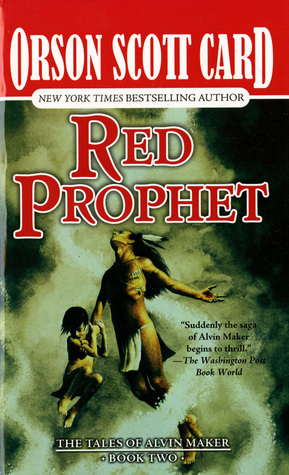
Come here to the magical America that might have been In this sequel to Seventh Son, Alvin Maker is awakening to many mysteries: his own strange powers, the magic of the land, and the special virtues of its chosen people, the Native Americans.
Alvin has discovered his own unique talent for making things whole again. Now he summons all his powers to prevent a tragic war between Native Americans and the white settlers of North America.
For Kivrin, preparing an on-site study of one of the deadliest eras in humanity's history was as simple as receiving inoculations against the diseases of the fourteenth century and inventing an alibi for a woman traveling alone. For her instructors in the twenty-first century, it meant painstaking calculations and careful monitoring of the rendezvous location where Kivrin would be received.
But a crisis strangely linking past and future strands Kivrin in a bygone age as her fellows try desperately to rescue her. In a time of superstition and fear, Kivrin--barely of age herself--finds she has become an unlikely angel of hope during one of history's darkest hours.
Connie Willis draws upon her understanding of the universalities of human nature to explore the ageless issues of evil, suffering, and the indomitable will of the human spirit.
1632 And in northern Germany things couldn't get much worse. Famine. Disease. Religous war laying waste the cities. Only the aristocrats remained relatively unscathed; for the peasants, death was a mercy.
2000 Things are going OK in Grantville, West Virginia, and everybody attending the wedding of Mike Stearn's sister (including the entire local chapter of the United Mine Workers of America, which Mike leads) is having a good time
THEN, EVERYTHING CHANGED....
When the dust settles, Mike leads a group of armed miners to find out what happened and finds the road into town is cut, as with a sword. On the other side, a scene out of Hell: a man nailed to a farmhouse door, his wife and daughter attacked by men in steel vests. Faced with this, Mike and his friends don't have to ask who to shoot.
At that moment Freedom and Justice, American style, are introduced to the middle of the Thirty Years' War.
The System of the World, the third and concluding volume of Neal Stephenson's shelf-bending Baroque Cycle (Quicksilver and The Confusion), brings the epic historical saga to its thrilling - and truly awe-inspiring - conclusion.
Set in the early 18th century and featuring a diverse cast of characters that includes alchemists, philosophers, mathematicians, spies, thieves, pirates, and royalty, The System of the World follows Daniel Waterhouse, an unassuming philosopher and confidant to some of the most brilliant minds of the age, as he returns to England to try and repair the rift between geniuses Sir Isaac Newton and Gottfried Wilhelm Leibniz. After reluctantly leaving his family in Boston, Waterhouse arrives in England and is almost killed by a mysterious Infernal Device. Having been away from the war-decimated country for two decades, Waterhouse quickly learns that although many things have changed, there is still violent revolution simmering just beneath the surface of seemingly civilized society. With Queen Anne deathly ill and Tories and Whigs jostling for political supremacy, Waterhouse and Newton vow to figure out who is trying to kill certain scientists and decipher the riddle behind the legend of King Solomon's gold, a mythical hoard of precious metal with miraculous properties.
Arguably one of the most ambitious -- and most researched -- stories ever written, Stephenson's Baroque Cycle is set in one of the most turbulent and exciting times in human history. Filled with wild adventure, political intrigue, social upheaval, civilization-changing discoveries, cabalistic mysticism, and even a little romance, this massive saga is worth its weight in (Solomon's) gold. Paul Goat Allen
A History professor is whisked back in time to Rome; only a few years before it's about to fall; with his foresight he attempts to not only create a living for himself but, at a later point, to stop the fall of Rome.
Quicksilver is the story of Daniel Waterhouse, fearless thinker and conflicted Puritan, pursuing knowledge in the company of the greatest minds of Baroque-era Europe, in a chaotic world where reason wars with the bloody ambitions of the mighty, and where catastrophe, natural or otherwise, can alter the political landscape overnight.
It is a chronicle of the breathtaking exploits of "Half-Cocked Jack" Shaftoe--London street urchin turned swashbuckling adventurer and legendary King of the Vagabonds--risking life and limb for fortune and love while slowly maddening from the pox.
And it is the tale of Eliza, rescued by Jack from a Turkish harem to become spy, confidante, and pawn of royals in order to reinvent Europe through the newborn power of finance.
A gloriously rich, entertaining, and endlessly inventive novel that brings a remarkable age and its momentous events to vivid life, Quicksilver is an extraordinary achievement from one of the most original and important literary talents of our time.
And it's just the beginning...
(back cover)
This P.S. edition includes 16 pages of supplementary materials.
Cover design by Richard L. Aquan Cover illustration from the Mary Evans Picture Library; painting of Great Fire of London on stepback
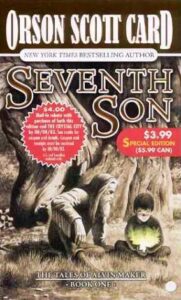
In an alternate version of frontier America, young Alvin is the seventh son of a seventh son, and such a birth is powerful magic. Yet even in the loving safety of his home, dark forces reach out to destroy him.
In one of the most powerful and thought-provoking novels of his remarkable career, Orson Scott Card's Pastwatch interweaves a compelling portrait of Christopher Columbus with the story of a future scientist who believes she can alter human history from a tragedy of bloodshed and brutality to a world filled with hope and healing.
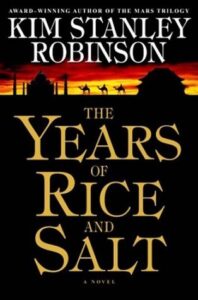
It is the fourteenth century and one of the most apocalyptic events in human history is set to occur - the coming of the Black Death. History teaches us that a third of Europe's population was destroyed. But what if? What if the plague killed 99 percent of the population instead? How would the world have changed? This is a look at the history that could have been: a history that stretches across centuries, a history that sees dynasties and nations rise and crumble, a history that spans horrible famine and magnificent innovation. These are the years of rice and salt.
Welcome Back!
Track your reading progress and sync your library.