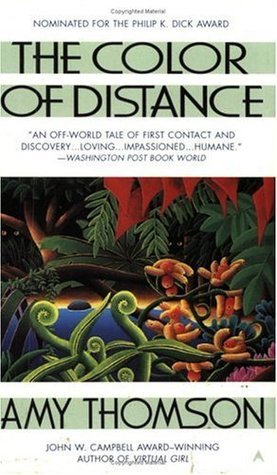
The Color of Distance
The award-winning author of Virtual Girl creates a strange new world of infinite possibilities where honor, sacrifice, and friendship between humans and aliens can mean many different things at once. Reprint.
Generations ago, humans fled to the cosmic anomaly known as Grass. Over time, they evolved a new and intricate society. But before humanity arrived, another species had already claimed Grass for its own. It, too, had developed a culture. . . .
Now, a deadly plague is spreading across the stars. No world save Grass has been left untouched. Marjorie Westriding Yrarier has been sent from Earth to discover the secret of the planet’s immunity. Amid the alien social structure and strange life-forms of Grass, Lady Westriding unravels the planet’s mysteries to find a truth so shattering it could mean the end of life itself.
Mary Doria Russell's debut novel, The Sparrow, took us on a journey to a distant planet and into the center of the human soul. A critically acclaimed bestseller, The Sparrow was chosen as one of Entertainment Weekly's Ten Best Books of the Year, a finalist for the Book-of-the-Month Club's First Fiction Prize and the winner of the James M. Tiptree Memorial Award. Now, in Children of God, Russell further establishes herself as one of the most innovative, entertaining and philosophically provocative novelists writing today.
The only member of the original mission to the planet Rakhat to return to Earth, Father Emilio Sandoz has barely begun to recover from his ordeal when the Society of Jesus calls upon him for help in preparing for another mission to Alpha Centauri. Despite his objections and fear, he cannot escape his past or the future.
Old friends, new discoveries and difficult questions await Emilio as he struggles for inner peace and understanding in a moral universe whose boundaries now extend beyond the solar system and whose future lies with children born in a faraway place.
Strikingly original, richly plotted, replete with memorable characters and filled with humanity and humor, Children of God is an unforgettable and uplifting novel that is a potent successor to The Sparrow and a startlingly imaginative adventure for newcomers to Mary Doria Russell’s special literary magic.
ISBN moved from less recent edition
The satellite-sized alien Gaea has gone completely insane. She has transformed her love of old movies into monstrous realities. She is Marilyn Monroe. She is King Kong. And now she must be destroyed.
Lilith Iyapo is in the Andes, mourning the death of her family, when war destroys Earth. Centuries later, she is resurrected -- by miraculously powerful unearthly beings, the Oankali. Driven by an irresistible need to heal others, the Oankali are rescuing our dying planet by merging genetically with mankind. But Lilith and all humanity must now share the world with uncanny, unimaginably alien creatures: their own children. This is their story...
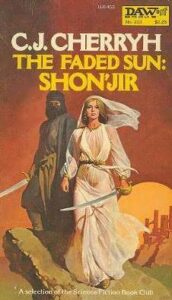
Sten Duncan had saved the lives of the last two of humanity's deadliest enemies, during the takeover of their planet Kesrith. Sten therefore felt responsible for them and for their future -- if any. For though the two mri were brother and sister, they represented different power-castes of their ancient warrior-race. Niun was the last of the bred samurai. Melein, though young, was perforce the last priestess-queen. But struggle and mutual danger had sealed Sten Duncan to their loyalty. As their blood-brother, he would have to help them flee mankind and take the long, long evasion-route across the cosmos to a legendary lost planet which might afford the mri one more chance.
The futures of both mankind and an alien species rest in the hands of one hybrid son in the award-winning science fiction author’s masterful sequel to Dawn.
Nuclear war had nearly destroyed mankind when the Oankali came to the rescue, saving humanity—but at a price. The Oankali survive by mixing their DNA with that of other species, and now on Earth they have permitted no child to be born without an Oankali parent. The first true hybrid is a boy named Akin—son of Lilith Iyapo— and to the naked eye he looks human, for now. He is born with extraordinary sensory powers, understanding speech at birth, speaking in sentences at two months old, and soon developing the ability to see at the molecular level. More powerful than any human or Oankali, he will be the architect of both races’ intergalactic future. But before he can carry this new species into the stars, Akin must decide which unlucky souls will stay behind.
At once a coming-of-age story, science fiction adventure, and philosophical exploration, Butler’s ambitious and breathtaking novel ultimately raises the question of what it means to be human.
They were the mri - tall, secretive, bound by honor and the rigid dictates of their society. For aeons this golden-skinned, golden-eyed race had provided the universe mercenary soldiers of almost unimaginable ability. But now the mri have faced an enemy unlike any other - an enemy whose only way of war is widespread destruction. These "humans" are mass fighters, creatures of the herd, and the mri have been slaughtered like animals.
Now, in the aftermath of war, the mri face extinction. It will be up to three individuals to save whatever remains of this devastated race: a warrior - one of the last survivors of his kind; a priestess of this honorable people; and a lone human - a man sworn to aid the enemy of his own kind. Can they retrace the galaxy-wide path of this nomadic race back through millennia to reclaim the ancient world which first gave them life?
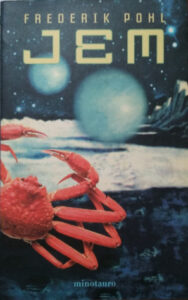
En un futuro muy lejano, la Tierra vive un equilibrio precario: la población crece inversamente a los recursos, y una suerte de guerra fría divide el mundo en tres bloques irreconciliables. Con el descubrimiento de Jem, un planeta rico y habitable, surge la oportunidad de empezar de cero. Sin embargo, toda esperanza de renacimiento de la humanidad se desvanece cuando, a través de un juego hipócrita de alianzas con las especies autóctonas, los colonizadores reproducen la arrogancia y el salvajismo que los había condenado, importando el más antiguo producto de la industria y el ingenio: la guerra.