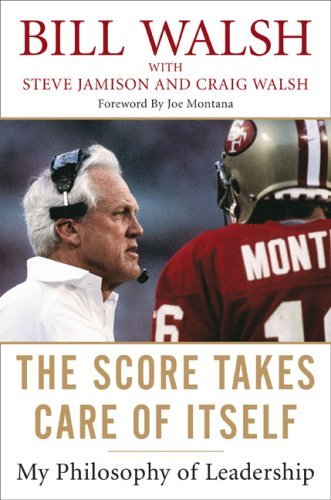
Offers insights and best leadership principles from the successful coach of the San Francisco 49ers, explaining how he motivated people, crafted winning teams, and his words of wisdom such as “Believe in people,” and “Keep a short enemies list.”
Avoid terrible advice, cognitive biases, and poor decisions.
Want to avoid business disasters, whether minor mishaps, such as excessive team conflict, or major calamities like those that threaten bankruptcy or doom a promising career? Fortunately, behavioral economics studies show that such disasters stem from poor decisions due to our faulty mental patterns—what scholars call “cognitive biases”—and are preventable.
Unfortunately, the typical advice for business leaders to “go with their guts” plays into these cognitive biases and leads to disastrous decisions that devastate the bottom line. By combining practical case studies with cutting-edge research, Never Go With Your Gut will help you make the best decisions and prevent these business disasters.
The leading expert on avoiding business disasters, Dr. Gleb Tsipursky, draws on over 20 years of extensive consulting, coaching, and speaking experience to show how pioneering leaders and organizations—many of them his clients—avoid business disasters. Reading this book will enable you to:
Discover how pioneering leaders and organizations address cognitive biases to avoid disastrous decisions. Adapt best practices on avoiding business disasters from these leaders and organizations to your own context. Develop processes that empower everyone in your organization to avoid business disasters.
"Who Moved My Cheese?" is a simple parable that reveals profound truths. It is an amusing and enlightening story of four characters who live in a "Maze" and look for "Cheese" to nourish them and make them happy.
Two are mice named Sniff and Scurry. And two are "Littlepeople" — beings the size of mice who look and act a lot like people. Their names are Hem and Haw.
"Cheese" is a metaphor for what you want to have in life — whether it's a good job, a loving relationship, money, a possession, health, or spiritual peace of mind.
And the "Maze" is where you look for what you want — the organisation you work in or the family or community you live in.
In the story, the characters are faced with unexpected change. Eventually, one of them deals with it successfully, and writes what he has learned from his experience on the Maze walls.
When you come to see "The Handwriting on the Wall," you can discover for yourself how to deal with change, so that you can enjoy less stress and more success (however you define it) in your work and in your life.
Written for all ages, the story takes less than an hour to read, but its unique insights can last for a lifetime.
The definitive biography of the NFL’s most enigmatic, controversial, and yet successful coach
Bill Belichick is perhaps the most fascinating figure in the NFL—the infamously dour face of one of the winningest franchises in sports. As head coach of the New England Patriots, he’s led the team to five Super Bowl championship trophies. In this revelatory and robust biography, readers will come to understand and see Belichick’s full life in football, from watching college games as a kid with his father, a Naval Academy scout, to orchestrating two Super Bowl–winning game plans as defensive coordinator for the Giants, to his dramatic leap to New England, where he has made history.
Award-winning columnist and New York Times best-selling author Ian O’Connor delves into the mind of the man who has earned a place among coaching legends like Lombardi, Halas, and Paul Brown, presenting sides of Belichick that have been previously unexplored. O’Connor discovers how this legendary coach shaped the people he met and worked with in ways perhaps even Belichick himself doesn’t know. Those who follow and love pro football know Bill Belichick only as the hooded genius of the Patriots. But there is so much more—from the hidden tensions and deep layers to his relationship with Tom Brady to his sometimes frosty dealings with owner Robert Kraft to his ability to earn the unmitigated respect of his players—if not their affection. This is a man who has many facets and, ultimately, has created a notorious football dynasty. Based on exhaustive research and countless interviews, this book circles around Belichick to tell his full story for the first time, and presents an incisive portrait of a mastermind at work.
In the most candid and compelling sports memoir since Andre Agassi’s riveting bestseller Open, former San Francisco 49er, Super Bowl champion, NFL MVP, and Hall of Famer Steve Young gives readers an unprecedented and stunning inside look at what it takes to become a super-elite professional quarterback.Steve Young produced some of the most memorable moments in NFL history. But his most impressive victories have been deeply personal ones that were won when no one was watching. His remarkably revealing memoir is the story of a Mormon boy with a 4.0 GPA, a photographic memory, and a severe case of separation anxiety. As an eighth-string quarterback at Brigham Young University, it was doubtful that he would ever see any playing time. But Young became an All-American, finished second in the Heisman voting, and was the top draft choice out of college. Then, after signing the largest contract in sports history, anxiety nearly drove him to walk away from football completely. In short, Young’s quest in life was always about grit. Now, he shares the experience of being inside his helmet while he faces down his toughest adversaries, both on and off the field."This book is gold.”—Peter King “Intense.”—San Francisco Chronicle “Steve Young is a hero of mine, and his story is a source of inspiration for me. His perseverance, intelligence, and, most of all, grace under pressure, NFL-style, make this book a fascinating read. Thanks, Steve, for sharing your story with one of your biggest fans!”—Tom Brady
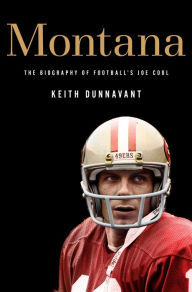
As long as football is played, Joe Montana will be synonymous with the heart-pounding rally. Seemingly impervious to the pressure of a scoreboard deficit, the quarterback known as Joe Cool brought a steadying calm to every huddle, especially when the situation seemed especially dire. His reputation for miracles began to take root at the University of Notre Dame. In the 1979 Cotton Bowl, he overcame the flu, hypothermia and a 22-point deficit to lead the Fighting Irish to a stunning victory over Houston. This narrative continued in the NFL, as he engineered 31 fourth-quarter comebacks, including victories known in professional football lore as The Catch and The Drive, forever casting his career in a heroic glow.
In MONTANA, acclaimed author Keith Dunnavant sketches the definitive portrait of a man who repeatedly defied the odds, on and off the field.
While leading the San Francisco 49ers to four Super Bowl championships over a nine-year period, establishing a new standard for passing efficiency, and twice earning the league's Most Valuable Player award, Montana became the signature quarterback of the 1980s and one of the greatest ever to play the game. Overcoming his own limitations, which caused him to be underrated coming out of Notre Dame, he quickly mastered Bill Walsh's West Coast Offense, and thereby, helped reinvent offensive football.
But it was rarely easy. Like the rallies he so often produced, his life was filled with the sort of tension that made his journey seem routinely dramatic: The father who pushed him. The high school coach who challenged his commitment. The college coach who very nearly squandered him. The back surgery that almost ended his career. The younger athlete who tried to take his job.
Rich an anecdotal detail, insight and context, MONTANA is a powerful story about a man who was defined by his intense competitiveness, and how this intangible helped him become one of the ionic figures in football history.
Billy Beane, general manager of MLB's Oakland A's and protagonist of Michael Lewis's Moneyball, had a problem: how to win in the Major Leagues with a budget that's smaller than that of nearly every other team. Conventional wisdom long held that big name, highly athletic hitters and young pitchers with rocket arms were the ticket to success. But Beane and his staff, buoyed by massive amounts of carefully interpreted statistical data, believed that wins could be had by more affordable methods such as hitters with high on-base percentage and pitchers who get lots of ground outs. Given this information and a tight budget, Beane defied tradition and his own scouting department to build winning teams of young affordable players and inexpensive castoff veterans.
Lewis was in the room with the A's top management as they spent the summer of 2002 adding and subtracting players and he provides outstanding play-by-play. In the June player draft, Beane acquired nearly every prospect he coveted (few of whom were coveted by other teams) and at the July trading deadline he engaged in a tense battle of nerves to acquire a lefty reliever. Besides being one of the most insider accounts ever written about baseball, Moneyball is populated with fascinating characters. We meet Jeremy Brown, an overweight college catcher who most teams project to be a 15th round draft pick (Beane takes him in the first). Sidearm pitcher Chad Bradford is plucked from the White Sox triple-A club to be a key set-up man and catcher Scott Hatteberg is rebuilt as a first baseman. But the most interesting character is Beane himself. A speedy athletic can't-miss prospect who somehow missed, Beane reinvents himself as a front-office guru, relying on players completely unlike, say, Billy Beane. Lewis, one of the top nonfiction writers of his era (Liar's Poker, The New New Thing), offers highly accessible explanations of baseball stats and his roadmap of Beane's economic approach makes Moneyball an appealing reading experience for business people and sports fans alike. --John Moe
The epic tale of the five owners who shepherded the NFL through its tumultuous early decades and built the most popular sport in America
The National Football League is a towering, distinctly American colossus spewing out $13 billion in annual revenue. Yet its current dominance has obscured how professional football got its start.
In The League, John Eisenberg reveals that Art Rooney, George Halas, Tim Mara, George Preston Marshall, and Bert Bell took an immense risk by investing in the professional game. At that time the sport barely registered on the national scene, where college football, baseball, boxing, and horseracing dominated. The five owners succeeded only because at critical junctures in the 1920s, 1930s, and 1940s each sacrificed the short-term success of his team for the longer-term good of the League.
At once a history of a sport and a remarkable story of business ingenuity, The League is an essential read for any fan of our true national pastime.
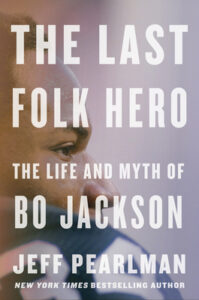
By the New York Times bestselling author of Showtime—the source for HBO’s Winning Time—the definitive biography of mythic multi-sport star Bo Jackson.
From the mid-1980s into the early 1990s, the greatest athlete of all time streaked across American sports and popular culture. Stadiums struggled to contain him. Clocks failed to capture his speed. His strength was legendary. His power unmatched. Video game makers turned him into an invincible character—and they were dead-on. He climbed (and walked across) walls, splintered baseball bats over his knee, turned oncoming tacklers into ground meat. He became the first person to simultaneously star in two major professional sports, and overtook Michael Jordan as America’s most recognizable pitchman. He was on our televisions, in our magazines, plastered across billboards. He was half man, half myth.
Then, almost overnight, he was gone.
He was Bo Jackson.
Drawing on an astonishing 720 original interviews, New York Times bestselling sportswriter Jeff Pearlman captures as never before the elusive truth about Jackson, Auburn University’s transcendent Heisman Trophy winner, superstar of both the NFL and Major League Baseball and ubiquitous “Bo Knows” Nike pitchman. Did Bo really jump over a parked Volkswagen? (Yes.) Did he actually run a 4.13 40? (Yes.) During the 1991 flight that nearly killed every member of the Chicago White Sox, was he in the cockpit trying to help? (Oddly, yes. Or no. Or … maybe.)
Bo Jackson isn’t Jim Thorpe.
He’s not Deion Sanders, either.
No, Bo Jackson is Paul Bunyan.
The Last Folk Hero is the true tale of Bo Jackson that only “master storyteller” (NPR) Jeff Pearlman could tell.
Welcome Back!
Track your reading progress and sync your library.