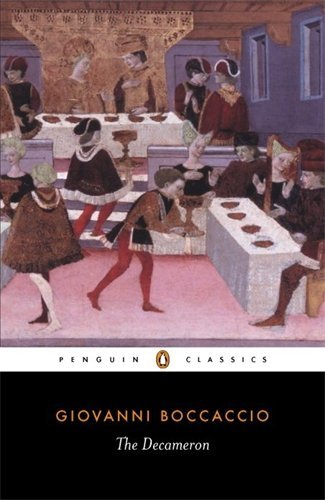
The Decameron (c.1351) is an entertaining series of one hundred stories written in the wake of the Black Death. The stories are told in a country villa outside the city of Florence by ten young noble men and women who are seeking to escape the ravages of the plague. Boccaccio’s skill as a dramatist is masterfully displayed in these vivid portraits of people from all stations in life, with plots that revel in a bewildering variety of human reactions.
Translated with an Introduction and Notes by G. H. McWilliam
"Kublai Khan does not necessarily believe everything Marco Polo says when he describes the cities visited on his expeditions, but the emperor of the Tartars does continue listening to the young Venetian with greater attention and curiosity than he shows any other messenger or explorer of his." So begins Italo Calvino's compilation of fragmentary urban images. As Marco tells the khan about Armilla, which "has nothing that makes it seem a city, except the water pipes that rise vertically where the houses should be and spread out horizontally where the floors should be," the spider-web city of Octavia, and other marvelous burgs, it may be that he is creating them all out of his imagination, or perhaps he is recreating fine details of his native Venice over and over again, or perhaps he is simply recounting some of the myriad possible forms a city might take.
If on a Winter's Night a Traveler is a marvel of ingenuity, an experimental text that looks longingly back to the great age of narration—"when time no longer seemed stopped and did not yet seem to have exploded." Italo Calvino's novel is in one sense a comedy in which the two protagonists, the Reader and the Other Reader, ultimately end up married, having almost finished If on a Winter's Night a Traveler. In another, it is a tragedy, a reflection on the difficulties of writing and the solitary nature of reading. The Reader buys a fashionable new book, which opens with an exhortation: "Relax. Concentrate. Dispel every other thought. Let the world around you fade." Alas, after 30 or so pages, he discovers that his copy is corrupted, and consists of nothing but the first section, over and over. Returning to the bookshop, he discovers the volume, which he thought was by Calvino, is actually by the Polish writer Bazakbal. Given the choice between the two, he goes for the Pole, as does the Other Reader, Ludmilla. But this copy turns out to be by yet another writer, as does the next, and the next.
The real Calvino intersperses 10 different pastiches—stories of menace, spies, mystery, premonition—with explorations of how and why we choose to read, make meanings, and get our bearings or fail to. Meanwhile the Reader and Ludmilla try to reach, and read, each other. If on a Winter's Night is dazzling, vertiginous, and deeply romantic. "What makes lovemaking and reading resemble each other most is that within both of them times and spaces open, different from measurable time and space."
Often likened to Kafka's The Castle, The Tartar Steppe is both a scathing critique of military life and a meditation on the human thirst for glory. It tells of young Giovanni Drogo, who is posted to a distant fort overlooking the vast Tartar steppe. Although not intending to stay, Giovanni suddenly finds that years have passed, as, almost without his noticing, he has come to share the others' wait for a foreign invasion that never happens. Over time the fort is downgraded and Giovanni's ambitions fade until the day the enemy begins massing on the desolate steppe...
Italo Calvino's extraordinary imagination and intelligence combine here in an enchanting series of stories about the evolution of the universe. He makes his characters out of mathematical formulae and simple cellular structures. They disport themselves among galaxies, experience the solidification of planets, move from aquatic to terrestrial existence, play games with hydrogen atoms, and even have a love life.
During the course of these stories Calvino toys with continuous creation, the transformation of matter, and the expanding and contracting reaches of space and time. He succeeds in relating complex scientific concepts to the ordinary reactions of common humanity.
William Weaver's excellent translation won a National Book Award in 1969
“Naturally, we were all there," old Qfwfq said, "where else could we have been? Nobody knew then that there could be space. Or time either: what use did we have for time, packed in there like sardines?”
The distance of the moon -- At daybreak -- A sign in space -- All at one point -- Without colors -- Games without end -- The aquatic uncle -- How much shall we bet? -- The dinosaurs -- The form of space -- The light-years -- The spiral.
A landmark new translation of a Calvino classic, a whimsical, spirited novel that imagines a life lived entirely on its own terms
Cosimo di Rondó, a young Italian nobleman of the eighteenth century, rebels against his parents by climbing into the trees and remaining there for the rest of his life. He adapts efficiently to an existence in the forest canopy—he hunts, sows crops, plays games with earth-bound friends, fights forest fires, solves engineering problems, and even manages to have love affairs. From his perch in the trees, Cosimo sees the Age of Enlightenment pass by, and a new century dawn.
The Baron in the Trees exemplifies Calvino’s peerless ability to weave tales that sparkle with enchantment. This new English rendering by acclaimed translator Ann Goldstein breathes new life into one of Calvino’s most beloved works.
¿Es posible revertir el inevitable final del Universo, o el mundo debe acabar de todas formas? es la pregunta que desde un día del siglo XXI, hasta generaciones y generaciones posteriores en el tiempo, hacen los humanos a los ordenadores.
En un relato aparentemente sencillo sobre un asunto sobrecogedor, el fin de los días, Asimov demuestra, una vez más, una mente preclara y una mano maestra para sobrecoger al lector y dejarlo en vilo, incluso después de la lectura.
Alternate cover edition of ISBN-13: 978-0140286809, ISBN-10/ASIN: 0140286802
For the first time in English, all the fiction by the writer who has been called “the greatest Spanish-language writer of our century” collected in a single volume
A Penguin Classics Deluxe Edition with flaps and deckle-edged paper
For some fifty years, in intriguing and ingenious fictions that reimagined the very form of the short story—from his 1935 debut with A Universal History of Iniquity through his immensely influential collections Ficciones and The Aleph, the enigmatic prose poems of The Maker, up to his final work in the 1980s, Shakespeare’s Memory—Jorge Luis Borges returned again and again to his celebrated themes: dreams, duels, labyrinths, mirrors, infinite libraries, the manipulations of chance, gauchos, knife fighters, tigers, and the elusive nature of identity itself. Playfully experimenting with ostensibly subliterary genres, he took the detective story and turned it into metaphysics; he took fantasy writing and made it, with its questioning and reinventing of everyday reality, central to the craft of fiction; he took the literary essay and put it to use reviewing wholly imaginary books.
Bringing together for the first time in English all of Borges’s magical stories, and all of them newly rendered into English in brilliant translations by Andrew Hurley, Collected Fictions is the perfect one-volume compendium for all who have long loved Borges, and a superb introduction to the master’s work for all who have yet to discover this singular genius.
White Nights is a short story by Fyodor Dostoevsky that was published in 1848. Set in St. Petersburg, it is the story of a young man fighting his inner restlessness. A light and tender narrative, it delves into the torment and guilt of unrequited love. Both protagonists suffer from a deep sense of alienation that initially brings them together. A blend of romanticism and realism, the story appeals gently to the senses and feelings.
Welcome Back!
Track your reading progress and sync your library.