Through Jim Burden’s endearing, smitten voice, we revisit the remarkable vicissitudes of immigrant life in the Nebraska heartland, with all its insistent bonds. Guiding the way are some of literature’s most beguiling characters: the Russian brothers plagued by memories of a fateful sleigh ride, Antonia’s desperately homesick father and self-indulgent mother, and the coy Lena Lingard. Holding the pastoral society’s heart, of course, is the bewitching, free-spirited Antonia.
Like his father and grandfather before him, Kino is a poor diver, gathering pearls from the gulf beds that once brought great wealth to the kings of Spain and now provide Kino, Juana, and their infant son with meager subsistence. Then, on a day like any other, Kino emerges from the sea with a pearl as large as a sea gull’s egg, as “perfect as the moon.” With the pearl comes hope, the promise of comfort and of security…
A story of classic simplicity, based on a Mexican folk tale, The Pearl explores the secrets of man’s nature, greed, the darkest depths of evil, and the luminous possibilities of love.
The classic novel of despair, forbidden emotions, and sexual undercurrents set against the austere New England countryside
Ethan Frome works his unproductive farm and struggles to maintain a bearable existence with his difficult, suspicious and hypochondriac wife, Zeena. But when Zeena's vivacious cousin enters their household as a hired girl, Ethan finds himself obsessed with her and with the possibilities for happiness she comes to represent.
In one of American fiction's finest and most intense narratives, Edith Wharton moves this ill-starred trio toward their tragic destinies. Different in both tone and theme from Wharton's other works, Ethan Frome has become perhaps her most enduring and most widely read book.
Cannery Row is a book without much of a plot. Rather, it is an attempt to capture the feeling and people of a place, the cannery district of Monterey, California, which is populated by a mix of those down on their luck and those who choose for other reasons not to live "up the hill" in the more respectable area of town. The flow of the main plot is frequently interrupted by short vignettes that introduce us to various denizens of the Row, most of whom are not directly connected with the central story. These vignettes are often characterized by direct or indirect reference to extreme violence: suicides, corpses, and the cruelty of the natural world.
The "story" of Cannery Row follows the adventures of Mack and the boys, a group of unemployed yet resourceful men who inhabit a converted fish-meal shack on the edge of a vacant lot down on the Row.
“And I will show you something different from either Your shadow at morning striding behind you Or your shadow at evening rising to meet you I will show you fear in a handful of dust”
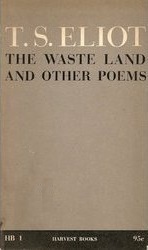
When The Waste Land was published in 1922, initial reaction to the poem was decidedly negative. Critics attacked the poem's "kaleidoscopic" design, and nearly everyone disagreed furiously about its meaning. The poem was even rumored to a hoax. Eventually, though, The Waste Land went on to become what many regard as the most influential poem written in English in the twentieth century.
"In ten years' time," wrote Edmund Wilson in Axel's Castle (1931), "Elliot has left upon English poetry a mark more unmistakable than that of any other poet writing in English." In 1948, T.S. Eliot was awarded the Nobel Price "for his work as a trail-blazing pioneer of modern poetry."
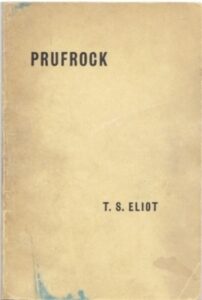
In addition to the title poem, this selection includes "The Love Song of J. Alfred Prufrock," "Geronition," "Ash-Wednesday," and other poems from Eliot's early and middle work.
Includes: - The Love Song of J. Alfred Prufrock - Preludes - Gerontion - Sweeney Among the Nightingales - The Waste Land: I. The Burial of the Dead II. A Game of Chess III. The Fire Sermon IV. Death by Water V. What the Thunder Said Notes on 'The Waste Land' - Ash-Wednesday -J ourney of the Magi - Marina - Landscapes: I. New Hampshire II. Virginia III. USK - Two Choruses from 'The Rock'
Dive deep into The Love Song of J. Alfred Prufrock by T.S. Eliot anywhere you on a plane, on a mountain, in a canoe, under a tree. Or grab a flashlight and read Shmoop under the covers. Shmoop's award-winning Poetry Guides are now available on your Nook. Shmoop eBooks are like having a trusted, fun, chatty, expert poetry-tour-guide always by your side, no matter where you are (or how late it is at night).
This Shmoop Poetry Guide offers fresh analysis, a line-by-line close reading of the poem, examination of the poet's technique, form, meter, rhyme, symbolism, jaw-dropping trivia, a glossary of poetry terms, and more. Best of all, Shmoop's analysis aims to look at a topic from multiple points of view to give you the fullest understanding.
Experts and educators from top universities, including Stanford, UC Berkeley, and Harvard, have written Shmoop guides designed to engage you and to get your brain bubbling. Shmoop is here to make you a better lover (of poetry) and to help you make connections to other poems, works of literature, current events, and pop culture. For more information, check out shmoop.com/poetry
"Smart and consistently humorous." - The Academy of American Poets
The Waste Land, first published in 1922, is often regarded as T.S. Eliot's masterpiece, as well as one of the most important poems of the 20th century and a central work of modernist poetry.
The work, divided in 5 sections, juxtaposes the legend of the Holy Grail and the Fisher King, with a snapshot of early twentieth-century British society. In contemporary times, it is often read published within The Waste Land and Other Poems and has come to be Eliot's most popular poem.
T.S. Elliot was a poet, essayist, publisher, playwright, literary critic and editor. Born in 1888 in St. Louis (MO, USA), he is considered one of the 20th century's major poets, and a central figure in English-language Modernist poetry."In ten years' time," wrote Edmund Wilson in Axel's Castle (1931), "Elliot has left upon English poetry a mark more unmistakable than that of any other poet writing in English." In 1948, Eliot was awarded the Nobel Price "for his work as a trail-blazing pioneer of modern poetry."
Fair and long-legged, independent and articulate, Janie Crawford sets out to be her own person—no mean feat for a black woman in the '30s. Janie's quest for identity takes her through three marriages and into a journey back to her roots.
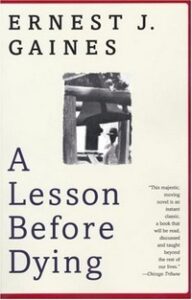
A Lesson Before Dying is set in a small Cajun community in the late 1940s. Jefferson, a young black man, is an unwitting party to a liquor store shoot out in which three men are killed; the only survivor, he is convicted of murder and sentenced to death. Grant Wiggins, who left his hometown for the university, has returned to the plantation school to teach. As he struggles with his decision whether to stay or escape to another state, his aunt and Jefferson's godmother persuade him to visit Jefferson in his cell and impart his learning and his pride to Jefferson before his death. In the end, the two men forge a bond as they both come to understand the simple heroism of resisting and defying the expected. Ernest J. Gaines brings to this novel the same rich sense of place, the same deep understanding of the human psyche, and the same compassion for a people and their struggle that have informed his previous, highly praised works of fiction.
Welcome Back!
Track your reading progress and sync your library.