In 2019, humanity finally finds proof of extraterrestrial life when a listening post in Puerto Rico picks up exquisite singing from a planet that will come to be known as Rakhat. While United Nations diplomats endlessly debate a possible first contact mission, the Society of Jesus quietly organizes an eight-person scientific expedition of its own. What the Jesuits find is a world so beyond comprehension that it will lead them to question what it means to be “human”.
Mary Doria Russell's debut novel, The Sparrow, took us on a journey to a distant planet and into the center of the human soul. A critically acclaimed bestseller, The Sparrow was chosen as one of Entertainment Weekly's Ten Best Books of the Year, a finalist for the Book-of-the-Month Club's First Fiction Prize and the winner of the James M. Tiptree Memorial Award. Now, in Children of God, Russell further establishes herself as one of the most innovative, entertaining and philosophically provocative novelists writing today.
The only member of the original mission to the planet Rakhat to return to Earth, Father Emilio Sandoz has barely begun to recover from his ordeal when the Society of Jesus calls upon him for help in preparing for another mission to Alpha Centauri. Despite his objections and fear, he cannot escape his past or the future.
Old friends, new discoveries and difficult questions await Emilio as he struggles for inner peace and understanding in a moral universe whose boundaries now extend beyond the solar system and whose future lies with children born in a faraway place.
Strikingly original, richly plotted, replete with memorable characters and filled with humanity and humor, Children of God is an unforgettable and uplifting novel that is a potent successor to The Sparrow and a startlingly imaginative adventure for newcomers to Mary Doria Russell’s special literary magic.
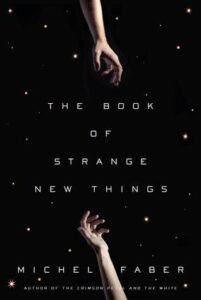
A monumental, genre-defying novel over ten years in the making, Michel Faber's The Book of Strange New Things is a masterwork from a writer in full command of his many talents.
It begins with Peter, a devoted man of faith, as he is called to the mission of a lifetime, one that takes him galaxies away from his wife, Bea. Peter becomes immersed in the mysteries of an astonishing new environment, overseen by an enigmatic corporation known only as USIC. His work introduces him to a seemingly friendly native population struggling with a dangerous illness and hungry for Peter's teachings—his Bible is their "book of strange new things." But Peter is rattled when Bea's letters from home become increasingly desperate: typhoons and earthquakes are devastating whole countries, and governments are crumbling. Bea's faith, once the guiding light of their lives, begins to falter.
Suddenly, a separation measured by an otherworldly distance, and defined both by one newly discovered world and another in a state of collapse, is threatened by an ever-widening gulf that is much less quantifiable. While Peter is reconciling the needs of his congregation with the desires of his strange employer, Bea is struggling for survival. Their trials lay bare a profound meditation on faith, love tested beyond endurance, and our responsibility to those closest to us.
Marked by the same bravura storytelling and precise language that made The Crimson Petal and the White such an international success, The Book of Strange New Things is extraordinary, mesmerizing, and replete with emotional complexity and genuine pathos.
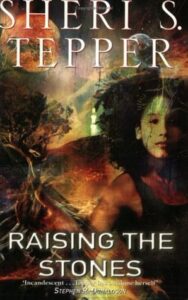
The author of The Gate to Women's Country and Grass weaves a moving story of one man's coming to accept his role in a far future universe, providing a brilliant exploration of relations between the sexes, the value of religion, and mankind's place in the universe.
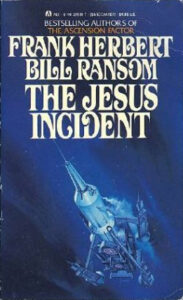
A determined group of colonists are attempting to establish a bridgehead on the planet Pandora, despite the savagery of the native lifeforms, as deadly as they are inhospitable. But they have more to deal with than just murderous aliens: their ship's computer has been given artificial consciousness and has decided that it is a God. Now it is insisting—with all the not inconsiderable force of its impressive array of armaments to back it up—that the colonists find appropriate ways to worship It.
NEW YORK TIMES BESTSELLER • Robert Heinlein at his superlative best. A fascinating and thought-provoking novel—one to make you smile, to make you wonder, and to make you care!
After that firewalking gig in Polynesia, the whole world was suddenly changed around him. Instead of fundamentalist minister Alexander Hergensheimer, he was now supposed to be Alec Graham, an underworld figure in the middle of an affair with his stewardess Margrethe—who was the only good thing in the whole mess.
Then there was an impossible iceberg that wrecked the ship in the tropics. Rescued by a Royal Mexican plane, they were hit by a double earthquake. From then on, as changed world followed changed world, things went from bad to worse.
To Alex, all the signs increasingly pointed to Armageddon and the Day of Judgement. And Margrethe was a determined heathen. Somehow he had to bring her to a state of grace, for Heaven would be no paradise without her. But time was growing short.
Somewhere, there had to be a solution to it all. And, of course, there was. But it was truly a Hell of a solution.
VALIS is the first book in Philip K. Dick's incomparable final trio of novels (the others being The Divine Invasion and The Transmigration of Timothy Archer). This disorienting and bleakly funny work is about a schizophrenic hero named Horselover Fat; the hidden mysteries of Gnostic Christianity; and reality as revealed through a pink laser. VALIS is a theological detective story, in which God is both a missing person and the perpetrator of the ultimate crime.
Doro is an entity who changes bodies like clothes, killing his hosts by reflex or design. He fears no one until he meets Anyanwu. Anyanwu is a shapeshifter who can absorb bullets and heal with a kiss and savage anyone who threatens her. She fears no one until she meets Doro. Together they weave a pattern of destiny (from Africa to the New World) unimaginable to mortals.
In 1941, Astounding Science Fiction magazine published a short story by a little-known writer named Isaac Asimov. The story was called "Nightfall", and many years later it has long been recognized as a classic, its author a legend. Now, the Grand Master of Science Fiction teams with Robert Silverberg, one of the field's top award-winning authors, to explore and expand an apocalyptic tale that is more spellbinding today than ever before -- Nightfall: The Novel.
Imagine living on a planet with six suns that never experiences darkness. Imagine never having seen the stars. Then, one by one the suns start to set, gradually leading into darkness for the first time ever. Kalgash is a world on the edge of chaos, torn between the madness of religious fanaticism and the unyielding rationalism of scientists. Lurking beneath it all is a collective, instinctual fear of the Darkness. For Kalgash knows only the perpetual light of day; to its inhabitants, a gathering twilight portends unspeakable horror. And only a handful of people on the planet are prepared to face the truth, their six suns are setting all at once for the first time in over two thousand years, signaling the end of civilization as it explodes in the awesome splendor of Nightfall.
Encompassing the psychology of disaster, the tenacity of the human spirit, and, ultimately, the regenerative power of hope, Nightfall is a tale rich in character and suspense that only the unique collaboration of Isaac Asimov and Robert Silverberg could create.
Welcome Back!
Track your reading progress and sync your library.