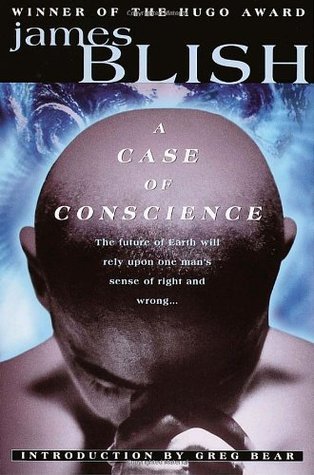
Father Ruiz-Sanchez is a dedicated man–a priest who is also a scientist, and a scientist who is also a human being. He has found no insoluble conflicts in his beliefs or his ethics . . . until he is sent to Lithia. There he comes upon a race of aliens who are admirable in every way except for their total reliance on cold reason; they are incapable of faith or belief.
Confronted with a profound scientific riddle and ethical quandary, Father Ruiz-Sanchez soon finds himself torn between the teachings of his faith, the teachings of his science, and the inner promptings of his humanity. There is only one solution: He must accept an ancient and unforgivable heresy–and risk the futures of both worlds . . .
Mary Doria Russell's debut novel, The Sparrow, took us on a journey to a distant planet and into the center of the human soul. A critically acclaimed bestseller, The Sparrow was chosen as one of Entertainment Weekly's Ten Best Books of the Year, a finalist for the Book-of-the-Month Club's First Fiction Prize and the winner of the James M. Tiptree Memorial Award. Now, in Children of God, Russell further establishes herself as one of the most innovative, entertaining and philosophically provocative novelists writing today.
The only member of the original mission to the planet Rakhat to return to Earth, Father Emilio Sandoz has barely begun to recover from his ordeal when the Society of Jesus calls upon him for help in preparing for another mission to Alpha Centauri. Despite his objections and fear, he cannot escape his past or the future.
Old friends, new discoveries and difficult questions await Emilio as he struggles for inner peace and understanding in a moral universe whose boundaries now extend beyond the solar system and whose future lies with children born in a faraway place.
Strikingly original, richly plotted, replete with memorable characters and filled with humanity and humor, Children of God is an unforgettable and uplifting novel that is a potent successor to The Sparrow and a startlingly imaginative adventure for newcomers to Mary Doria Russell’s special literary magic.
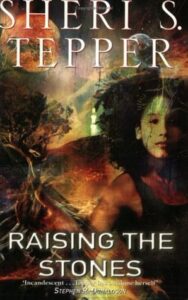
The author of The Gate to Women's Country and Grass weaves a moving story of one man's coming to accept his role in a far future universe, providing a brilliant exploration of relations between the sexes, the value of religion, and mankind's place in the universe.
Fraa Erasmas is a young avout living in the Concent of Saunt Edhar, a sanctuary for mathematicians, scientists, and philosophers, protected from the corrupting influences of the outside "saecular" world by ancient stone, honored traditions, and complex rituals. Over the centuries, cities and governments have risen and fallen beyond the concent's walls. Three times during history's darkest epochs violence born of superstition and ignorance has invaded and devastated the cloistered mathic community. Yet the avout have always managed to adapt in the wake of catastrophe, becoming out of necessity even more austere and less dependent on technology and material things. And Erasmas has no fear of the outside—the Extramuros—for the last of the terrible times was long, long ago.
Now, in celebration of the week-long, once-in-a-decade rite of Apert, the fraas and suurs prepare to venture beyond the concent's gates—at the same time opening them wide to welcome the curious "extras" in. During his first Apert as a fraa, Erasmas eagerly anticipates reconnecting with the landmarks and family he hasn't seen since he was "collected." But before the week is out, both the existence he abandoned and the one he embraced will stand poised on the brink of cataclysmic change.
Powerful unforeseen forces jeopardize the peaceful stability of mathic life and the established ennui of the Extramuros—a threat that only an unsteady alliance of saecular and avout can oppose—as, one by one, Erasmas and his colleagues, teachers, and friends are summoned forth from the safety of the concent in hopes of warding off global disaster. Suddenly burdened with a staggering responsibility, Erasmas finds himself a major player in a drama that will determine the future of his world—as he sets out on an extraordinary odyssey that will carry him to the most dangerous, inhospitable corners of the planet . . . and beyond.
In 2019, humanity finally finds proof of extraterrestrial life when a listening post in Puerto Rico picks up exquisite singing from a planet that will come to be known as Rakhat. While United Nations diplomats endlessly debate a possible first contact mission, the Society of Jesus quietly organizes an eight-person scientific expedition of its own. What the Jesuits find is a world so beyond comprehension that it will lead them to question what it means to be "human".
David Brin's Uplift novels are among the most thrilling and extraordinary science fiction ever written. Sundiver, Startide Rising, and The Uplift War—a New York Times bestseller—together make up one of the most beloved sagas of all time. Brin's tales are set in a future universe in which no species can reach sentience without being "uplifted" by a patron race. But the greatest mystery of all remains unsolved: who uplifted humankind?
The Terran exploration vessel Streaker has crashed in the uncharted water world of Kithrup, bearing one of the most important discoveries in galactic history. Below, a handful of her human and dolphin crew battles armed rebellion and a hostile planet to safeguard her secret—the fate of the Progenitors, the fabled First Race who seeded wisdom throughout the stars.
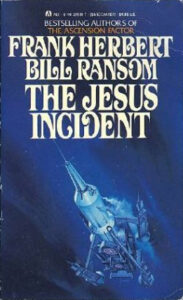
A determined group of colonists are attempting to establish a bridgehead on the planet Pandora, despite the savagery of the native lifeforms, as deadly as they are inhospitable. But they have more to deal with than just murderous aliens: their ship's computer has been given artificial consciousness and has decided that it is a God. Now it is insisting—with all the not inconsiderable force of its impressive array of armaments to back it up—that the colonists find appropriate ways to worship It.
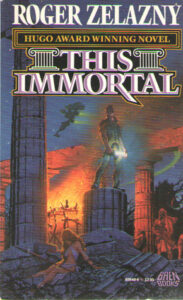
Conrad Nomikos has a long, rich personal history that he'd rather not talk about. And, as Arts Commissioner, he's been given a job he'd rather not do. Escorting an alien grandee on a guided tour of the shattered remains of Earth is not something he relishes—especially when it is apparent that this places him at the center high-level intrigue that has some bearing on the future of Earth itself.
In The Divine Invasion, Philip K. Dick asks: What if God — or a being called Yah — were alive and in exile on a distant planet? How could a second coming succeed against the high technology and finely tuned rationalized evil of the modern police state?
The Divine Invasion "blends Judaism, Kabalah, Zoroastrianism, and Christianity into a fascinating fable of human existence" --West Coast Review of Books
Welcome Back!
Track your reading progress and sync your library.