A vicious fifteen-year-old droog is the central character of this 1963 classic. In Anthony Burgess’s nightmare vision of the future, where criminals take over after dark, the story is told by the central character, Alex, who talks in a brutal invented slang that brilliantly renders his and his friends’ social pathology. A Clockwork Orange is a frightening fable about good and evil, and the meaning of human freedom. And when the state undertakes to reform Alex to “redeem” him, the novel asks, “At what cost?”
This edition includes the controversial last chapter not published in the first edition and Burgess’s introduction “A Clockwork Orange Resucked.”
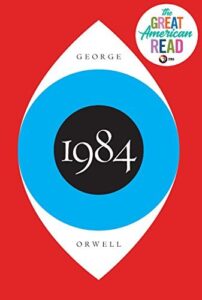
Among the seminal texts of the 20th century, Nineteen Eighty-Four is a rare work that grows more haunting as its futuristic purgatory becomes more real. Published in 1949, the book offers political satirist George Orwell's nightmarish vision of a totalitarian, bureaucratic world and one poor stiff's attempt to find individuality. The brilliance of the novel is Orwell's prescience of modern life—the ubiquity of television, the distortion of the language—and his ability to construct such a thorough version of hell. Required reading for students since it was published, it ranks among the most terrifying novels ever written.
The astonishing novel Brave New World, originally published in 1932, presents Aldous Huxley's vision of the future--of a world utterly transformed. Through the most efficient scientific and psychological engineering, people are genetically designed to be passive and therefore consistently useful to the ruling class. This powerful work of speculative fiction sheds a blazing critical light on the present and is considered to be Aldous Huxley's most enduring masterpiece.
The non-fiction work Brave New World Revisited, published in 1958, is a fascinating work in which Huxley uses his tremendous knowledge of human relations to compare the modern-day world with his prophetic fantasy envisioned in Brave New World, including the threats to humanity, such as over-population, propaganda, and chemical persuasion.
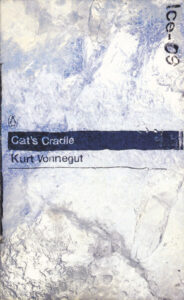
Told with deadpan humour and bitter irony, Kurt Vonnegut's cult tale of global destruction preys on our deepest fears of witnessing Armageddon and, worse still, surviving it ...
Dr Felix Hoenikker, one of the founding 'fathers' of the atomic bomb, has left a deadly legacy to the world. For he's the inventor of 'ice-nine', a lethal chemical capable of freezing the entire planet. The search for its whereabouts leads to Hoenikker's three ecentric children, to a crazed dictator in the Caribbean, to madness. Felix Hoenikker's Death Wish comes true when his last, fatal gift to humankind brings about the end, that for all of us, is nigh...
In Ballard's hallucinatory novel, the car provides the hellish tableau in which Vaughan, a "TV scientist" turned "nightmare angel of the highways," experiments with erotic atrocities among auto crash victims, each more sinister than the last. James Ballard, his friend and fellow obsessive, tells the story of this twisted visionary as he careens rapidly toward his own demise in an intentionally orchestrated car crash with Elizabeth Taylor. A classic work of cutting edge fiction, Crash explores the disturbing potentialities of contemporary society's increasing dependence on technology as intermediary in human relations.
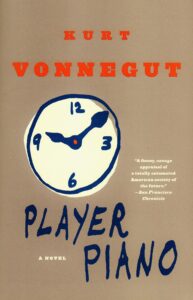
Kurt Vonnegut’s first novel spins the chilling tale of engineer Paul Proteus, who must find a way to live in a world dominated by a supercomputer and run completely by machines. Paul’s rebellion is vintage Vonnegut—wildly funny, deadly serious, and terrifyingly close to reality.
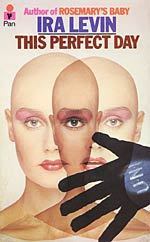
The story is set in a seemingly perfect global society. Uniformity is the defining feature; there is only one language and all ethnic groups have been eugenically merged into one race called "The Family."
The world is ruled by a central computer called UniComp that has been programmed to keep every single human on the surface of the earth in check. People are continually drugged by means of regular injections so that they can never realize their potential as human beings, but will remain satisfied and cooperative. They are told where to live, when to eat, whom to marry, when to reproduce. Even the basic facts of nature are subject to UniComp's will - men do not grow facial hair, women do not develop breasts, and it only rains at night.
"The Family" was everywhere. For centuries, mankind longed for a world without suffering or war. The Family made that dream come true. They have triumphed. Programmed, every need satisfied, they knew nothing of struggle or pain. They had mastered... perfected Earth.
But for one man, perfection was not enough. For Chip, it was a nightmare. The Family was a suffocating force of evil. His dream was to escape... and destroy!
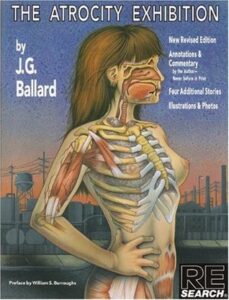
Easily one of the 20th century's most visionary writers, J. G. Ballard lived far ahead of his time. Called his "prophetic masterpiece" by many, The Atrocity Exhibition practically lies outside of any literary tradition. Part science fiction, part eerie historical fiction, part pornography, its characters adhere to no rules of linearity or stability. This reissued edition features an introduction by William S. Burroughs, extensive text commentary by Ballard, and four additional stories. Of specific interest are the illustrations by underground cartoonist and professional medical illustrator Phoebe Gloeckner. Her ultrarealistic images of eroticism and destruction add an important dimension to Ballard's text.
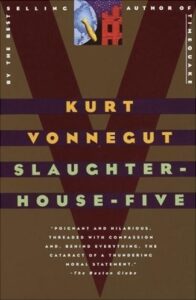
Slaughterhouse-Five, an American classic, is one of the world’s great antiwar books. Centering on the infamous World War II firebombing of Dresden, the novel is the result of what Kurt Vonnegut described as a twenty-three-year struggle to write a book about what he had witnessed as an American prisoner of war. It combines historical fiction, science fiction, autobiography, and satire in an account of the life of Billy Pilgrim, a barber’s son turned draftee turned optometrist turned alien abductee. As Vonnegut had, Billy experiences the destruction of Dresden as a POW. Unlike Vonnegut, he experiences time travel, or coming “unstuck in time.”
An instant bestseller, Slaughterhouse-Five made Kurt Vonnegut a cult hero in American literature, a reputation that only strengthened over time, despite his being banned and censored by some libraries and schools for content and language. But it was precisely those elements of Vonnegut’s writing—the political edginess, the genre-bending inventiveness, the frank violence, the transgressive wit—that have inspired generations of readers not just to look differently at the world around them but to find the confidence to say something about it.
Fifty years after its initial publication at the height of the Vietnam War, Vonnegut's portrayal of political disillusionment, PTSD, and postwar anxiety feels as relevant, darkly humorous, and profoundly affecting as ever, an enduring beacon through our own era’s uncertainties.
Welcome Back!
Track your reading progress and sync your library.