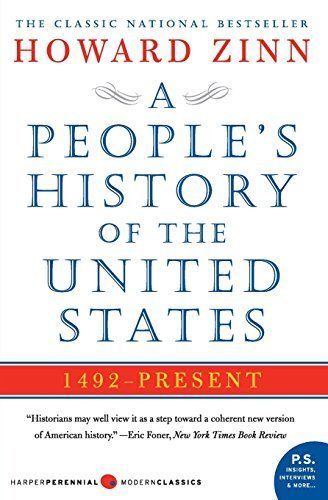
In the book, Zinn presented a different side of history from the more traditional “fundamental nationalist glorification of country”. Zinn portrays a side of American history that can largely be seen as the exploitation and manipulation of the majority by rigged systems that hugely favor a small aggregate of elite rulers from across the orthodox political parties. A People’s History has been assigned as reading in many high schools and colleges across the United States. It has also resulted in a change in the focus of historical work, which now includes stories that previously were ignored
Library Journal calls Howard Zinn’s book “a brilliant and moving history of the American people from the point of view of those…whose plight has been largely omitted from most histories.”
Poet and contributor to The Atlantic Clint Smith’s revealing, contemporary portrait of America as a slave owning nation
Beginning in his own hometown of New Orleans, Clint Smith leads the reader through an unforgettable tour of monuments and landmarks-those that are honest about the past and those that are not-that offer an intergenerational story of how slavery has been central in shaping our nation's collective history, and ourselves.
It is the story of the Monticello Plantation in Virginia, the estate where Thomas Jefferson wrote letters espousing the urgent need for liberty while enslaving over 400 people on the premises. It is the story of the Whitney Plantation, one of the only former plantations devoted to preserving the experience of the enslaved people whose lives and work sustained it. It is the story of Angola Prison in Louisiana, a former plantation named for the country from which most of its enslaved people arrived and which has since become one of the most gruesome maximum-security prisons in the world. And it is the story of Blandford Cemetery, the final resting place of tens of thousands of Confederate soldiers.
In a deeply researched and transporting exploration of the legacy of slavery and its imprint on centuries of American history, How the Word Is Passed illustrates how some of our country's most essential stories are hidden in plain view-whether in places we might drive by on our way to work, holidays such as Juneteenth, or entire neighborhoods—like downtown Manhattan—on which the brutal history of the trade in enslaved men, women and children has been deeply imprinted.
Informed by scholarship and brought alive by the story of people living today, Clint Smith’s debut work of nonfiction is a landmark work of reflection and insight that offers a new understanding of the hopeful role that memory and history can play in understanding our country.
The Pulitzer Prize–winning, bestselling author of The Warmth of Other Suns examines the unspoken caste system that has shaped America and shows how our lives today are still defined by a hierarchy of human divisions.
“As we go about our daily lives, caste is the wordless usher in a darkened theater, flashlight cast down in the aisles, guiding us to our assigned seats for a performance. The hierarchy of caste is not about feelings or morality. It is about power—which groups have it and which do not.”
In this brilliant book, Isabel Wilkerson gives us a masterful portrait of an unseen phenomenon in America as she explores, through an immersive, deeply researched narrative and stories about real people, how America today and throughout its history has been shaped by a hidden caste system, a rigid hierarchy of human rankings.
Beyond race, class, or other factors, there is a powerful caste system that influences people’s lives and behavior and the nation’s fate. Linking the caste systems of America, India, and Nazi Germany, Wilkerson explores eight pillars that underlie caste systems across civilizations, including divine will, bloodlines, stigma, and more. Using riveting stories about people—including Martin Luther King, Jr., baseball’s Satchel Paige, a single father and his toddler son, Wilkerson herself, and many others—she shows the ways that the insidious undertow of caste is experienced every day. She documents how the Nazis studied the racial systems in America to plan their out-cast of the Jews; she discusses why the cruel logic of caste requires that there be a bottom rung for those in the middle to measure themselves against; she writes about the surprising health costs of caste, in depression and life expectancy, and the effects of this hierarchy on our culture and politics. Finally, she points forward to ways America can move beyond the artificial and destructive separations of human divisions, toward hope in our common humanity.
An epoch-defining history of African America, the first to appear in a generation, Four Hundred Souls is a chronological account of four hundred years of Black America as told by ninety of America's leading Black writers.
Curated by Ibram X. Kendi, author of the number one bestseller How To Be an Antiracist, and fellow historian Keisha N. Blain, Four Hundred Souls begins with the arrival of twenty enslaved Ndongo people on the shores of the British colony in mainland America in 1619, the year before the arrival of the Mayflower.
In eighty chronological chapters, the book charts the tragic and triumphant four-hundred-year history of Black American experience in a choral work of exceptional power and beauty.
Contributors include some of the best-known scholars, writers, historians, journalists, lawyers, poets and activists of contemporary America who together bring to vivid life countless new facets to the drama of slavery and resistance, segregation and survival, migration and self-discovery, cultural oppression and world-changing artistic, literary and musical creativity. In these pages are dozens of extraordinary lives and personalities, rescued from the archives and restored to their rightful place in America's narrative, as well as the ghosts of millions more.
Four Hundred Souls is an essential work of story-telling and reclamation that redefines America and changes our notion of how history is written.
This extraordinary and historic book required twenty years to research and write. The oft-challenged findings of the Warren Commission Lee Harvey Oswald, acting alone, shot and killed President John F. Kennedy are here confirmed beyond all doubt. But "Reclaiming History" does much more than that. In addition to providing a powerful and unprecedented narrative of events and a biography of the assassin, it confronts and destroys every one of the conspiracy theories that have grown up since the assassination, exposing their selective use of evidence, flawed logic, and outright deceptions. So thoroughly documented, so compellingly lucid in its conclusions, "Reclaiming History" is, in a sense, the investigation that completes the work of the Warren Commission. In it, Vincent Bugliosi, the nation's foremost prosecutor, takes on the most important murder in American history. At 1:00 p.m. on November 22, 1963, President John F. Kennedy was pronounced dead, the victim of a sniper attack during his motorcade through Dallas. That may be the only fact generally agreed upon in the vast literature spawned by the assassination. National polls reveal that an overwhelming majority of Americans (75%) believe that there was a high-level conspiracy behind Lee Harvey Oswald. Many even believe that Oswald was entirely innocent. In this continuously absorbing, powerful, ground-breaking book, Vincent Bugliosi shows how we have come to believe such lies about an event that changed the course of history. The brilliant prosecutor of Charles Manson and the man who forged an iron-clad case of circumstantial guilt around O. J. Simpson in his best-selling "Outrage "Bugliosi is perhaps the only man in America capable of writing the definitive book on the Kennedy assassination. This is an achievement that has for years seemed beyond reach. No one imagined that such a book would ever be written: a single volume that once and for all resolves, beyond any reasonable doubt, every lingering question as to what happened in Dallas and who was responsible. There have been hundreds of books about the assassination, but there has never been a book that covers "the entire case," including addressing each and every conspiracy theory and the facts, or alleged facts, on which they are based. In this monumental work, the author has raised scholarship on the assassination to a new and final level, one that far surpasses all other books on the subject. It adds resonance, depth, and closure to the admirable work of the Warren Commission. "Reclaiming History" is a narrative compendium of fact, forensic evidence, reexamination of key witnesses, and common sense. Every detail and nuance is accounted for, every conspiracy theory revealed as a fraud on the American public. Bugliosi's irresistible logic, command of the evidence, and ability to draw startling inferences shed fresh light on this American nightmare. At last it all makes sense.
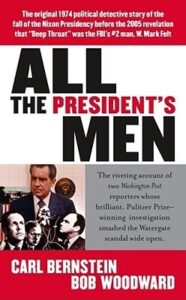
The full account of the Watergate scandal from the two Washington Post reporters who broke the story. This is “the work that brought down a presidency— perhaps the most influential piece of journalism in history” (Time, All-Time 100 Best Nonfiction Books).
This is the book that changed America. Published just two months before President Nixon’s resignation, All the President’s Men revealed the full scope of the Watergate scandal and introduced for the first time the mysterious “Deep Throat.” Beginning with the story of a simple burglary at Democratic headquarters and then continuing through headline after headline, Bernstein and Woodward deliver the stunning revelations and pieces in the Watergate puzzle that brought about Nixon’s shocking downfall. Their explosive reports won a Pulitzer Prize for The Washington Post, toppled the president, and have since inspired generations of reporters.
All the President’s Men is a riveting detective story, capturing the exhilarating rush of the biggest presidential scandal in U.S. history as it unfolded in real time. It is, as former New York Times managing editor Gene Roberts has called it, “maybe the single greatest reporting effort of all time.”
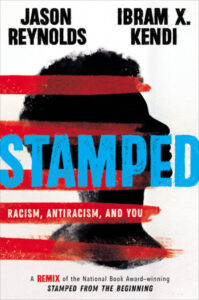
A remix of the National Book Award-winning Stamped from the Beginning for ages 12 and up.
A timely, crucial, and empowering exploration of racism--and antiracism--in America.
This is NOT a history book. This is a book about the here and now. A book to help us better understand why we are where we are. A book about race.
The construct of race has always been used to gain and keep power, to create dynamics that separate and silence. This is a remarkable reimagining of Dr. Ibram X. Kendi's Stamped from the Beginning, winner of a National Book Award. It reveals the history of racist ideas in America and inspires hope for an antiracist future.
Stamped takes you on a race journey from then to now, shows you why we feel how we feel, and why the poison of racism lingers. It also proves that while racist ideas have always been easy to fabricate and distribute, they can also be discredited.
Through a gripping, fast-paced, and energizing narrative, Jason Reynolds shines a light on the many insidious forms of racist ideas--and on ways readers can identify and stamp out racist thoughts in their daily lives.
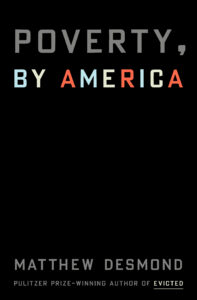
Reimagining the debate on poverty, making a new and bracing argument about why it persists in America: because the rest of us benefit from it.
The United States, the richest country on earth, has more poverty than any other advanced democracy. Why? Why does this land of plenty allow one in every eight of its children to go without basic necessities, permit scores of its citizens to live and die on the streets, and authorize its corporations to pay poverty wages?
In this landmark book, acclaimed sociologist Matthew Desmond draws on history, research, and original reporting to show how affluent Americans knowingly and unknowingly keep poor people poor. Those of us who are financially secure exploit the poor, driving down their wages while forcing them to overpay for housing and access to cash and credit. We prioritize the subsidization of our wealth over the alleviation of poverty, designing a welfare state that gives the most to those who need the least. And we stockpile opportunity in exclusive communities, creating zones of concentrated riches alongside those of concentrated despair. Some lives are made small so that others may grow.
Elegantly written and fiercely argued, this compassionate book gives us new ways of thinking about a morally urgent problem. It also helps us imagine solutions. Desmond builds a startlingly original and ambitious case for ending poverty. He calls on us all to become poverty abolitionists, engaged in a politics of collective belonging to usher in a new age of shared prosperity and, at last, true freedom.
Reveals the alt-right’s project to claim science fiction and—by extension—the future
Fascists such as Richard Spencer interpret science fiction films and literature as saying only white men have the imagination required to invent a high-tech future. Other white nationalists envision racist utopias filled with Aryan supermen and all-white space colonies. Speculative Whiteness traces these ideas through the entangled histories of science fiction culture and white supremacist politics, showing that debates about representation in science fiction films and literature are struggles over who has the right to imagine and inhabit the future. Although fascists insist that tomorrow belongs to them, they have always been and will continue to be contested by antifascist fans willing to fight for the future.
Welcome Back!
Track your reading progress and sync your library.