The master of a Victorian mansion dies suddenly – and his sister is convinced it was murder…. When Cora is savagely murdered with a hatchet, the extraordinary remark she made the previous day at her brother Richard’s funeral suddenly takes on a chilling significance. At the reading of Richard’s will, Cora was clearly heard to say: ‘It’s been hushed up very nicely, hasn’t it…But he was murdered, wasn’t he?’ In desperation, the family solicitor turns to Hercule Poirot to unravel the mystery.
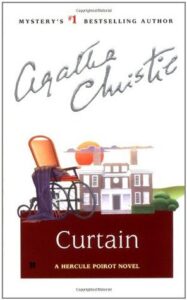
Arthritic and immobilized, Poirot calls on his old friend Captain Hastings to join him at Styles to be the eyes and ears that will feed observations to Poirot's still razor sharp mind. Though aware of the criminal's identity, Poirot will not reveal it to the frustrated Hastings, and dubs the nameless personage 'X'. Already responsible for several murders, X, Poirot warns, is ready to strike again, and the partners must work swiftly to prevent imminent murder.
Poirot’s final case, a mystery which brings him and Hastings back to Styles where they first solved a crime together. The story was both anticipated and dreaded by Agatha Christie fans worldwide, many of whom still refuse to read it, as it is known to contain Poirot’s death.
Agatha Christie wrote it during World War II, as a gift for her daughter should she not survive the bombings, and it was kept in a safe for over thirty years. It was agreed among the family that Curtain would be published finally in 1975 by Collins, her long-standing publishers, and that Sleeping Murder (the Marple story written during the war for her husband, Max) would follow.
The reception of Poirot’s death was international, even earning him an obituary in The New York Times; he is still the only fictional character to have received such an honour. The first actor to take on the role of portraying Poirot in his final hours was David Suchet, as the final episode of the series Agatha Christie’s Poirot for which he’d been playing the role for twenty-five years. The episode was adapted in 2013.
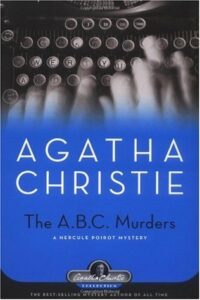
When Alice Asher is murdered in Andover, Hercule Poirot is already looking into the clues. Alphabetically speaking, it's one letter down, twenty-five to go.
There's a serial killer on the loose. His macabre calling card is to leave the ABC Railway Guide beside each victim's body. But if A is for Alice Asher, bludgeoned to death in Andover, and B is for Betty Bernard, strangled with her belt on the beach at Bexhill, who will then be Victim C? More importantly, why is this happening?
Often considered to be one of Agatha Christie's best.
Librarian's note: the first fifteen novels in the Hercule Poirot series are 1) The Mysterious Affair at Styles, 1920; 2) The Murder on the Links, 1923; 3) The Murder of Roger Ackroyd, 1926; 4) The Big Four, 1927; 5) The Mystery of the Blue Train, 1928; 6) Peril at End House, 1932; 7) Lord Edgware Dies, 1933; 8) Murder on the Orient Express, 1934; 9) Three Act Tragedy, 1935; 10) Death in the Clouds, 1935; 11) The A.B.C. Murders, 1936; 12) Murder in Mesopotamia, 1936; 13) Cards on the Table, 1936; 14) Dumb Witness, 1937; and 15) Death on the Nile, 1937. These are just the novels; Poirot also appears in this period in a play, Black Coffee, 1930, and two collections of short stories, Poirot Investigates, 1924, and Murder in the Mews, 1937. Each novel, play and short story has its own entry on Goodreads.
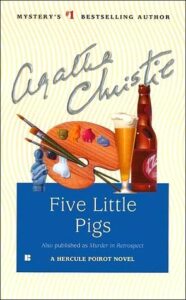
It was an open and shut case. All the evidence said Caroline Crale poisoned her philandering husband, a brilliant painter. She was quickly and easily convicted and sentenced to life in prison. Now, sixteen years later, in a posthumous letter, Mrs. Crale has assured her grown daughter that she was innocent. But instead of setting the young woman's mind at ease, the letter only raises disquieting questions. Did Caroline indeed write the truth? And if she didn't kill her husband, who did?
To find out, the Crale’s daughter asks Hercule Poirot to reopen the case. His investigation takes him deep into the conflicting memories and motivations of the five other people who were with the Crales on the fatal day. With his keen understanding of human psychology, he manages to discover the surprising truth behind the artist's death.
Our first meeting with Sherlock Holmes. And it's John Watson's too! They meet at the start of this novel, and the young doctor is astonished by Holmes' many idiosyncrasies including his talents on the violin.
But it's not long before Sherlock Holmes, with Watson in tow, is working with Scotland Yard investigating the murder of two Americans whose deaths have some mysterious connection to sinister groups gathering power in both Britain and America.
Here's where it all began - 'A Study in Scarlet.' Meet Sherlock Holmes, one of the world's leading consulting detectives - fictional of course!
Three young women share a London flat. The first is a coolly efficient secretary. The second is an artist. The third interrupts Hercule Poirot’s breakfast confessing that she is a murderer—and then promptly disappears. Slowly, Poirot learns of the rumors surrounding the mysterious third girl, her family, and her disappearance. Yet hard evidence is needed before the great detective can pronounce her guilty, innocent, or insane.
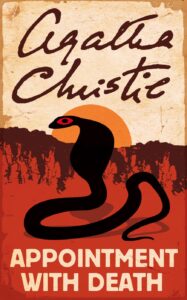
Among the towering red cliffs of Petra, like some monstrous swollen Buddha, sat the corpse of Mrs Boynton. A tiny puncture mark on her wrist was the only sign of the fatal injection that had killed her.
With only 24 hours available to solve the mystery, Hercule Poirot recalled a chance remark he’d overheard back in Jerusalem: ‘You see, don’t you, that she’s got to be killed?’ Mrs Boynton was, indeed, the most detestable woman he’d ever met.
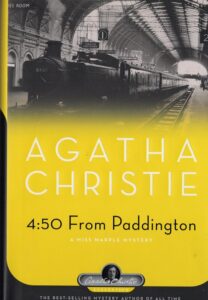
For an instant the two trains ran together, going in the same direction side by side. In that frozen moment, Elspeth, riding in the one train, witnessed a murder in the other. Helplessly, she stared out her carriage window as a man remorselessly tightened his grip around a woman’s throat. The body crumpled. Then the other train drew away.
Who, apart from Miss Marple, would take her story seriously? After all, there were no suspects, no other witnesses... and no corpse. Not the police.
Librarian's note: this entry is for the novel, "4:50 from Paddington." Collections and other Miss Marple stories are located elsewhere on Goodreads. The series includes 12 novels and 20 short stories. Entries for the short stories can be found by searching Goodreads for: "a Miss Marple Short Story."
First, there were ten—a curious assortment of strangers summoned as weekend guests to a little private island off the coast of Devon. Their host, an eccentric millionaire unknown to all of them, is nowhere to be found. All that the guests have in common is a wicked past they're unwilling to reveal—and a secret that will seal their fate. For each has been marked for murder. A famous nursery rhyme is framed and hung in every room of the mansion:
"Ten little boys went out to dine; One choked his little self and then there were nine. Nine little boys sat up very late; One overslept himself and then there were eight. Eight little boys traveling in Devon; One said he'd stay there then there were seven. Seven little boys chopping up sticks; One chopped himself in half and then there were six. Six little boys playing with a hive; A bumblebee stung one and then there were five. Five little boys going in for law; One got in Chancery and then there were four. Four little boys going out to sea; A red herring swallowed one and then there were three. Three little boys walking in the zoo; A big bear hugged one and then there were two. Two little boys sitting in the sun; One got frizzled up and then there was one. One little boy left all alone; He went out and hanged himself and then there were none."
When they realize that murders are occurring as described in the rhyme, terror mounts. One by one they fall prey. Before the weekend is out, there will be none. Who has choreographed this dastardly scheme? And who will be left to tell the tale? Only the dead are above suspicion.
Welcome Back!
Track your reading progress and sync your library.