
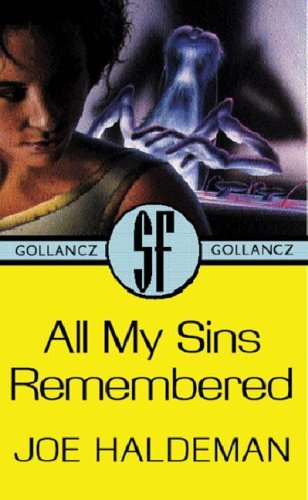
Otto McGavin is peaceful and idealistic by nature, an Anglo-Buddhist, who seeks employment with the Confederacion because he believes in it and its mission to protect the rights of humans and nonhumans. The only problem is that the Confederacion needs him as a Prime Operator for its secret service, the TBII, and the TBII wants Otto as a spy, a thief and an assassin. It’s not, of course, a problem for the Confederacion, which simply uses immersion therapy and hypnosis for Otto’s training, and then sends him out in deep cover on a variety of dangerous missions on a number of bizarre worlds. But for Otto, it’s a different what he has to witness and what he is forced to do take a terrible toll on him …
Murderbot—the sardonic, almost-homicidal, media-loving android created by Martha Wells—has proven to be one of the most popular characters in 21 st century science fiction. Everything that makes this protagonist (it would be wrong to call Murderbot a hero) beloved of fans is on display in Compulsory.
While trying to watch episode 44 of The Rise and Fall of Sanctuary Moon, Murderbot is—again, what is it with humans?—distracted by something that is technically outside its purview. A miner is suddenly in danger following a pointless (to Murderbot’s way of thinking) argument, and the choice is to risk discovery and leap into action, which would require hitting the pause button during a very exciting part of SanctuaryMoon, or to follow orders and stay still.
This is a tougher choice than it seems. But then, when has Murderbot ever been faced with an easy choice?
A shorter version of this story originally appeared in Wired magazine.
The 21st century was drawing to a close, and metapsychic humankind was poised at last to achieve Unity to be admitted into the group mind of the already unified alien races of the Galactic Milieu. But a growing corps of rebels was plotting to keep the people of Earth forever separate in the name of human individuality. And the rebels had a secret supporter: Fury, the insane metapsychic creatrue that would stop at nothing to claim humanity for itself. Fury's greatest enemy was the mutant genius Jack the Bodiless, whose power it craved. But Jack would never be a tool for Fury . . . And so it turned to Dorothea Macdonald, a young woman who had spent a lifetime hiding her towering mindpowers from the best mind readers of the Milieu. But she could not hide them from Fury or from Jack. Time and again she rejected their advances, unwilling to be drawn into the maelstrom of galactic politics or megalomaniacal dreams. And in the end, no one not Jack, not Fury, not even the Galactic Milieu would be a match for the awesome powers of the girl who would come to be called Diamond Mask . . .
In the year 2051, Earth stood on the brink of acceptance as full member of the Galactic Milieu, a confederation of worlds spread across the galaxy. Leading humanity was the powerful Remillard family, but somebody--or something--known only as "Fury" wanted them out of the way. Only Rogi Remillard, the chosen tool of the most powerful alien being in the Milieu, and his nephew Marc, the greatest metapsychic yet born on Earth, knew about Fury. But even they were powerless to stop it when it began to kill off Remillards and other metapsychic operants--and all the suspects were Remillards themselves. Meanwhile, a Remillard son was born, a boy who could represent the future of all humanity. His incredible mind was more powerful even than his brother Marc's--but he was destined to be desroyed by his own DNA...unless Fury got to him first!
"FASCINATING . . . May has cemented her position as one of this generation's foremost storytellers. . . .This satisfying end to a remarkable feat of the imagination is a necessary purchase." --Library Journal
By the mid-twenty-first century, humanity is beginning to enjoy membership in the Galactic Milieu. Human colonies are thriving on numerous planets, life on Earth is peaceful and prosperous, and as more humans are being born with metapsychic abilities, it will not be long before these gifted minds at last achieve total Unity.
But xenophobia is deeply rooted in the human soul. A growing corps of rebels plots to keep the people of Earth forever separate, led by a man obsessed with human Marc Remillard. Marc's goal is nothing less than the elevation of human metapsychics above all others, by way of artificial enhancement of mental faculties. His methods are unpalatable, his goal horrific. And so Marc and his coconspirators continue their work in secret.
Only the very Unity he fears and abhors can foil Marc's plans. And only his brother, Jack the Bodiless, and the young woman called Diamond Mask can hope to lead the metaconcert to destroy Marc, Unify humanity, and pave the way for the Golden Age of the Galactic Milieu to begin . . .
In 1941, Astounding Science Fiction magazine published a short story by a little-known writer named Isaac Asimov. The story was called "Nightfall", and many years later it has long been recognized as a classic, its author a legend. Now, the Grand Master of Science Fiction teams with Robert Silverberg, one of the field's top award-winning authors, to explore and expand an apocalyptic tale that is more spellbinding today than ever before -- Nightfall: The Novel.
Imagine living on a planet with six suns that never experiences darkness. Imagine never having seen the stars. Then, one by one the suns start to set, gradually leading into darkness for the first time ever. Kalgash is a world on the edge of chaos, torn between the madness of religious fanaticism and the unyielding rationalism of scientists. Lurking beneath it all is a collective, instinctual fear of the Darkness. For Kalgash knows only the perpetual light of day; to its inhabitants, a gathering twilight portends unspeakable horror. And only a handful of people on the planet are prepared to face the truth, their six suns are setting all at once for the first time in over two thousand years, signaling the end of civilization as it explodes in the awesome splendor of Nightfall.
Encompassing the psychology of disaster, the tenacity of the human spirit, and, ultimately, the regenerative power of hope, Nightfall is a tale rich in character and suspense that only the unique collaboration of Isaac Asimov and Robert Silverberg could create.
Wizardry, transforming its master into a cloud of fine mist...cloning, duplicating the ideal man ten times over...Utopia, in a city where almost everyone is perfectly happy...
Ursula Le Guin, author of The Earthsea Trilogy, has a special way of blending stirring adventure with fantasy that has made comparison with such masters as C.S. Lewis and J.R.R. Tolkien inevitable.
Now, in The Wind's Twelve Quarters, seventeen of her favorite stories reaffirm Ursula Le Guin as one of America's outstanding writers.
CONTENTS:
Foreword Semley's Necklace April in Paris The Masters Darkness Box The Word of Unbinding The Rule of Names Winter's King The Good Trip Nine Lives Things A Trip to the Head Vaster than Empires and More Slow The Stars Below The Field of Vision Direction of the Road The Ones Who Walk Away from Omelas The Day Before the Revolution
Intervention sets the scene for Julian May's new trlogy of the Galactic Milieu. This has been split into two books: The Surveillance (containing Prologue, The Surveillance, and The Disclosure) and The Metaconcert, containing The Intervention and Epilogue.
For 60 000 years the five races of the Galactic Milieu have watched and waited for the time when human mental development on Earth is ready for the Intervention ...
As the twentieth century draws to its end, phenomenal mental powers are displayed by 'operants' all across our planet... They can 'farspeak' one another telepathically. They can build mental shields and they are capable of coercion by power of mind.
One of there is Rogatien Remillard, a dealer in secondhand books, whose memories - written a century on - form the core of this chronicle. They tell of a world where the mind has become a weapon; and of two brothers, each possessed of extraordinary powers - one a peace-bringer, the other an advocate of evil...
The recipient of numerous literary prizes, including the National Book Award, the Kafka Award, and the Pushcart Prize, Ursula K. Le Guin is renowned for her lyrical writing, rich characters, and diverse worlds. The Wind's Twelve Quarters collects seventeen powerful stories, each with an introduction by the author, ranging from fantasy to intriguing scientific concepts, from medieval settings to the future.
Including an insightful foreword by Le Guin, describing her experience, her inspirations, and her approach to writing, this stunning collection explores human values, relationships, and survival, and showcases the myriad talents of one of the most provocative writers of our time.
Welcome Back!
Track your reading progress and sync your library.