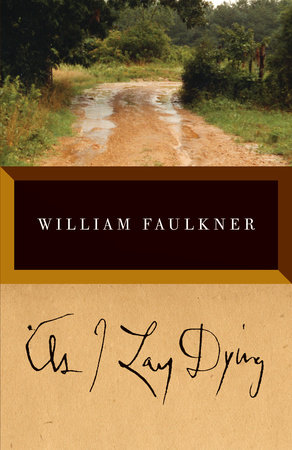
As I Lay Dying is Faulkner’s harrowing account of the Bundren family’s odyssey across the Mississippi countryside to bury Addie, their wife and mother. Narrated in turn by each of the family members — including Addie herself — as well as others; the novel ranges in mood, from dark comedy to the deepest pathos. Considered one of the most influential novels in American fiction in structure, style, and drama, As I Lay Dying is a true 20th-century classic.
This edition reproduces the corrected text of As I Lay Dying as established in 1985 by Noel Polk.
This compelling novel has as its protagonist Cornelius Suttree, living alone and in exile in a disintegrating houseboat on the wrong side of the Tennessee River close by Knoxville. He stays at the edge of an outcast community inhabited by eccentrics, criminals and the poverty-stricken. Rising above the physical and human squalor around him, his detachment and wry humour enable him to survive dereliction and destitution with dignity.
Librarian's note: An alternate cover edition can be found here
This short novel, already a modern classic, is the superbly told, tragic story of a Cuban fisherman in the Gulf Stream and the giant Marlin he kills and loses—specifically referred to in the citation accompanying the author's Nobel Prize for literature in 1954.
Like his father and grandfather before him, Kino is a poor diver, gathering pearls from the gulf beds that once brought great wealth to the kings of Spain and now provide Kino, Juana, and their infant son with meager subsistence. Then, on a day like any other, Kino emerges from the sea with a pearl as large as a sea gull’s egg, as “perfect as the moon.” With the pearl comes hope, the promise of comfort and of security…
A story of classic simplicity, based on a Mexican folk tale, The Pearl explores the secrets of man’s nature, greed, the darkest depths of evil, and the luminous possibilities of love.
Published in 1936, Absalom, Absalom! is considered by many to be William Faulkner's masterpiece. Although the novel's complex and fragmented structure poses considerable difficulty to readers, the book's literary merits place it squarely in the ranks of America's finest novels. The story concerns Thomas Sutpen, a poor man who finds wealth and then marries into a respectable family. His ambition and extreme need for control bring about his ruin and the ruin of his family. Sutpen's story is told by several narrators, allowing the reader to observe variations in the saga as it is recounted by different speakers. This unusual technique spotlights one of the novel's central questions: To what extent can people know the truth about the past?
The Hamlet, the first novel of Faulkner's Snopes trilogy, is both an ironic take on classical tragedy and a mordant commentary on the grand pretensions of the antebellum South and the depths of its decay in the aftermath of war and Reconstruction. It tells of the advent and the rise of the Snopes family in Frenchman's Bend, a small town built on the ruins of a once-stately plantation. Flem Snopes -- wily, energetic, a man of shady origins -- quickly comes to dominate the town and its people with his cunning and guile.
Dive deep into The Love Song of J. Alfred Prufrock by T.S. Eliot anywhere you on a plane, on a mountain, in a canoe, under a tree. Or grab a flashlight and read Shmoop under the covers. Shmoop's award-winning Poetry Guides are now available on your Nook. Shmoop eBooks are like having a trusted, fun, chatty, expert poetry-tour-guide always by your side, no matter where you are (or how late it is at night).
This Shmoop Poetry Guide offers fresh analysis, a line-by-line close reading of the poem, examination of the poet's technique, form, meter, rhyme, symbolism, jaw-dropping trivia, a glossary of poetry terms, and more. Best of all, Shmoop's analysis aims to look at a topic from multiple points of view to give you the fullest understanding.
Experts and educators from top universities, including Stanford, UC Berkeley, and Harvard, have written Shmoop guides designed to engage you and to get your brain bubbling. Shmoop is here to make you a better lover (of poetry) and to help you make connections to other poems, works of literature, current events, and pop culture. For more information, check out shmoop.com/poetry
"Smart and consistently humorous." - The Academy of American Poets
The Waste Land, first published in 1922, is often regarded as T.S. Eliot's masterpiece, as well as one of the most important poems of the 20th century and a central work of modernist poetry.
The work, divided in 5 sections, juxtaposes the legend of the Holy Grail and the Fisher King, with a snapshot of early twentieth-century British society. In contemporary times, it is often read published within The Waste Land and Other Poems and has come to be Eliot's most popular poem.
T.S. Elliot was a poet, essayist, publisher, playwright, literary critic and editor. Born in 1888 in St. Louis (MO, USA), he is considered one of the 20th century's major poets, and a central figure in English-language Modernist poetry."In ten years' time," wrote Edmund Wilson in Axel's Castle (1931), "Elliot has left upon English poetry a mark more unmistakable than that of any other poet writing in English." In 1948, Eliot was awarded the Nobel Price "for his work as a trail-blazing pioneer of modern poetry."
Through Jim Burden's endearing, smitten voice, we revisit the remarkable vicissitudes of immigrant life in the Nebraska heartland, with all its insistent bonds. Guiding the way are some of literature's most beguiling characters: the Russian brothers plagued by memories of a fateful sleigh ride, Antonia's desperately homesick father and self-indulgent mother, and the coy Lena Lingard. Holding the pastoral society's heart, of course, is the bewitching, free-spirited Antonia.
Welcome Back!
Track your reading progress and sync your library.