
As the Last I May Know
An alternate history short story looking at decisions and consequences, and what it takes to pull the trigger.
At the Publisher’s request, this title is being sold without Digital Rights Management Software (DRM) applied.
An alternate history short story looking at decisions and consequences, and what it takes to pull the trigger.
At the Publisher’s request, this title is being sold without Digital Rights Management Software (DRM) applied.
Harlan Ellison is probably best known as a script writer for sci-fi and fantasy movies and TV series such as the original Outer Limits, The Hunger, Logan's Run, and Babylon Five. But his range is much broader than that, encompassing stories, novels, essays, reviews, reminiscences, plays, even fake autobiographies. The Essential Ellison, a special limited edition personally signed and numbered by Ellison, contains 74 unabridged works, including such classics as "A Boy and His Dog," "Xenogenesis," and "Mefisto in Onyx."
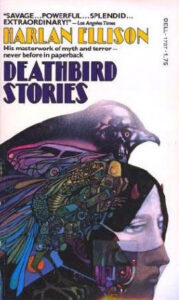
Harlan Ellison's masterwork of myth and terror as he seduces all innocence on a mind-freezing odyssey into the darkest reaches of mortal terror and the most dazzling heights of Olympian hell in his finest collection.
Deathbird Stories is a collection of 19 of Harlan Ellison's best stories, including Edgar and Hugo winners, originally published between 1960 and 1974. The collection contains some of Ellison's best stories from earlier collections and is judged by some to be his most consistently high quality collection of short fiction. The theme of the collection can be loosely defined as God, or Gods. Sometimes they're dead or dying, some of them are as brand-new as today's technology. Unlike some of Ellison's collections, the introductory notes to each story can be as short as a phrase and rarely run more than a sentence or two. One story took a Locus Poll Award, the two final ones both garnered Hugo Awards and Locus Poll awards, and the final one also received a Jupiter Award from the Instructors of Science Fiction in Higher Education (discontinued in 1979). When the collection was published in Britain, it won the 1979 British Science Fiction Award for Short Fiction.
"His stories will rivet you to the floor and change your heartbeat...as unforgettable a chamber of horror, fantasy and reality as you'll ever experience." -Gallery
"Brutally and flamboyantly shocking, frequently brilliant, and always irresistibly mesmerizing." -Richmond Times-Dispatch
Contents:
· Introduction: Oblations at Alien Altars
· The Whimper of Whipped Dogs · ss Bad Moon Rising, ed. Thomas M. Disch, Harper&Row, 1973
· Along the Scenic Route [“Dogfight on 101”] · ss Adam Aug’69; Amazing Sep’69
· On the Downhill Side · ss Universe 2, ed. Terry Carr, Ace, 1972
· O Ye of Little Faith · ss Knight Sep’68
· Neon · ss The Haunt of Horror Aug’73
· Basilisk · ss F&SF Aug’72
· Pretty Maggie Moneyeyes · nv Knight May’67
· Corpse · ss F&SF Jan’72
· Shattered Like a Glass Goblin · ss Orbit 4, ed. Damon Knight, G.P. Putnam’s, 1968
· Delusion for a Dragon Slayer · ss Knight Sep’66
· The Face of Helene Bournouw · ss Collage Oct’60
· Bleeding Stones · ss Vertex Apr’73
· At the Mouse Circus · ss New Dimensions I, ed. Robert Silverberg, Doubleday, 1971
· The Place with No Name · ss F&SF Jul’69
· Paingod · ss Fantastic Jun’64
· Ernest and the Machine God · nv Knight Jan’68
· Rock God · ss Coven 13 Nov’69
· Adrift Just Off the Islets of Langerhans: Latitude 38°54’N, Longitude 77°00’13"W · nv F&SF Oct’74
· The Deathbird · nv F&SF Mar’73
All you need to know about this book:
1- It is the companion volume to the most influential book of speculative fiction in the past twenty-five years, the award-winning "Dangerous Visions". Of course, you've heard of "Dangerous Visions".
2- It contains original stories, written especially for this anthology, by forty-two very special writers, none of whom were in "Dangerous Visions". Of course, you remember the writers who won all those awards for "Dangerous Visions".
3- It contains forty-six stories ranging in length from shorties of 1,000 words to short novels of 40,000 words; each story was written without thought to taboos or publishing restrictions that usually hamper sci-fi writers. Of course, you remember what a mind-blower, in this respect, was "Dangerous Visions".
4- Each story has its own Afterword by the author, as well as its own individual Introduction by the editor. Of course, you remember the wealth of addenda that made such a milestone of "Dangerous Visions".
5, 6, & 7- It took over three years to compile this book. It has been edited by Harlan Ellison who put together "Dangerous Visions", which you will surely recall. And... this is a more startling book than "Dangerous Visions". This book takes off where "Dangerous Visions" stopped and it is a BETTER book than "Dangerous Visions".
From the moment John Varley burst onto the scene in 1974, his short fiction was like nothing anyone else was writing. His stories won every award the science fiction field had to offer, many times over. His first collection, The Persistence of Vision, published in 1978, was the most important collection of the decade, and changed what fans would come to expect from science fiction.
Now, The John Varley Reader gathers his best stories, many out of print for years. This is the volume no Varley fan - or science fiction reader - can do without.
1 • Picnic on Nearside • [Eight Worlds] • (1974) • novelette by John Varley
24 • Overdrawn at the Memory Bank • [Eight Worlds] • (1976) • novelette by John Varley
53 • In the Hall of the Martian Kings • (1976) • novella by John Varley
91 • Gotta Sing, Gotta Dance • [Eight Worlds] • (1976) • novelette by John Varley
119 • The Barbie Murders • [Anna-Louise Bach] • (1978) • novelette by John Varley
146 • The Phantom of Kansas • [Eight Worlds] • (1976) • novelette by John Varley
180 • Beatnik Bayou • [Eight Worlds] • (1980) • novelette by John Varley
212 • Air Raid • (1977) • shortstory by John Varley
228 • The Persistence of Vision • (1978) • novella by John Varley
271 • Press Enter [] • (1984) • novella by John Varley
327 • The Pusher • (1981) • shortstory by John Varley
343 • Tango Charlie and Foxtrot Romeo • [Eight Worlds] • (1986) • novella by John Varley
409 • Options • [Eight Worlds] • (1979) • novelette by John Varley
437 • Just Another Perfect Day • (1989) • shortstory by John Varley
449 • In Fading Suns and Dying Moons • (2003) • novelette by John Varley
467 • The Flying Dutchman • (1998) • shortstory by John Varley
486 • Good Intentions • (1992) • shortstory by John Varley
502 • The Bellman • [Anna-Louise Bach] • (2003) • novelette by John Varley
Harlan Ellison is undoubtedly one of the most audacious, infuriating, brazen characters on the planet. Which may help explain why he is also one of the most brilliant, innovative, and eloquent writers on earth. Slippage simply presents recent, typical Ellison. In a word, masterful. The 21 stories in this 1997 collection, which is encased in black boxes, show Ellison at the height of his powers, with several of the stories (no surprise here) major award-winners. Highlights include a black mind reader who pays a visit to a white serial killer, a husband who falls prey to a vampiric personal computer, and a love affair between a young man and a woman who may be more undead than alive. Perhaps even more fascinating are the painfully candid snapshots of autobiography running throughout the volume. Even if Ellison's unsettling fictions are not enough to dazzle you, his often bizarre life experiences as an author will still keep you compulsively turning the page like a polite voyeur. --Stanley Wiater
Contents:
The Man Who Rowed Christopher Columbus Ashore (1992)
Anywhere but Here, with Anybody but You (1996)
Crazy as a Soup Sandwich (1989)
Darkness upon the Face of the Deep (1991)
The Pale Silver Dollar of the Moon Pays Its Way and Makes Change: Version 1 (1997)
The Pale Silver Dollar of the Moon Pays Its Way and Makes Change: Version 2 (1994)
The Lingering Scent of Woodsmoke (1996)
The Museum on Cyclops Avenue (1995)
Go toward the Light (1996)
Mefisto in Onyx (1993)
Where I Shall Dwell in the Next World (1992)
Chatting with Anubis (1995)
The Few, the Proud (1989)
The Deadly "Nackles" Affair (1987) essay
Nackles (1964)
Nackles (1987)
Sensible City (1994)
The Dragon on the Bookshelf (1995) with Robert Silverberg
Keyboard (1995)
Jane Doe #112 (1990)
The Dreams a Nightmare Dreams (1997)
Pulling Hard Time (1995)
Scartaris, June 28th (1990)
She's a Young Thing and Cannot Leave Her Mother (1988)
Midnight in the Sunken Cathedral (1995)
Dr. Cliff Miyashiro arrives in the Arctic Circle to continue his recently deceased daughter's research, only to discover a virus, newly unearthed from melting permafrost. The plague unleashed reshapes life on earth for generations. Yet even while struggling to counter this destructive force, humanity stubbornly persists in myriad moving and ever inventive ways.
Among those adjusting to this new normal are an aspiring comedian, employed by a theme park designed for terminally ill children, who falls in love with a mother trying desperately to keep her son alive; a scientist who, having failed to save his own son from the plague, gets a second chance at fatherhood when one of his test subjects-a pig-develops human speech; a man who, after recovering from his own coma, plans a block party for his neighbours who have also woken up to find that they alone have survived their families; and a widowed painter and her teenaged granddaughter who must set off on cosmic quest to locate a new home planet.
From funerary skyscrapers to hotels for the dead, How High We Go in the Dark follows a cast of intricately linked characters spanning hundreds of years as humanity endeavours to restore the delicate balance of the world. This is a story of unshakable hope that crosses literary lines to give us a world rebuilding itself through an endless capacity for love, resilience and reinvention. Wonderful and disquieting, dreamlike and all too possible.
The November/December 2022 issue of Hugo Award-winning Uncanny Magazine.
Featuring new fiction by Samantha Mills, Vivian Shaw, Matthew Olivas, Nina Kiriki Hoffman, Iori Kusano, Anya Ow, and Emily Y. Teng. Reprint fiction by Catherynne M. Valente. Essays by Izzy Wasserstein, Jennifer Marie Brissett, Alex Jennings, and Karen Heuler, poetry by Eshqin Ahmad, Ewen Ma, May Chong, Taiwo Hassan, and Ai Jiang, interviews with Vivian Shaw and Iori Kusano by Caroline M. Yoachim, a cover by Maxine Vee, and editorials by Lynne M. Thomas and Michael Damian Thomas, and Meg Elison.
In The Issue
FICTION
Rabbit Test by Samantha Mills
Transference by Vivian Shaw
To Walk the River of Stars by Emily Y. Teng
The Other Side of Mictlān by Matthew Olivas
A Fall Counts Anywhere by Catherynne M. Valente
can i offer you a nice egg in this trying time by Iori Kusano
Earth Dragon, Turning by Anya Ow
Travelers’ Unrest by Nina Kiriki Hoffman
POETRY
A Dead, Divine Thing by Eshqin Ahmad
Crossing by Ewen Ma
Sang Kancil at the Protest by May Chong
I Am a Little Hotel by Ai Jiang
A Testament of Bloom by Taiwo Hassan
EDITORIALS
The Uncanny Valley by Lynne M. Thomas & Michael Damian Thomas
The Horny Body Problem by Meg Elison
ESSAYS
The Necessity of Trans Joy by Izzy Wasserstein
Thank You, Patreon Supporters! by Lynne M. Thomas & Michael Damian Thomas
For Your Re-Consideration by Jennifer Marie Brissett
Across the Afterverse: A Conversation with Afropunk SF/F Author Alex Smith by Alex Jennings
What Do the Dying Know? by Karen Heuler
INTERVIEWS
Interview: Vivian Shaw by Caroline M. Yoachim
Interview: Iori Kusano by Caroline M. Yoachim
In 1941, Astounding Science Fiction magazine published a short story by a little-known writer named Isaac Asimov. The story was called "Nightfall", and many years later it has long been recognized as a classic, its author a legend. Now, the Grand Master of Science Fiction teams with Robert Silverberg, one of the field's top award-winning authors, to explore and expand an apocalyptic tale that is more spellbinding today than ever before -- Nightfall: The Novel.
Imagine living on a planet with six suns that never experiences darkness. Imagine never having seen the stars. Then, one by one the suns start to set, gradually leading into darkness for the first time ever. Kalgash is a world on the edge of chaos, torn between the madness of religious fanaticism and the unyielding rationalism of scientists. Lurking beneath it all is a collective, instinctual fear of the Darkness. For Kalgash knows only the perpetual light of day; to its inhabitants, a gathering twilight portends unspeakable horror. And only a handful of people on the planet are prepared to face the truth, their six suns are setting all at once for the first time in over two thousand years, signaling the end of civilization as it explodes in the awesome splendor of Nightfall.
Encompassing the psychology of disaster, the tenacity of the human spirit, and, ultimately, the regenerative power of hope, Nightfall is a tale rich in character and suspense that only the unique collaboration of Isaac Asimov and Robert Silverberg could create.