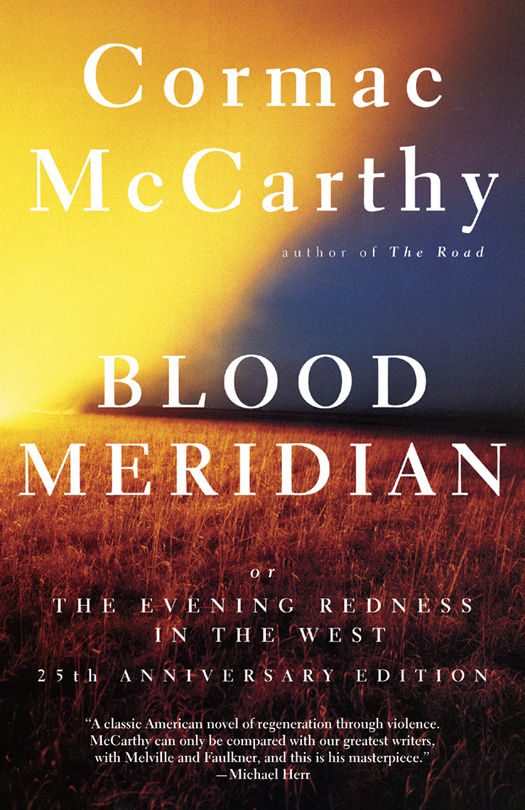
Blood Meridian is an epic novel of the violence and depravity that attended America’s westward expansion, brilliantly subverting the conventions of the Western novel and the mythology of the Wild West. Based on historical events that took place on the Texas-Mexico border in the 1850s, it traces the fortunes of the Kid, a fourteen-year-old Tennesseean who stumbles into a nightmarish world where Indians are being murdered and the market for their scalps is thriving.
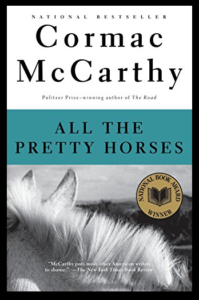
Teenager John Grady Cole, the last of a long line of Texas ranchers, has nothing left to stay for. Across the border Mexico beckons—beautiful and desolate, rugged and cruelly civilized. With neighbor Rawlins, and scruffy boy, he rides toward an idyllic, sometimes comic adventure, to a place where dreams are paid for in blood.
This is one of McMurtry's most memorable novels - the basis for the film of the same name. Set in a small, dusty Texas town, it introduces Jacy, Duane and Sonny, teenagers stumbling towards adulthood, discovering the beguiling mysteries of sex and the even more baffling mysteries of love.
This was no ordinary war. This was a war to make the world safe for democracy. And if democracy was made safe, then nothing else mattered - not the millions of dead bodies, nor the thousands of ruined lives...
This is no ordinary novel. This is a novel that never takes the easy way out: it is shocking, violent, terrifying, horrible, uncompromising, brutal, remorseless and gruesome... but so is war.
Alternate covers of this ISBN can be found here, here and here.
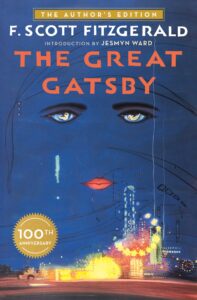
The only edition of the beloved classic that is authorized by Fitzgerald’s family and from his lifelong publisher.
This edition is the enduring original text, updated with the author’s own revisions, a foreword by his granddaughter, and with a new introduction by National Book Award winner Jesmyn Ward.
The Great Gatsby, F. Scott Fitzgerald’s third book, stands as the supreme achievement of his career. First published by Scribner in 1925, this quintessential novel of the Jazz Age has been acclaimed by generations of readers. The story of the mysteriously wealthy Jay Gatsby and his love for the beautiful Daisy Buchanan is an exquisitely crafted tale of America in the 1920s.
Cannery Row is a book without much of a plot. Rather, it is an attempt to capture the feeling and people of a place, the cannery district of Monterey, California, which is populated by a mix of those down on their luck and those who choose for other reasons not to live "up the hill" in the more respectable area of town. The flow of the main plot is frequently interrupted by short vignettes that introduce us to various denizens of the Row, most of whom are not directly connected with the central story. These vignettes are often characterized by direct or indirect reference to extreme violence: suicides, corpses, and the cruelty of the natural world.
The "story" of Cannery Row follows the adventures of Mack and the boys, a group of unemployed yet resourceful men who inhabit a converted fish-meal shack on the edge of a vacant lot down on the Row.
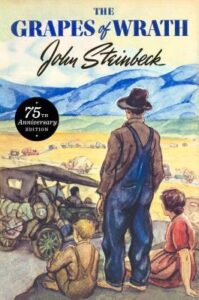
The Pulitzer Prize-winning epic of the Great Depression, a book that galvanized—and sometimes outraged—millions of readers.
First published in 1939, Steinbeck’s Pulitzer Prize-winning epic of the Great Depression chronicles the Dust Bowl migration of the 1930s and tells the story of one Oklahoma farm family, the Joads—driven from their homestead and forced to travel west to the promised land of California. Out of their trials and their repeated collisions against the hard realities of an America divided into Haves and Have-Nots evolves a drama that is intensely human yet majestic in its scale and moral vision, elemental yet plainspoken, tragic but ultimately stirring in its human dignity. A portrait of the conflict between the powerful and the powerless, of one man’s fierce reaction to injustice, and of one woman’s stoical strength, the novel captures the horrors of the Great Depression and probes into the very nature of equality and justice in America. At once a naturalistic epic, captivity narrative, road novel, and transcendental gospel, Steinbeck’s powerful landmark novel is perhaps the most American of American Classics.
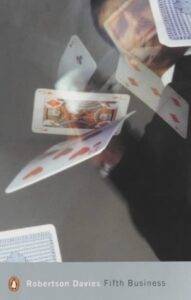
Ramsay is a man twice born, a man who has returned from the hell of the battle-grave at Passchendaele in World War I decorated with the Victoria Cross and destined to be caught in a no man's land where memory, history, and myth collide. As Ramsay tells his story, it begins to seem that from boyhood, he has exerted a perhaps mystical, perhaps pernicious, influence on those around him. His apparently innocent involvement in such innocuous events as the throwing of a snowball or the teaching of card tricks to a small boy in the end prove neither innocent nor innocuous. Fifth Business stands alone as a remarkable story told by a rational man who discovers that the marvelous is only another aspect of the real.
Giants in the Earth (Norwegian: Verdens Grøde) is a novel by Norwegian-American author Ole Edvart Rølvaag. First published in Norway as two books in 1924 and 1925, the author collaborated with Minnesotan Lincoln Colcord on the English translation.
The novel follows a Norwegian family's struggles as they try to make a new life as pioneers in the Dakota territory. Rølvaag is interested in psychology and the human cost of empire building, at a time when other writers focused on the glamor and romance of the West. The book reflects his personal experiences as a settler as well as the immigrant homesteader experience of his wife’s family. Both the grim realities of pioneering and the gloomy fatalism of the Norse mind are captured in depictions of snow storms, locusts, poverty, hunger, loneliness, homesickness, the difficulty of fitting into a new culture, and the estrangement of immigrant children who grow up in a new land. It is a novel at once palpably European and distinctly American.
Giants in the Earth was turned into an opera by Douglas Moore and Arnold Sundgaard; it won the Pulitzer Prize for Music in 1951.
Welcome Back!
Track your reading progress and sync your library.