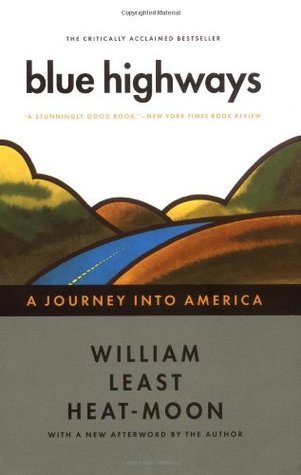
Hailed as a masterpiece of American travel writing, Blue Highways is an unforgettable journey along our nation’s backroads. William Least Heat-Moon set out with little more than the need to put home behind him and a sense of curiosity about “those little towns that get on the map-if they get on at all-only because some cartographer has a blank space to fill: Remote, Oregon; Simplicity, Virginia; New Freedom, Pennsylvania; New Hope, Tennessee; Why, Arizona; Whynot, Mississippi.” His adventures, his discoveries, and his recollections of the extraordinary people he encountered along the way amount to a revelation of the true American experience.
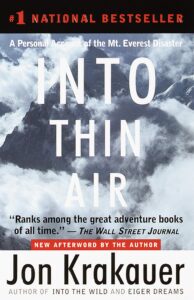
When Jon Krakauer reached the summit of Mt. Everest in the early afternoon of May 10, 1996, he hadn't slept in fifty-seven hours and was reeling from the brain-altering effects of oxygen depletion. As he turned to begin his long, dangerous descent from 29,028 feet, twenty other climbers were still pushing doggedly toward the top. No one had noticed that the sky had begun to fill with clouds. Six hours later and 3,000 feet lower, in 70-knot winds and blinding snow, Krakauer collapsed in his tent, freezing, hallucinating from exhaustion and hypoxia, but safe. The following morning, he learned that six of his fellow climbers hadn't made it back to their camp and were desperately struggling for their lives. When the storm finally passed, five of them would be dead, and the sixth so horribly frostbitten that his right hand would have to be amputated.
Into Thin Air is the definitive account of the deadliest season in the history of Everest by the acclaimed journalist and author of the bestseller Into the Wild. On assignment for Outside Magazine to report on the growing commercialization of the mountain, Krakauer, an accomplished climber, went to the Himalayas as a client of Rob Hall, the most respected high-altitude guide in the world. A rangy, thirty-five-year-old New Zealander, Hall had summited Everest four times between 1990 and 1995 and had led thirty-nine climbers to the top. Ascending the mountain in close proximity to Hall's team was a guided expedition led by Scott Fischer, a forty-year-old American with legendary strength and drive who had climbed the peak without supplemental oxygen in 1994. But neither Hall nor Fischer survived the rogue storm that struck in May 1996.
Krakauer examines what it is about Everest that has compelled so many people -- including himself -- to throw caution to the wind, ignore the concerns of loved ones, and willingly subject themselves to such risk, hardship, and expense. Written with emotional clarity and supported by his unimpeachable reporting, Krakauer's eyewitness account of what happened on the roof of the world is a singular achievement.
A compulsively readable account of a journey to the Congo — a country virtually inaccessible to the outside world — vividly told by a daring and adventurous journalist.
Ever since Stanley first charted its mighty river in the 1870s, the Congo has epitomized the dark and turbulent history of a failed continent. However, its troubles only served to increase the interest of Daily Telegraph correspondent Tim Butcher, who was sent to cover Africa in 2000. Before long he became obsessed with the idea of recreating Stanley’s original expedition — but travelling alone.
Despite warnings Butcher spent years poring over colonial-era maps and wooing rebel leaders before making his will and venturing to the Congo’s eastern border. He passed through once thriving cities of this country and saw the marks left behind by years of abuse and misrule. Almost, 2,500 harrowing miles later, he reached the Atlantic Ocean, a thinner and a wiser man.
Butcher’s journey was a remarkable feat. But the story of the Congo, vividly told in Blood River, is more remarkable still.
Jeannette Walls's memoir The Glass Castle was "nothing short of spectacular" (Entertainment Weekly). Now, in Half Broke Horses, she brings us the story of her grandmother, told in a first-person voice that is authentic, irresistible, and triumphant.
"Those old cows knew trouble was coming before we did." So begins the story of Lily Casey Smith, Jeannette Walls's no nonsense, resourceful, and spectacularly compelling grandmother. By age six, Lily was helping her father break horses. At fifteen, she left home to teach in a frontier town -- riding five hundred miles on her pony, alone, to get to her job. She learned to drive a car ("I loved cars even more than I loved horses. They didn't need to be fed if they weren't working, and they didn't leave big piles of manure all over the place") and fly a plane. And, with her husband Jim, she ran a vast ranch in Arizona. She raised two children, one of whom is Jeannette's memorable mother, Rosemary Smith Walls, unforgettably portrayed in The Glass Castle.
Lily survived tornadoes, droughts, floods, the Great Depression, and the most heartbreaking personal tragedy. She bristled at prejudice of all kinds -- against women, Native Americans, and anyone else who didn't fit the mold. Rosemary Smith Walls always told Jeannette that she was like her grandmother, and in this true-life novel, Jeannette Walls channels that kindred spirit. Half Broke Horses is Laura Ingalls Wilder for adults, as riveting and dramatic as Isak Dinesen's Out of Africa or Beryl Markham's West with the Night. Destined to become a classic, it will transfix audiences everywhere.
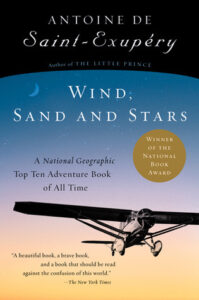
Recipient of the Grand Prix of the Académie Française, Wind, Sand and Stars captures the grandeur, danger, and isolation of flight. Its exciting account of air adventure, combined with lyrical prose and the spirit of a philosopher, makes it one of the most popular works ever written about flying. Translated by Lewis Galantière.
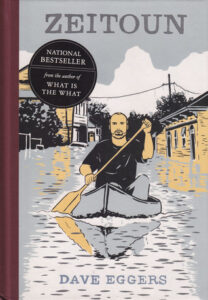
The true story of one family, caught between America’s two biggest policy disasters: the war on terror and the response to Hurricane Katrina.
Abdulrahman and Kathy Zeitoun run a house-painting business in New Orleans. In August of 2005, as Hurricane Katrina approaches, Kathy evacuates with their four young children, leaving Zeitoun to watch over the business. In the days following the storm he travels the city by canoe, feeding abandoned animals and helping elderly neighbors. Then, on September 6th, police officers armed with M-16s arrest Zeitoun in his home. Told with eloquence and compassion, Zeitoun is a riveting account of one family’s unthinkable struggle with forces beyond wind and water.
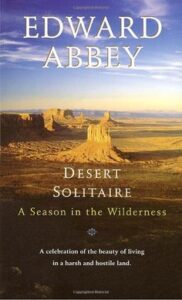
First published in 1968, Desert Solitaire is one of Edward Abbey’s most critically acclaimed works and marks his first foray into the world of nonfiction writing. Written while Abbey was working as a ranger at Arches National Park outside of Moab, Utah, Desert Solitaire is a rare view of one man’s quest to experience nature in its purest form.
Through prose that is by turns passionate and poetic, Abbey reflects on the condition of our remaining wilderness and the future of a civilization that cannot reconcile itself to living in the natural world as well as his own internal struggle with morality. As the world continues its rapid development, Abbey’s cry to maintain the natural beauty of the West remains just as relevant today as when this book was written.
This 1942 memoir (not a complete autobiography) by Beryl Markham chronicles her experiences growing up in Kenya (then British East Africa) in the early 1900s, and her stellar careers as racehorse trainer and bush pilot.
Markham was the first woman in East Africa to be granted a commercial pilot's license, piloting passengers and supplies to remote corners of Africa. She became the first person to fly solo across the Atlantic from east to west.
Considered a classic of outdoor literature and ranked #8 by National Geographic Adventure in 2008 on its list of the 100 best adventure books.
An alternative cover edition for this ISBN can be found here
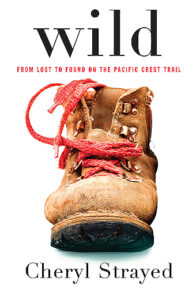
At twenty-two, Cheryl Strayed thought she had lost everything. In the wake of her mother’s death, her family scattered and her own marriage was soon destroyed. Four years later, with nothing more to lose, she made the most impulsive decision of her life. With no experience or training, driven only by blind will, she would hike more than a thousand miles of the Pacific Crest Trail from the Mojave Desert through California and Oregon to Washington State — and she would do it alone.
Told with suspense and style, sparkling with warmth and humor, Wild powerfully captures the terrors and pleasures of one young woman forging ahead against all odds on a journey that maddened, strengthened, and ultimately healed her.
Welcome Back!
Track your reading progress and sync your library.