With this groundbreaking novel, Maureen F. McHugh established herself as one of the decade’s best science fiction writers. In its pages, we enter a post-revolution America, moving from the hyper-urbanized eastern seaboard to the Arctic bleakness of Baffin Island; from the new Imperial City to an agricultural commune on Mars. The overlapping lives of cyber-kite fliers, lonely colonists, illicit neural-pressball players, and organic engineers blend into a powerful, taut story of a young man’s journey of discovery. This is a macroscopic world of microscopic intensity, one of the most brilliant visions of modern SF.
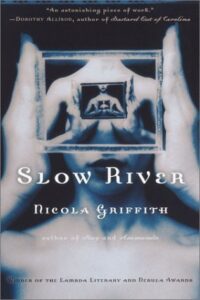
Once a culturally rich world, the planet Aka has been utterly transformed by technology. Records of the past have been destroyed, and citizens are strictly monitored. But an official observer from Earth named Sutty has learned of a group of outcasts who live in the wilderness. They still believe in the ancient ways and still practice its lost religion - the Telling.
Intrigued by their beliefs, Sutty joins them on a sacred pilgrimage into the mountains...and into the dangerous terrain of her own heart, mind, and soul.
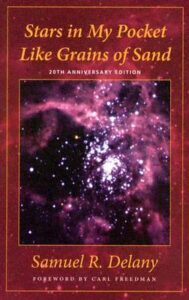
The story of a truly galactic civilization with over 6,000 inhabited worlds.
Stars in My Pocket Like Grains of Sand is a science fiction masterpiece, an essay on the inexplicability of sexual attractiveness, and an examination of interstellar politics among far-flung worlds. First published in 1984, the novel's central issues--technology, globalization, gender, sexuality, and multiculturalism--have only become more pressing with the passage of time.
The novel's topic is information itself: What are the repercussions, once it has been made public, that two individuals have been found to be each other's perfect erotic object out to "point nine-nine-nine and several nines percent more"? What will it do to the individuals involved, to the city they inhabit, to their geosector, to their entire world society, especially when one is an illiterate worker, the sole survivor of a world destroyed by "cultural fugue," and the other is--you!
In a story as exciting as any science fiction adventure written, Samuel R. Delany's 1976 SF novel, originally published as Triton, takes us on a tour of a utopian society at war with . . . our own Earth! High wit in this future comedy of manners allows Delany to question gender roles and sexual expectations at a level that, 20 years after it was written, still make it a coruscating portrait of the happily reasonable man, Bron Helstrom -- an immigrant to the embattled world of Triton, whose troubles become more and more complex, till there is nothing left for him to do but become a woman. Against a background of high adventure, this minuet of a novel dances from the farthest limits of the solar system to Earth's own Outer Mongolia. Alternately funny and moving, it is a wide-ranging tale in which character after character turns out not to be what he -- or she -- seems.
It has influenced William Gibson and been listed as one of the ten essential works of science fiction. Most importantly, Joanna Russ's The Female Man is a suspenseful, surprising and darkly witty chronicle of what happens when Jeannine, Janet, Joanna, and Jael—four alternative selves from drastically different realities—meet.
She awoke in an alley to the splash of rain. She was naked, a foot-long gash in her back was still bleeding, and her identity implant was gone. Lore Van Oesterling had been the daughter of one of the world’s most powerful families…and now she was nobody, and she had to hide.
Then out of the rain walked Spanner, predator and thief, who took her in, cared for her wound, and taught her how to reinvent herself again and again. No one could find Lore now: not the police, not her family, and not the kidnappers who had left her in that alley to die. She had escaped…but the cost of her newfound freedom was crime and deception, and she paid it over and over again, until she had become someone she loathed.
Lore had a choice: She could stay in the shadows, stay with Spanner…and risk losing herself forever. Or she could leave Spanner and find herself again by becoming someone else: stealing the identity implant of a dead woman, taking over her life, and creating a new future.
But to start again, Lore required Spanner’s talents–Spanner, who needed her and hated her, and who always had a price. And even as Lore agreed to play Spanner’s game one final time, she found that there was still the price of being a Van Oesterling to be paid. Only by confronting her family, her past, and her own demons could Lore meld together who she had once been, who she had become, and the person she intended to be…
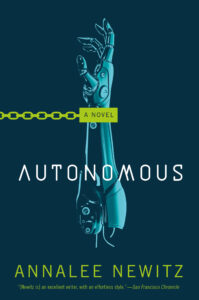
Autonomous features a rakish female pharmaceutical pirate named Jack who traverses the world in her own submarine. A notorious anti-patent scientist who has styled herself as a Robin Hood heroine fighting to bring cheap drugs to the poor, Jack’s latest drug is leaving a trail of lethal overdoses across what used to be North America—a drug that compels people to become addicted to their work.
On Jack’s trail are an unlikely pair: an emotionally shut-down military agent and his partner, Paladin, a young military robot, who fall in love against all expectations. Autonomous alternates between the activities of Jack and her co-conspirators, and Elias and Paladin, as they all race to stop a bizarre drug epidemic that is tearing apart lives, causing trains to crash, and flooding New York City.
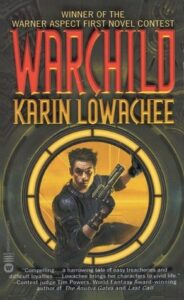
The merchant ship Mukudori encompasses the whole of eight-year-old Jos's world, until a notorious pirate destroys the ship, slaughters the adults, and enslaves the children. Thus begins a desperate odyssey of terror and escape that takes Jos beyond known space to the homeworld of the strits, Earth's alien enemies. To survive, the boy must become a living weapon and a master spy. But no training will protect Jos in a war where every hope might be a deadly lie, and every friendship might hide a lethal betrayal. And all the while he will face the most grueling trial of his lifebecoming his own man.
Four-BEE was an utopian city. If you didn't mind being taken care of all your long long life, having a wild time as a "jang" teen-ager, able to do anything you wanted from killing yourself innumerable times, changing bodies, changing sex, and raising perpetual hell, it could be heaven. But for one inhabitant there was always something askew. He/she had tried everything and yet the taste always soured. And then he/she succeeded in committing the one illegal act--and was thrown out of heaven forever. But forever is not a term any native of that robotic utopia understood. And so he/she challenged the rules, declared independence, and set out to prove that a human was still smarter than the cleverest and most protective robot.
Welcome Back!
Track your reading progress and sync your library.