l malestar en la cultura”, trabajo en el que Sigmund Freud (1856-1939) sentó que nuestra especie ha pagado por el progreso el elevado precio de sacrificar la vida instintiva y reprimir la espontaneidad, es uno de los ensayos con más amplias repercusiones en el pensamiento del siglo XX por su rara clarividencia. Completan este volumen imprescindible otros textos freudianos fundamentales, como «Sobre la conquista del fuego», «Consideraciones de actualidad sobre la guerra y la muerte» y los ensayos destinados a ser publicados bajo el rótulo genérico de «Metapsicología».
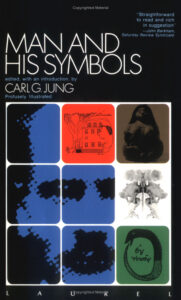
Man and His Symbols owes its existence to one of Jung's own dreams. The great psychologist dreamed that his work was understood by a wide public, rather than just by psychiatrists, and therefore he agreed to write and edit this fascinating book. Here, Jung examines the full world of the unconscious, whose language he believed to be the symbols constantly revealed in dreams. Convinced that dreams offer practical advice, sent from the unconscious to the conscious self, Jung felt that self-understanding would lead to a full and productive life. Thus, the reader will gain new insights into himself from this thoughtful volume, which also illustrates symbols throughout history. Completed just before his death by Jung and his associates, it is clearly addressed to the general reader.
Librarian note: an alternate cover for this edition can be found here.
Barely two hundred and fifty years ago a man condemned of attempting to assassinate the King of France was drawn and quartered in a grisly spectacle that suggested an unmediated duel between the violence of the criminal and the violence of the state. This groundbreaking book by the most influential philosopher since Sartre compels us to reevaluate our assumptions about all the ensuing reforms in the penal institutions of the West. For as he examines innovations that range from the abolition of torture to the institution of forced labor and the appearance of the modern penitentiary, Michel Foucault suggests that punishment has shifted its focus from the prisoner's body to the soul — and that our very concern with rehabilitation encourages and refines criminal activity.
Lucidly reasoned and deftly marshaling a vast body of research, Discipline and Punish is a genuinely revolutionary book, whose implications extend beyond the prison to the minute power relations of our society.
One of the most important philosophical works of our time, a work that has had tremendous influence on philosophy, literature, and psychology, and has literally changed the intellectual map of the modern world.
O Ser e o Nada (1943), escrito durante a ocupação nazi, é um dos textos fundamentais do século XX. O livro que marcou como nenhum outro uma época a braços com o desmoronamento de uma civilização é ao mesmo tempo a bíblia do existencialismo e o último grande sistema filosófico.
Para Sartre, o sentido das nossas vidas não é predeterminado nem por Deus nem pela natureza, não há nenhuma essência que preceda a existê o que nos define não é dado a priori, mas decorre das escolhas que fizermos. Primeiro existimos, e só depois nos definimos. Não existe natureza humana à qual tenhamos irresistivelmente de estamos condenados a ser livres e somos os únicos responsáveis pelos nossos destinos.
No âmago destas posições, está a conceção sartriana de consciência, influenciada pela fenomenologia de Husserl e pela ontologia de Heidegger. Como a consciência é sempre consciência de alguma coisa, ela própria não é nada enquanto não visa algo fora de si. O ser-para-si, a consciência humana, caracteriza-se por ser permanente projeção para o exterior. Daí os conceitos filosóficos de angústia e de «má-fé», ilustrada pelo famoso exemplo do empregado de mesa, e a problemática relação com os demais, tipificada na investigação sobre o desejo sexual e o «olhar» do Outro.
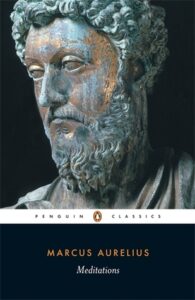
Written in Greek by the only Roman emperor who was also a philosopher, without any intention of publication, the Meditations of Marcus Aurelius offer a remarkable series of challenging spiritual reflections and exercises developed as the emperor struggled to understand himself and make sense of the universe. While the Meditations were composed to provide personal consolation and encouragement, Marcus Aurelius also created one of the greatest of all works of philosophy: a timeless collection that has been consulted and admired by statesmen, thinkers and readers throughout the centuries.
A good book may have the power to change the way we see the world, but a great book actually becomes part of our daily consciousness, pervading our thinking to the point that we take it for granted, and we forget how provocative and challenging its ideas once were—and still are. The Structure of Scientific Revolutions is that kind of book. When it was first published in 1962, it was a landmark event in the history and philosophy of science. Fifty years later, it still has many lessons to teach.
With The Structure of Scientific Revolutions, Kuhn challenged long-standing linear notions of scientific progress, arguing that transformative ideas don’t arise from the day-to-day, gradual process of experimentation and data accumulation but that the revolutions in science, those breakthrough moments that disrupt accepted thinking and offer unanticipated ideas, occur outside of “normal science,” as he called it. Though Kuhn was writing when physics ruled the sciences, his ideas on how scientific revolutions bring order to the anomalies that amass over time in research experiments are still instructive in our biotech age.
This new edition of Kuhn’s essential work in the history of science includes an insightful introduction by Ian Hacking, which clarifies terms popularized by Kuhn, including paradigm and incommensurability, and applies Kuhn’s ideas to the science of today. Usefully keyed to the separate sections of the book, Hacking’s introduction provides important background information as well as a contemporary context. Newly designed, with an expanded index, this edition will be eagerly welcomed by the next generation of readers seeking to understand the history of our perspectives on science.
Since its first publication in two volumes between 1918-1923, The Decline of the West has ranked as one of the most widely read and most talked about books of our time. In all its various editions, it has sold nearly 100,000 copies. A twentieth-century Cassandra, Oswald Spengler thoroughly probed the origin and "fate" of our civilization, and the result can be (and has been) read as a prophesy of the Nazi regime. His challenging views have led to harsh criticism over the years, but the knowledge and eloquence that went into his sweeping study of Western culture have kept The Decline of the West alive. As the face of Germany and Europe as a whole continues to change each day, The Decline of the West cannot be ignored.
The abridgment, prepared by the German scholar Helmut Werner, with the blessing of the Spengler estate, consists of selections from the original (translated into English by Charles Francis Atkinson) linked by explanatory passages which have been put into English by Arthur Helps. H. Stuart Hughes has written a new introduction for this edition.
In this engrossing and highly controversial philosophy of history, Spengler describes how we have entered into a centuries-long "world-historical" phase comparable to late antiquity. Guided by the philosophies of Goethe and Nietzsche, he rejects linear progression, and instead presents a world view based on the cyclical rise and decline of civilizations. He argues that a culture blossoms from the soil of a definable landscape and dies when it has exhausted all of its possibilities.
Despite Spengler's reputation today as an extreme pessimist, The Decline of the West remains essential reading for anyone interested in the history of civilization.
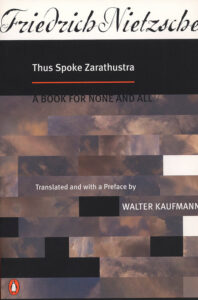
Friedrich Nietzsche's most accessible and influential philosophical work, misquoted, misrepresented, brilliantly original and enormously influential, Thus Spoke Zarathustra is translated from the German by R.J. Hollingdale in Penguin Classics.
Nietzsche was one of the most revolutionary and subversive thinkers in Western philosophy, and Thus Spoke Zarathustra remains his most famous and influential work. It describes how the ancient Persian prophet Zarathustra descends from his solitude in the mountains to tell the world that God is dead and that the Superman, the human embodiment of divinity, is his successor. Nietzsche's utterance 'God is dead', his insistence that the meaning of life is to be found in purely human terms, and his doctrine of the Superman and the will to power were all later seized upon and unrecognisably twisted by, among others, Nazi intellectuals. With blazing intensity and poetic brilliance, Nietzsche argues that the meaning of existence is not to be found in religious pieties or meek submission to authority, but in an all-powerful life passionate, chaotic and free.
Welcome Back!
Track your reading progress and sync your library.