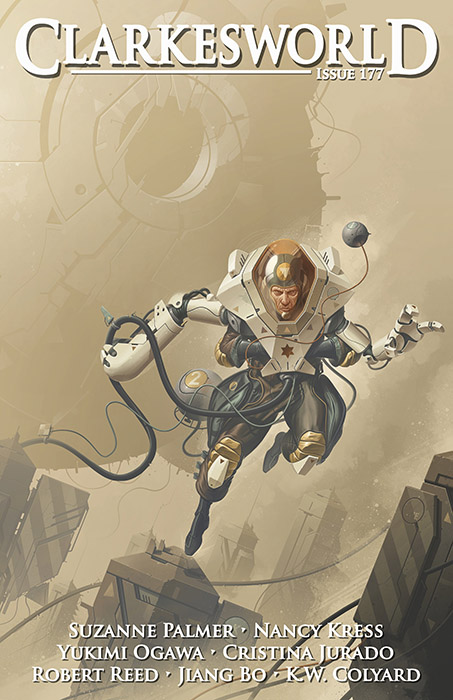
FICTION Little Animals by Nancy Kress Poubelle by Robert Reed Bots of the Lost Ark by Suzanne Palmer Face Changing by Jiang Bo, translated by Andy Dudak The Shroud for the Mourners by Yukimi Ogawa Our Fate, Told in Photons by K.W. Colyard Embracing the Movement by Cristina Jurado, translated by Sue Burke
NON-FICTION Fungi in Fiction by Carrie Sessarego Undoing Good Women: A Conversation with Cassandra Khaw by Arley Sorg A Wider Range of Freedom: A Conversation with Alyssa Winans by Arley Sorg Editor’s Desk: What Do You Want? by Neil Clarke
FICTION "Antarctic Birds" by A. Brym "Little /^^^&-" by Eric Schwitzgebel "The Secret Life of Bots" by Suzanne Palmer "Pan-Humanism: Hope and Pragmatics" by Jess Barber and Sara Saab "Möbius Continuum" by Gu Shi, translated by S. Qiouyi Lu "Bonding with Morry" by Tom Purdom "Warmth" by Geoff Ryman
NON-FICTION "Artificial Wombs and Control of Reproductive Technology" by Stephanie M. Bucklin "Occult Agencies and Political Satire: A Conversation with Charles Stross" by Chris Urie "Another Word: The Dream of Writing Full Time" by Kelly Robson "Editor's Desk: Home for the Month" by Neil Clarke
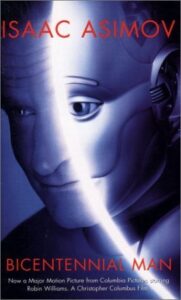
Andrew was one of Earth's first house robot domestic servants—smoothly designed and functional. But when Andrew started to develop special talents which exceeded the confines of his allotted positronic pathways, he abandoned his domestic duties in favour of more intellectual pursuits. As time passed, Andrew acquired knowledge, feelings and ambitions way beyond anything ever experienced by any other mechanical men. And he found himself launched on to a career which would bring him fame fortune — and danger. For a robot who wants to be human must also be prepared to die...
In the Bicentennial Man, Isaac Asimov returns to his first and most enduring love — robotics. The result is a brilliant book of first-class entertainment and mind-spinning ideas which confirm Asimov's supreme status as Grand Master of science fiction.
Content
"Feminine Intuition" (1969) "Waterclap" (1970) "That Thou Art Mindful of Him" (1974) "Stranger in Paradise" (1974) "The Life and Times of Multivac" (1975) "The Winnowing" (1976) "The Bicentennial Man" (1976) "Marching In" (1976) "Old-Fashioned" (1976) "The Tercentenary Incident" (1976) "Birth of a Notion" (1976)
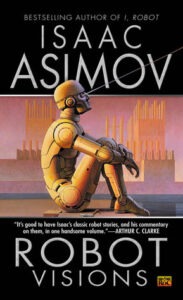
From Isaac Asimov, the Hugo Award-winning Grand Master of Science Fiction whose name is synonymous with the science of robotics, comes five decades of robot visions: thirty-four landmark stories and essays—including three rare tales—gathered together in one volume.
Meet all of Asimov’s most famous creations including: Robbie, the very first robot that his imagination brought to life; Susan Calvin, the original robot psychologist; Stephen Byerley, the humanoid robot; and the famous human/robot detective team of Lije Bailey and R. Daneel Olivaw, who have appeared in such bestselling novels as The Robots of Dawn and Robots and Empire.
Let the master himself guide you through the key moments in the fictional history of robot-human relations—from the most primitive computers and mobile machines to the first robot to become a man. (back cover)
Contents:
Robot Visions • cover and interior artwork by Ralph McQuarrie Introduction: The Robot Chronicles • essay by Isaac Asimov Robot Visions / short story by Isaac Asimov Too Bad! (1989) / short story by Isaac Asimov Robbie (1940) / short story by Isaac Asimov (variant of Strange Playfellow) Reason [Mike Donovan] (1941) / short story by Isaac Asimov Liar! [Susan Calvin] (1941) / short story by Isaac Asimov Runaround [Mike Donovan] (1942) / novelette by Isaac Asimov Evidence [Susan Calvin] (1946) / novelette by Isaac Asimov Little Lost Robot [Susan Calvin] (1947) / novelette by Isaac Asimov The Evitable Conflict [Susan Calvin] (1950) / novelette by Isaac Asimov Feminine Intuition [Susan Calvin] (1969) / novelette by Isaac Asimov The Bicentennial Man (1976) / novelette by Isaac Asimov Someday (1956) / short story by Isaac Asimov Think! (1977) / short story by Isaac Asimov Segregationist (1967) / short story by Isaac Asimov Mirror Image [Elijah Bailey/R. Daneel Olivaw] (1972) / short story by Isaac Asimov Lenny [Susan Calvin] (1958) / short story by Isaac Asimov Galley Slave [Susan Calvin] (1957) / novelette by Isaac Asimov Christmas Without Rodney (1988) / short story by Isaac Asimov Essays by Isaac Asimov: Robots I Have Known (1954); The New Teachers (1976); Whatever You Wish (1977); The Friends We Make (1977); Our Intelligent Tools (1977); The Laws of Robotics (1979); Future Fantastic (1989); The Machine and the Robot (1978); The New Profession (1979); The Robot As Enemy? (1979); Intelligences Together (1979); My Robots (1987); The Laws of Humanics (1987); Cybernetic Organism (1987); The Sense of Humor (1988); Robots in Combination (1988).
The volume features many black-and-white illustrations by Ralph McQuarrie.
THE CLONED STRANGERS Not everyone would envy young Lord Miles Naismith Vorkosigan, even though he had formed his own mercenary fleet before attending the naval academy, and even though his mother was the beautiful Cordelia, the ship captain who has taught the Lords of Barrayar much about the perils of sexism. Even the fact that Miles is third in line to the throne and personally owns a major chunk of his home planet would not tempt any normal person to change places with him.
When assassins came to rid the world of his father, his mother, pregnant with Miles, was in the line of fire, and Miles was but an egg for the omelet in an all too literal sense. Thanks to heroic medical intervention, Miles survived his near fatal brush with war gas-as a pain-filled dwarf with bones as weak and brittle as some malign composite of chalk and glass. Miles is often mistaken for a mutant by his mutant loathing countrymen.
But there is one who does envy him, who wants to be him: his brother, his cloned stranger formed from tissue stolen from Miles when he was a child. For Mark Vorkosigan was created and raised up for only one purpose: to become Miles, to murder and replace him. In Brothers in Arms that conspiracy was routed and Mark made more or less compliant to his new Miles-less fate. But in the intervening years Mark has learned that without Miles he is . . . nothing. The new and better Mark doesn't really want to kill his brother, but still it may come to that: Mark to stay, Miles to go. . . .
Earth is long since dead. On a colony planet, a band of men has gained control of technology, made themselves immortal, and now rule their world as the gods of the Hindu pantheon. Only one dares oppose them: he who was once Siddhartha and is now Mahasamatman. Binder of Demons, Lord of Light.
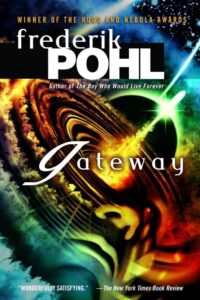
Gateway opened on all the wealth of the Universe... and on reaches of unimaginable horror.
When prospector Robinette Broadhead went out to Gateway on the Heechee spacecraft, he decided he would know which was the right mission to make him his fortune. Three missions later, now famous and permanently rich, Rob Broadhead has to face what happened to him and what he has become... in a journey into himself as perilous and even more horrifying than the nightmare trip through the interstellar void that he drove himself to take!
David Brin's Uplift novels are among the most thrilling and extraordinary science fiction ever written. Sundiver, Startide Rising, and The Uplift War--a New York Times bestseller--together make up one of the most beloved sagas of all time. Brin's tales are set in a future universe in which no species can reach sentience without being "uplifted" by a patron race. But the greatest mystery of all remains unsolved: who uplifted humankind?
As galactic armadas clash in quest of the ancient fleet of the Progenitors, a brutal alien race seizes the dying planet of Garth. The various uplifted inhabitants of Garth must battle their overlords or face ultimate extinction. At stake is the existence of Terran society and Earth, and the fate of the entire Five Galaxies. Sweeping, brilliantly crafted, inventive and dramatic, The Uplift War is an unforgettable story of adventure and wonder from one of today's science fiction greats.
From the author of Axis and Vortex , the first Hugo Award-winning novel in the environmental apocalyptic Spin Trilogy...
One night in October when he was ten years old, Tyler Dupree stood in his back yard and watched the stars go out. They all flared into brilliance at once, then disappeared, replaced by a flat, empty black barrier. He and his best friends, Jason and Diane Lawton, had seen what became known as the Big Blackout. It would shape their lives.
The effect is worldwide. The sun is now a featureless disk--a heat source, rather than an astronomical object. The moon is gone, but tides remain. Not only have the world's artificial satellites fallen out of orbit, their recovered remains are pitted and aged, as though they'd been in space far longer than their known lifespans. As Tyler, Jason, and Diane grow up, space probe reveals a bizarre The barrier is artificial, generated by huge alien artifacts. Time is passing faster outside the barrier than inside--more than a hundred million years per day on Earth. At this rate, the death throes of the sun are only about forty years in our future.
Jason, now a promising young scientist, devotes his life to working against this slow-moving apocalypse. Diane throws herself into hedonism, marrying a sinister cult leader who's forged a new religion out of the fears of the masses.
Earth sends terraforming machines to Mars to let the onrush of time do its work, turning the planet green. Next they send humans...and immediately get back an emissary with thousands of years of stories to tell about the settling of Mars. Then Earth's probes reveal that an identical barrier has appeared around Mars. Jason, desperate, seeds near space with self-replicating machines that will scatter copies of themselves outward from the sun--and report back on what they find.
Life on Earth is about to get much, much stranger.
Welcome Back!
Track your reading progress and sync your library.