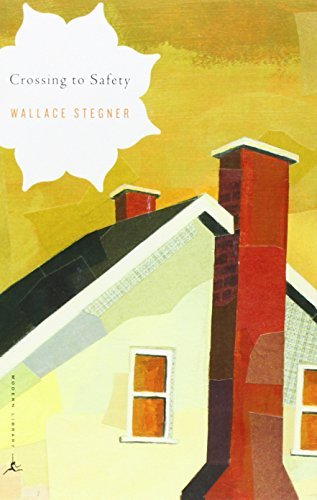
Crossing to Safety has, since its publication in 1987, established itself as one of the greatest and most cherished American novels of the twentieth century. Tracing the lives, loves, and aspirations of two couples who move between Vermont and Wisconsin, it is a work of quiet majesty, deep compassion, and powerful insight into the alchemy of friendship and marriage.
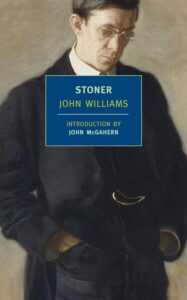
William Stoner is born at the end of the nineteenth century into a dirt-poor Missouri farming family. Sent to the state university to study agronomy, he instead falls in love with English literature and embraces a scholar’s life, so different from the hardscrabble existence he has known. And yet as the years pass, Stoner encounters a succession of disappointments: marriage into a “proper” family estranges him from his parents; his career is stymied; his wife and daughter turn coldly away from him; a transforming experience of new love ends under threat of scandal. Driven ever deeper within himself, Stoner rediscovers the stoic silence of his forebears and confronts an essential solitude.
John Williams’s luminous and deeply moving novel is a work of quiet perfection. William Stoner emerges from it not only as an archetypal American, but as an unlikely existential hero, standing, like a figure in a painting by Edward Hopper, in stark relief against an unforgiving world.
The protagonist of Tobias Wolff’s shrewdly—and at times devastatingly—observed first novel is a boy at an elite prep school in 1960. He is an outsider who has learned to mimic the negligent manner of his more privileged classmates. Like many of them, he wants more than anything on earth to become a writer. But to do that he must first learn to tell the truth about himself.
The agency of revelation is the school literary contest, whose winner will be awarded an audience with the most legendary writer of his time. As the fever of competition infects the boy and his classmates, fraying alliances, exposing weaknesses, Old School explores the ensuing deceptions and betrayals with an unblinking eye and a bottomless store of empathy. The result is further evidence that Wolff is an authentic American master.
Cannery Row is a book without much of a plot. Rather, it is an attempt to capture the feeling and people of a place, the cannery district of Monterey, California, which is populated by a mix of those down on their luck and those who choose for other reasons not to live "up the hill" in the more respectable area of town. The flow of the main plot is frequently interrupted by short vignettes that introduce us to various denizens of the Row, most of whom are not directly connected with the central story. These vignettes are often characterized by direct or indirect reference to extreme violence: suicides, corpses, and the cruelty of the natural world.
The "story" of Cannery Row follows the adventures of Mack and the boys, a group of unemployed yet resourceful men who inhabit a converted fish-meal shack on the edge of a vacant lot down on the Row.
Giants in the Earth (Norwegian: Verdens Grøde) is a novel by Norwegian-American author Ole Edvart Rølvaag. First published in Norway as two books in 1924 and 1925, the author collaborated with Minnesotan Lincoln Colcord on the English translation.
The novel follows a Norwegian family's struggles as they try to make a new life as pioneers in the Dakota territory. Rølvaag is interested in psychology and the human cost of empire building, at a time when other writers focused on the glamor and romance of the West. The book reflects his personal experiences as a settler as well as the immigrant homesteader experience of his wife’s family. Both the grim realities of pioneering and the gloomy fatalism of the Norse mind are captured in depictions of snow storms, locusts, poverty, hunger, loneliness, homesickness, the difficulty of fitting into a new culture, and the estrangement of immigrant children who grow up in a new land. It is a novel at once palpably European and distinctly American.
Giants in the Earth was turned into an opera by Douglas Moore and Arnold Sundgaard; it won the Pulitzer Prize for Music in 1951.
Ramsay is a man twice born, a man who has returned from the hell of the battle-grave at Passchendaele in World War I decorated with the Victoria Cross and destined to be caught in a no man's land where memory, history, and myth collide. As Ramsay tells his story, it begins to seem that from boyhood, he has exerted a perhaps mystical, perhaps pernicious, influence on those around him. His apparently innocent involvement in such innocuous events as the throwing of a snowball or the teaching of card tricks to a small boy in the end prove neither innocent nor innocuous. Fifth Business stands alone as a remarkable story told by a rational man who discovers that the marvelous is only another aspect of the real.
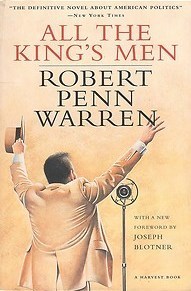
All the King's Men is a 1946 novel by Robert Penn Warren. Its title is drawn from the nursery rhyme "Humpty Dumpty". The novel tells the story of charismatic populist governor Willie Stark and his political machinations in the Depression-era Deep South. It is commonly thought to have been loosely inspired by the real-life story of U.S. Senator Huey P. Long, who was assassinated in 1935. Warren won the Pulitzer Prize for All the King's Men in 1947. The novel has received critical acclaim and remained perennially popular since its first publication. It was rated the 36th greatest novel of the 20th century by Modern Library, and it was chosen as one of Time magazine's 100 best novels since 1923. All the King's Men portrays the dramatic and theatrical political rise and governorship of Willie Stark, a cynical populist in the 1930s American South.
The magnificent second novel from the legendary author of One Flew Over the Cuckoo's Nest...
Following the astonishing success of his first novel, One Flew Over the Cuckoo's Nest, Ken Kesey wrote what Charles Bowden calls "one of the few essential books written by an American in the last half century." This wild-spirited tale tells of a bitter strike that rages through a small lumber town along the Oregon coast. Bucking that strike out of sheer cussedness are the Stampers. Out of the Stamper family's rivalries and betrayals Ken Kesey has crafted a novel with the mythic impact of Greek tragedy.
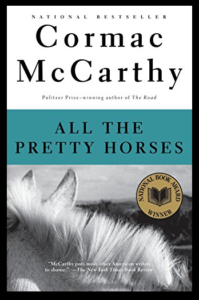
Teenager John Grady Cole, the last of a long line of Texas ranchers, has nothing left to stay for. Across the border Mexico beckons—beautiful and desolate, rugged and cruelly civilized. With neighbor Rawlins, and scruffy boy, he rides toward an idyllic, sometimes comic adventure, to a place where dreams are paid for in blood.
Welcome Back!
Track your reading progress and sync your library.