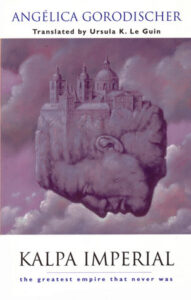
This is the first of Argentinean writer Angelica Gorodischer's nineteen award-winning books to be translated into English. In eleven chapters, "Kalpa Imperial"'s multiple storytellers relate the story of a fabled nameless empire which has risen and fallen innumerable times. Fairy tales, oral histories and political commentaries are all woven tapestry-style into Kalpa Imperial: beggars become emperors, democracies become dictatorships, and history becomes legends and stories. But this is much more than a simple political allegory or fable. It is also a celebration of the power of storytelling. Gorodischer and translator Ursula K. Le Guin are a well-matched, sly and delightful team of magician-storytellers. Rarely have author and translator been such an effortless pairing. "Kalpa Imperial" is a powerful introduction to the writing of Angelica Gorodischer, a novel which will enthrall readers already familiar with the worlds of Le Guin.
Stella thought she’d made up a lie on the spot, asking her childhood friend if he remembered the strange public broadcast TV show with the unsettling host she and all the neighborhood kids appeared on years ago. But he does remember. And so does her mom. So why doesn’t Stella? The more she investigates the show and the grip it has on her hometown, the eerier the mystery grows.
At the Publisher's request, this title is being sold without Digital Rights Management Software (DRM) applied.
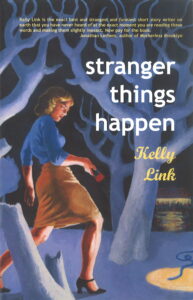
This first collection by award-winning author Kelly Link takes fairy tales and cautionary tales, dictators and extraterrestrials, amnesiacs and honeymooners, revenants and readers alike, on a voyage into new, strange, and wonderful territory. The girl detective must go to the underworld to solve the case of the tap-dancing bank robbers. A librarian falls in love with a girl whose father collects artificial noses. A dead man posts letters home to his estranged wife. Two women named Louise begin a series of consecutive love affairs with a string of cellists. A newly married couple become participants in an apocalyptic beauty pageant. Sexy blond aliens invade New York City. A young girl learns how to make herself disappear.
These eleven extraordinary stories are quirky, spooky, and smart. They all have happy endings. Every story contains a secret prize. Each story was written especially for you.
Stories from Stranger Things Happen have won the Nebula, Tiptree, and World Fantasy Award. Stranger Things Happen was a Salon Book of the Year, one of the Village Voice's 25 Favorite Books of 2001, and was nominated for the Firecracker Alternative Book Award.
Contents: - Carnation, Lily, Lily, Rose (1998) - Water Off a Black Dog's Back (1995) - The Specialist's Hat (1998) - Flying Lessons (1995) - Travels with the Snow Queen (1996/1997) - Vanishing Act (1996) - Survivor's Ball, or, The Donner Party (1998) - Shoe and Marriage (2000) - Most of My Friends Are Two-Thirds Water (2001) - Louise's Ghost (2001) - The Girl Detective (1999)
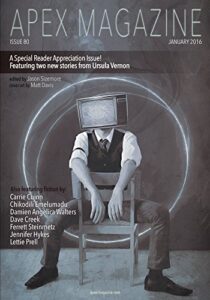
Apex Magazine is a monthly science fiction, fantasy, and horror magazine featuring original, mind-bending short fiction from many of the top pros of the field. New issues are released on the first Tuesday of every month.
Extra large Customer Appreciation issue!
TABLE OF CONTENTS FICTION The Tomato Thief—Ursula Vernon The Open-Hearted—Lettie Prell Soursop—Chikodili Emelumadu Bones of the World—Jennifer Hykes That Lucky Old Sun—Carrie Cuinn Razorback—Ursula Vernon Kutraya’s Skies—Dave Creek Riding Atlas—Ferrett Steinmetz Paper Tigers (Novel Excerpt)—Damien Angelica Walters
NONFICTION Interview with Ursula Vernon—Andrea Johnson Interview with Chikodili Emelumadu—Andrea Johnson Interview with Lettie Prell—Andrea Johnson Interview with Matt Davis, Cover Artist—Russell Dickerson An Exploration of Racism in Heart of Darkness—Lucy A. Snyder
POETRY RX-200 Series: It’s Everything You Need—Samson Stormcrow Hayes Upside of the Cataclysmic Meteor—Zebulon Huset The Doctor’s Assistant—Anton Rose In the Far Future, Billy Experiences the Most Powerful Drug Known to Man—Greg Leunig Automaton—Bianca Spriggs Maxwell’s Demon—Annie Neugebauer Various Kinds of Wolves—J.J. Hunter
Editorial Words from the Editor-in-Chief — Jason Sizemore
Harlan Ellison is probably best known as a script writer for sci-fi and fantasy movies and TV series such as the original Outer Limits, The Hunger, Logan's Run, and Babylon Five. But his range is much broader than that, encompassing stories, novels, essays, reviews, reminiscences, plays, even fake autobiographies. The Essential Ellison, a special limited edition personally signed and numbered by Ellison, contains 74 unabridged works, including such classics as "A Boy and His Dog," "Xenogenesis," and "Mefisto in Onyx."
Full of philosophical puzzles and supernatural surprises, these stories contain some of Borges's most fully realized human characters. With uncanny insight, he takes us inside the minds of an unrepentant Nazi, an imprisoned Mayan priest, fanatical Christian theologians, a woman plotting vengeance on her father’s “killer,” and a man awaiting his assassin in a Buenos Aires guest house. This volume also contains the hauntingly brief vignettes about literary imagination and personal identity collected in The Maker, which Borges wrote as failing eyesight and public fame began to undermine his sense of self.
For more than seventy years, Penguin has been the leading publisher of classic literature in the English-speaking world. With more than 1,700 titles, Penguin Classics represents a global bookshelf of the best works throughout history and across genres and disciplines. Readers trust the series to provide authoritative texts enhanced by introductions and notes by distinguished scholars and contemporary authors, as well as up-to-date translations by award-winning translators.
The seventeen pieces in Ficciones demonstrate the whirlwind of Borges's genius and mirror the precision and potency of his intellect and inventiveness, his piercing irony, his skepticism, and his obsession with fantasy. Borges sends us on a journey into a compelling, bizarre, and profoundly resonant realm; we enter the fearful sphere of Pascal's abyss, the surreal and literal labyrinth of books, and the iconography of eternal return. To enter the worlds in Ficciones is to enter the mind of Jorge Luis Borges, wherein lies Heaven, Hell, and everything else in between.
Part One: The Garden of Forking Paths Prologue Tlön, Uqbar, Orbis Tertius (1940) The Approach to Al-Mu'tasim (1936, not included in the 1941 edition) Pierre Menard, Author of the Quixote (1939) The Circular Ruins (1940) The Lottery in Babylon (1941) An Examination of the Work of Herbert Quain (1941) The Library of Babel (1941) The Garden of Forking Paths (1941) Part Two: Artifices Prologue Funes the Memorious (1942) The Form of the Sword (1942) Theme of the Traitor and the Hero (1944) Death and the Compass (1942) The Secret Miracle (1943) Three Versions of Judas (1944) The End (1953, 2nd edition only) The Sect of the Phoenix (1952, 2nd edition only) The South (1953, 2nd edition only)
"Kublai Khan does not necessarily believe everything Marco Polo says when he describes the cities visited on his expeditions, but the emperor of the Tartars does continue listening to the young Venetian with greater attention and curiosity than he shows any other messenger or explorer of his." So begins Italo Calvino's compilation of fragmentary urban images. As Marco tells the khan about Armilla, which "has nothing that makes it seem a city, except the water pipes that rise vertically where the houses should be and spread out horizontally where the floors should be," the spider-web city of Octavia, and other marvelous burgs, it may be that he is creating them all out of his imagination, or perhaps he is recreating fine details of his native Venice over and over again, or perhaps he is simply recounting some of the myriad possible forms a city might take.
Welcome Back!
Track your reading progress and sync your library.