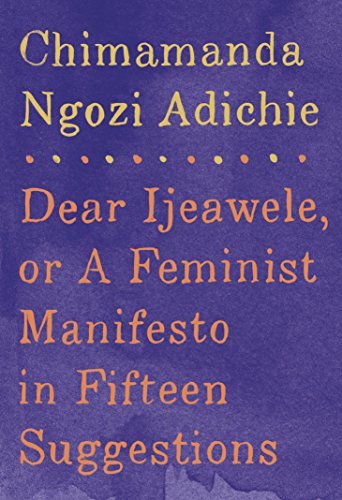
Após o enorme sucesso de Sejamos todos feministas, Chimamanda Ngozi Adichie retoma o tema da igualdade de gêneros neste manifesto com quinze sugestões de como criar filhos dentro de uma perspectiva feminista. Escrito no formato de uma carta da autora a uma amiga que acaba de se tornar mãe de uma menina, Para educar crianças feministas traz conselhos simples e precisos de como oferecer uma formação igualitária a todas as crianças, o que se inicia pela justa distribuição de tarefas entre pais e mães. E é por isso que este breve manifesto pode ser lido igualmente por homens e mulheres, pais de meninas e meninos. Partindo de sua experiência pessoal para mostrar o longo caminho que ainda temos a percorrer, Adichie oferece uma leitura essencial para quem deseja preparar seus filhos para o mundo contemporâneo e contribuir para uma sociedade mais justa.
Books similar to Dear Ijeawele, or A Feminist Manifesto in Fifteen Suggestions
What does “feminism” mean today? That is the question at the heart of We Should All Be Feminists, a personal, eloquently-argued essay—adapted from her much-viewed TEDx talk of the same name—by Chimamanda Ngozi Adichie, the award-winning author of Americanah and Half of a Yellow Sun.
With humor and levity, here Adichie offers readers a unique definition of feminism for the twenty-first century—one rooted in inclusion and awareness. She shines a light not only on blatant discrimination, but also the more insidious, institutional behaviors that marginalize women around the world, in order to help readers of all walks of life better understand the often masked realities of sexual politics. Throughout, she draws extensively on her own experiences—in the U.S., in her native Nigeria, and abroad—offering an artfully nuanced explanation of why the gender divide is harmful for women and men, alike.
Argued in the same observant, witty and clever prose that has made Adichie a bestselling novelist, here is one remarkable author’s exploration of what it means to be a woman today—and an of-the-moment rallying cry for why we should all be feminists.
Pink is my favorite color. I used to say my favorite color was black to be cool, but it is pink—all shades of pink. If I have an accessory, it is probably pink. I read Vogue, and I’m not doing it ironically, though it might seem that way. I once live-tweeted the September issue.
In these funny and insightful essays, Roxane Gay takes us through the journey of her evolution as a woman of color while also taking readers on a ride through culture of the last few years and commenting on the state of feminism today. The portrait that emerges is not only one of an incredibly insightful woman continually growing to understand herself and our society, but also one of our culture.
Bad Feminist is a sharp, funny, and spot-on look at the ways in which the culture we consume becomes who we are, and an inspiring call-to-arms of all the ways we still need to do better.
Feel me, see me, hear me, reach me -- Peculiar benefits -- Typical first year professor -- To scratch, claw or grope clumsily or frantically -- How to be friends with another woman -- Girls, girls, girls -- I once was Miss America -- Garish, glorious spectacles -- Not here to make friends -- How we all lose -- Reaching for catharsis : getting fat right (or wrong) and Diana Spechler's Skinny -- The smooth surfaces of idyll -- The careless language of sexual violence -- What we hunger for -- The illusion of safety/the safety of illusion -- The spectacle of broken men -- A tale of three coming out stories -- Beyond the measure of men -- Some jokes are funnier than others -- Dear young ladies who love Chris Brown -- So much they would let him beat them -- Blurred lines, indeed -- The trouble with Prince Charming, or, He who trespassed against us -- The solace of preparing fried foods and other quaint remembrances from 1960s Mississippi : thoughts on The help -- Surviving Django -- Beyond the struggle narrative -- The morality of Tyler Perry -- The last day of a young black man -- When less is more -- The politics of respectability -- When Twitter does what journalism cannot -- The alienable rights of women -- Holding out for a hero -- A tale of two profiles -- The racism we all carry -- Tragedy, call, compassion, response -- Bad feminist : take one -- Bad feminist : take two
Data is fundamental to the modern world. From economic development, to healthcare, to education and public policy, we rely on numbers to allocate resources and make crucial decisions. But because so much data fails to take into account gender, because it treats men as the default and women as atypical, bias and discrimination are baked into our systems. And women pay tremendous costs for this bias, in time, money, and often with their lives.
Celebrated feminist advocate Caroline Criado Perez investigates the shocking root cause of gender inequality and research in Invisible Women, diving into women’s lives at home, the workplace, the public square, the doctor’s office, and more. Built on hundreds of studies in the US, the UK, and around the world, and written with energy, wit, and sparkling intelligence, this is a groundbreaking, unforgettable exposé that will change the way you look at the world.
From two of our most fiercely moral voices, a passionate call to arms against our era’s most pervasive human rights violation: the oppression of women and girls in the developing world.
With Pulitzer Prize winners Nicholas D. Kristof and Sheryl WuDunn as our guides, we undertake an odyssey through Africa and Asia to meet the extraordinary women struggling there, among them a Cambodian teenager sold into sex slavery and an Ethiopian woman who suffered devastating injuries in childbirth. Drawing on the breadth of their combined reporting experience, Kristof and WuDunn depict our world with anger, sadness, clarity, and, ultimately, hope.
They show how a little help can transform the lives of women and girls abroad. That Cambodian girl eventually escaped from her brothel and, with assistance from an aid group, built a thriving retail business that supports her family. The Ethiopian woman had her injuries repaired and in time became a surgeon. A Zimbabwean mother of five, counseled to return to school, earned her doctorate and became an expert on AIDS.
Through these stories, Kristof and WuDunn help us see that the key to economic progress lies in unleashing women’s potential. They make clear how so many people have helped to do just that, and how we can each do our part. Throughout much of the world, the greatest unexploited economic resource is the female half of the population. Countries such as China have prospered precisely because they emancipated women and brought them into the formal economy. Unleashing that process globally is not only the right thing to do; it’s also the best strategy for fighting poverty.
Deeply felt, pragmatic, and inspirational, Half the Sky is essential reading for every global citizen.
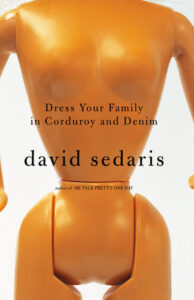
David Sedaris plays in the snow with his sisters. He goes on vacation with his family. He gets a job selling drinks. He attends his brother’s wedding. He mops his sister’s floor. He gives directions to a lost traveler. He eats a hamburger. He has his blood sugar tested. It all sounds so normal, doesn’t it? In his newest collection of essays, David Sedaris lifts the corner of ordinary life, revealing the absurdity teeming below its surface. His world is alive with obscure desires and hidden motives — a world where forgiveness is automatic and an argument can be the highest form of love. Dress Your Family in Corduroy and Denim is another unforgettable collection from one of the wittiest and most original writers at work today. --davidsedarisbooks.com
I come from a country that was created at midnight. When I almost died it was just after midday.
When the Taliban took control of the Swat Valley in Pakistan, one girl spoke out. Malala Yousafzai refused to be silenced and fought for her right to an education.
On Tuesday, October 9, 2012, when she was fifteen, she almost paid the ultimate price. She was shot in the head at point-blank range while riding the bus home from school, and few expected her to survive.
Instead, Malala's miraculous recovery has taken her on an extraordinary journey from a remote valley in northern Pakistan to the halls of the United Nations in New York. At sixteen, she has become a global symbol of peaceful protest and the youngest-ever Nobel Peace Prize laureate.
I Am Malala is the remarkable tale of a family uprooted by global terrorism, of the fight for girls' education, of a father who, himself a school owner, championed and encouraged his daughter to write and attend school, and of brave parents who have a fierce love for their daughter in a society that prizes sons.
Life can be hard: your lover cheats on you; you lose a family member; you can’t pay the bills - and it can be great: you've had the hottest sex of your life; you get that plum job; you muster the courage to write your novel. Sugar - the once-anonymous online columnist at The Rumpus, now revealed as Cheryl Strayed, author of the bestselling memoir Wild - is the person thousands turn to for advice. Tiny Beautiful Things brings the best of Dear Sugar in one place and includes never-before-published columns and a new introduction by Steve Almond. Rich with humor, insight, compassion - and absolute honesty - this bookis a balm for everything life throws our way.
I THINK I AM, THEREFORE I AM. I THINK. In Napalm & Silly Putty, George Carlin, the thinking person's comic, offers a hilarious new collection of razor-sharp observations on God, language, death, pets, driving, food, sports, airplanes, advertising, news, businessmen, and much, much more!
* Just when I discovered the meaning of life, they changed it. * If people climb Mt. Everest because it's hard to do, why do they go up on the easy side? * With a little effort, oxen can be trained to genuflect and whistle softly in the moonlight. * How can it be a spy satellite if they announce on TV that its a spy satellite? * If people stand in a circle long enough, they will eventually begin to dance. * Guys don't seem to be called "Lefty" anymore. * No one quite knows what's next, but everybody does it. * I think it would be great if you could make a guy's head explode just by staring at him. * Am I the only one who's noticed that the Lone Ranger and Tonto never got their laundry done?
You'll learn what Carlin thinks of saving the planet, his suggestion for revamping the prison system, and why he prays to Joe Pesci. Add to the mix "The Ten Most Embarrassing Songs of All Time," "The 20th Century Hostility Scoreboard," and "People I Can Do Without," and you have an irresistible assortment of quips, probes, thrusts, and verbal ordeals that are as smart as they are infectiously funny.
Welcome Back!
Track your reading progress and sync your library.