Emil Sinclair ist ein Junge, der in einem als “Scheinwelt” beschrieben bürgerlichen Elternhaus aufgewachsen ist. Dies ist die dramatische Geschichte seiner Abstieg – gesteuert durch sein frühreifen Schulkamerad Max Demian – in eine geheime und gefährliche Welt der Kleinkriminalität und Revolte gegen Konvention und seiner Erwachen zu Selbstheit.
Steppenwolf is a poetical self-portrait of a man who felt himself to be half-human and half-wolf. This Faust-like and magical story is evidence of Hesse's searching philosophy and extraordinary sense of humanity as he tells of the humanization of a middle-aged misanthrope. Yet his novel can also be seen as a plea for rigorous self-examination and an indictment of the intellectual hypocrisy of the period. As Hesse himself remarked, "Of all my books Steppenwolf is the one that was more often and more violently misunderstood than any of the others".
Written in 1914 but not published until 1925, a year after Kafka’s death, The Trial is the terrifying tale of Josef K., a respectable bank officer who is suddenly and inexplicably arrested and must defend himself against a charge about which he can get no information. Whether read as an existential tale, a parable, or a prophecy of the excesses of modern bureaucracy wedded to the madness of totalitarianism, The Trial has resonated with chilling truth for generations of readers.
Marcel Proust’s In Search of Lost Time is one of the most entertaining reading experiences in any language and arguably the finest novel of the twentieth century. But since its original prewar translation there has been no completely new version in English. Now, Penguin Classics brings Proust’s masterpiece to new audiences throughout the world, beginning with Lydia Davis’s internationally acclaimed translation of the first volume, Swann’s Way.
G. K. Chesterton's surreal masterpiece is a psychological thriller that centers on seven anarchists in turn-of-the-century London who call themselves by the names of the days of the week. Chesterton explores the meanings of their disguised identities in what is a fascinating mystery and, ultimately, a spellbinding allegory.
As Jonathan Lethem remarks in his Introduction, The real characters are the ideas. Chesterton's nutty agenda is really quite simple: to expose moral relativism and parlor nihilism for the devils he believes them to be. This wouldn't be interesting at all, though, if he didn't also show such passion for giving the devil his due. He animates the forces of chaos and anarchy with every ounce of imaginative verve and rhetorical force in his body.
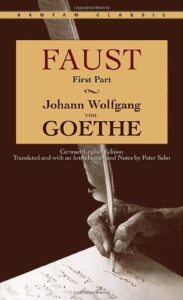
Goethe’s masterpiece and perhaps the greatest work in German literature, Faust has made the legendary German alchemist one of the central myths of the Western world. Here indeed is a monumental Faust, an audacious man boldly wagering with the devil, Mephistopheles, that no magic, sensuality, experience, or knowledge can lead him to a moment he would wish to last forever. Here, in Faust, Part I, the tremendous versatility of Goethe’s genius creates some of the most beautiful passages in literature. Here too we experience Goethe’s characteristic humor, the excitement and eroticism of the witches’ Walpurgis Night, and the moving emotion of Gretchen’s tragic fate.
This authoritative edition, which offers Peter Salm’s wonderfully readable translation as well as the original German on facing pages, brings us Faust in a vital, rhythmic American idiom that carefully preserves the grandeur, integrity, and poetic immediacy of Goethe’s words.
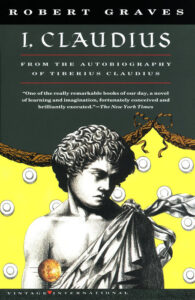
A modern classic of historical fiction written in the form of Claudius's autobiography.
Tiberius Claudius Drusus Nero Germanicus lived from 10 B.C. to 54 A.D. Despised as a weakling and dismissed as an idiot because of his physical infirmities, Claudius survived the intrigues and poisonings that marked the reigns of Augustus, Tiberius, and the mad Caligula to become emperor of Rome in 41 A.D. The first part of Robert Graves’s two-part account of the life of Tiberius Claudius, I, Claudius stands as a landmark historical novel of the 20th century from one of its great writers.
Cannery Row is a book without much of a plot. Rather, it is an attempt to capture the feeling and people of a place, the cannery district of Monterey, California, which is populated by a mix of those down on their luck and those who choose for other reasons not to live "up the hill" in the more respectable area of town. The flow of the main plot is frequently interrupted by short vignettes that introduce us to various denizens of the Row, most of whom are not directly connected with the central story. These vignettes are often characterized by direct or indirect reference to extreme violence: suicides, corpses, and the cruelty of the natural world.
The "story" of Cannery Row follows the adventures of Mack and the boys, a group of unemployed yet resourceful men who inhabit a converted fish-meal shack on the edge of a vacant lot down on the Row.
Seul l'être capable d'indépendance spirituelle est digne des grandes entreprises. Tel Napoléon qui n'hésita pas à ouvrir le feu sur une foule désarmée, Raskolnikov, qui admire le grand homme, se place au-dessus du commun des mortels. Les considérations théoriques qui le poussent à tuer une vieille usurière cohabitent en s'opposant dans l'esprit du héros et constituent l'essence même du roman. Pour Raskolnikov, le crime qu'il va commettre n'est que justice envers les hommes en général et les pauvres qui se sont fait abusés en particulier. « Nous acceptons d'être criminels pour que la terre se couvre enfin d'innocents », écrira Albert Camus. Mais cet idéal d'humanité s'accorde mal avec la conscience de supériorité qui anime le héros, en qualité de « surhomme », il se situe au-delà du bien et du mal. Fomenté avec un sang-froid mêlé de mysticisme, le meurtre tourne pourtant à l'échec. Le maigre butin ne peut satisfaire son idéal de justice, tandis que le crime loin de l'élever de la masse, l'abaisse parmi les hommes. Raskolnikov finira par se rendre et accepter la condamnation, par-là même, il accèdera à la purification. Crime et Châtiment est le roman de la déchéance humaine, l’œuvre essentielle du maître de la littérature russe. — Lenaïc Gravis et Jocelyn Blériot
Welcome Back!
Track your reading progress and sync your library.