Alternate Cover Edition ISBN 0679734511. (ISBN13: 9780679734512)
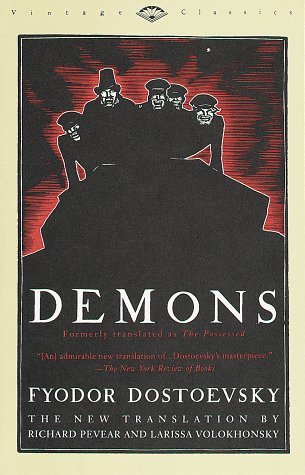
Inspired by the true story of a political murder that horrified Russians in 1869, Fyodor Dostoevsky conceived of Demons as a “novel-pamphlet” in which he would say everything about the plague of materialist ideology that he saw infecting his native land. What emerged was a prophetic and ferociously funny masterpiece of ideology and murder in pre-revolutionary Russia.
Seul l'être capable d'indépendance spirituelle est digne des grandes entreprises. Tel Napoléon qui n'hésita pas à ouvrir le feu sur une foule désarmée, Raskolnikov, qui admire le grand homme, se place au-dessus du commun des mortels. Les considérations théoriques qui le poussent à tuer une vieille usurière cohabitent en s'opposant dans l'esprit du héros et constituent l'essence même du roman. Pour Raskolnikov, le crime qu'il va commettre n'est que justice envers les hommes en général et les pauvres qui se sont fait abusés en particulier. « Nous acceptons d'être criminels pour que la terre se couvre enfin d'innocents », écrira Albert Camus. Mais cet idéal d'humanité s'accorde mal avec la conscience de supériorité qui anime le héros, en qualité de « surhomme », il se situe au-delà du bien et du mal. Fomenté avec un sang-froid mêlé de mysticisme, le meurtre tourne pourtant à l'échec. Le maigre butin ne peut satisfaire son idéal de justice, tandis que le crime loin de l'élever de la masse, l'abaisse parmi les hommes. Raskolnikov finira par se rendre et accepter la condamnation, par-là même, il accèdera à la purification. Crime et Châtiment est le roman de la déchéance humaine, l’œuvre essentielle du maître de la littérature russe. — Lenaïc Gravis et Jocelyn Blériot
The Brothers Karamazov is a murder mystery, a courtroom drama, and an exploration of erotic rivalry in a series of triangular love affairs involving the “wicked and sentimental” Fyodor Pavlovich Karamazov and his three sons―the impulsive and sensual Dmitri; the coldly rational Ivan; and the healthy, red-cheeked young novice Alyosha. Through the gripping events of their story, Dostoevsky portrays the whole of Russian life, is social and spiritual striving, in what was both the golden age and a tragic turning point in Russian culture.
This award-winning translation by Richard Pevear and Larissa Volokhonsky remains true to the verbal inventiveness of Dostoevsky’s prose, preserving the multiple voices, the humor, and the surprising modernity of the original. It is an achievement worthy of Dostoevsky’s last and greatest novel.
Returning to Russia from a sanitarium in Switzerland, the Christ-like epileptic Prince Myshkin finds himself enmeshed in a tangle of love, torn between two women—the notorious kept woman Nastasya and the pure Aglaia—both involved, in turn, with the corrupt, money-hungry Ganya. In the end, Myshkin’s honesty, goodness, and integrity are shown to be unequal to the moral emptiness of those around him. In her revision of the Garnett translation, Anna Brailovsky has corrected inaccuracies wrought by Garnett’s drastic anglicization of the novel, restoring as much as possible the syntactical structure of the original story.
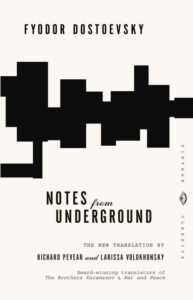
Dostoevsky’s most revolutionary novel, Notes from Underground marks the dividing line between nineteenth- and twentieth-century fiction, and between the visions of self each century embodied. One of the most remarkable characters in literature, the unnamed narrator is a former official who has defiantly withdrawn into an underground existence. In complete retreat from society, he scrawls a passionate, obsessive, self-contradictory narrative that serves as a devastating attack on social utopianism and an assertion of man’s essentially irrational nature.
Richard Pevear and Larissa Volokhonsky, whose Dostoevsky translations have become the standard, give us a brilliantly faithful edition of this classic novel, conveying all the tragedy and tormented comedy of the original.
The American poet John Shade is dead. His last poem, 'Pale Fire', is put into a book, together with a preface, a lengthy commentary and notes by Shade's editor, Charles Kinbote. Known on campus as the 'Great Beaver', Kinbote is haughty, inquisitive, intolerant, but is he also mad, bad - and even dangerous? As his wildly eccentric annotations slide into the personal and the fantastical, Kinbote reveals perhaps more than he should be.
Nabokov's darkly witty, richly inventive masterpiece is a suspenseful whodunit, a story of one-upmanship and dubious penmanship, and a glorious literary conundrum.
Part of a major new series of the works of Vladimir Nabokov, author of Lolita and Pale Fire, in Penguin Classics.
Bazarov—a gifted, impatient, and caustic young man—has journeyed from school to the home of his friend Arkady Kirsanov. But soon Bazarov’s outspoken rejection of authority and social conventions touches off quarrels, misunderstandings, and romantic entanglements that will utterly transform the Kirsanov household and reflect the changes taking place across all of nineteenth-century Russia.
Fathers and Sons enraged the old and the young, reactionaries, romantics, and radicals alike when it was first published. At the same time, Turgenev won the acclaim of Flaubert, Maupassant, and Henry James for his craftsmanship as a writer and his psychological insight. Fathers and Sons is now considered one of the greatest novels of the nineteenth century.
A timeless depiction of generational conflict during social upheaval, it vividly portrays the clash between the older Russian aristocracy and the youthful radicalism that foreshadowed the revolution to come—and offers modern-day readers much to reflect upon as they look around at their own tumultuous, ever changing world.
Román vypráví o osudu mukla a věčného vyhnance Olega Kostoglotova, který se v polovině padesátých let přichází léčit na taškentskou onkologickou kliniku. Je to v době, kdy Stalin je již dva roky mrtev, Berija popraven a kdy se začínají objevovat první nesmělé náznaky změn. Na onkologické klinice se setkávají členové strany i vyhnanci, národy, které sem Stalin vysídlil, i původní obyvatelé, lékaři i pacienti. Jejich společným nepřítelem je rakovina: nemoc, smrt, konec života... V blízkosti smrti padají všechny dosavadní jistoty, všechny plány, všechna privilegia. A v tomto světě rozehrává Solženicyn příběhy svých hrdinů, jejich lásek a nadějí. Nádory, sarkomy a metanoblastomy jsou nejen krutou skutečností, s níž se potýkají hrdinové románu i lékaři, ale i metaforou pro rakovinu lži, přetvářky, násilí a útlaku, která metastázuje do všech vrstev ruské společnosti.
Published two weeks after his seventieth birthday, Ada, or Ardor is one of Nabokov's greatest masterpieces, the glorious culmination of his career as a novelist. It tells a love story troubled by incest. But more: it is also at once a fairy tale, epic, philosophical treatise on the nature of time, parody of the history of the novel, and erotic catalogue. Ada, or Ardor is no less than the superb work of an imagination at white heat.
This is the first American edition to include the extensive and ingeniously sardonic appendix by the author, written under the anagrammatic pseudonym Vivian Darkbloom.
Welcome Back!
Track your reading progress and sync your library.