To rescue her family from poverty and avoid marrying her slope-shouldered cousin, seventeen-year-old Orchid competes to be one of the Emperor’s wives. When she is chosen as a lower-ranking concubine she enters the erotically charged and ritualised Forbidden City. But beneath its immaculate façade lie whispers of murders and ghosts, and the thousands of concubines will stoop to any lengths to bear the Emperor’s son.
Orchid trains herself in the art of pleasuring a man, bribes her way into the royal bed, and seduces the monarch, drawing the attention of dangerous foes. Little does she know that China will collapse around her, and that she will be its last Empress.
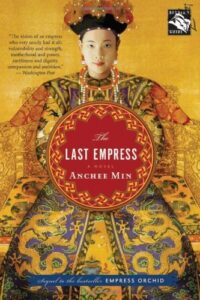
The last decades of the nineteenth century were a violent period in China’s history marked by humiliating foreign incursions and domestic rebellion, ultimately ending in the demise of the Ch’ing dynasty. The only constant during this tumultuous time was the power wielded by one person, the resilient, ever-resourceful Tzu Hsi, Lady Yehonala -- or Empress Orchid, as readers came to know her in Anchee Min’s critically acclaimed novel covering the first part of her life.
The Last Empress is the story of Orchid’s dramatic transition from a strong-willed, instinctive young woman to a wise and politically savvy leader who ruled China for more than four decades. Moving from the intimacy of the concubine quarters into the spotlight of the world stage, Orchid must face not only the perilous condition of her empire but also a series of devastating personal losses, as first her son and then her adopted son succumb to early death. Yearning only to step aside, and yet growing constantly into her role, only she—allied with the progressives, but loyal to the conservative Manchu clan of her dynasty—can hold the nation’s rival factions together.
Anchee Min offers a powerful revisionist portrait based on extensive research of one of the most important figures in Chinese history. Viciously maligned by the western press of the time as the “Dragon Lady,” a manipulative, blood-thirsty woman who held onto power at all costs, the woman Min gives us is a compelling, very human leader who assumed power reluctantly, and who sacrificed all she had to protect those she loved and an empire that was doomed to die.
Winnie and Helen have kept each other's worst secrets for more than fifty years. Now, because she believes she is dying, Helen wants to expose everything. And Winnie angrily determines that she must be the one to tell her daughter, Pearl, about the past—including the terrible truth even Helen does not know. And so begins Winnie's story of her life on a small island outside Shanghai in the 1920s, and other places in China during World War II, and traces the happy and desperate events that led to Winnie's coming to America in 1949.
In seventeenth-century China, three women become emotionally involved with The Peony Pavilion, a famed opera rumored to cause lovesickness and even death, including Peony, the cloistered daughter of a wealthy scholar, who succumbs to its spell only to return after her death as a "hungry ghost" to haunt her former fiancé, who has married another.
Set in the turbulent days of the founding of Hong Kong in the 1840s, Tai-Pan is the story of Dirk Struan, the ruler - the Tai-Pan - of the most powerful trading company in the Far East. He is also a pirate, an opium smuggler, and a master manipulator of men. This is the story of his fight to establish himself and his dynasty as the undisputed masters of the Orient.
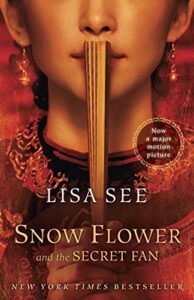
In nineteenth-century China, in a remote Hunan county, a girl named Lily, at the tender age of seven, is paired with a laotong, “old same,” in an emotional match that will last a lifetime. The laotong, Snow Flower, introduces herself by sending Lily a silk fan on which she’s painted a poem in nu shu, a unique language that Chinese women created in order to communicate in secret, away from the influence of men.
As the years pass, Lily and Snow Flower send messages on fans, compose stories on handkerchiefs, reaching out of isolation to share their hopes, dreams, and accomplishments. Together, they endure the agony of foot-binding, and reflect upon their arranged marriages, shared loneliness, and the joys and tragedies of motherhood. The two find solace, developing a bond that keeps their spirits alive. But when a misunderstanding arises, their deep friendship suddenly threatens to tear apart.
A 20-year-old Chinese painter named Stephen is sent to his family's summer home in a Japanese coastal village to recover from a bout with tuberculosis. Here he is cared for by Matsu, a reticent housekeeper and a master gardener. Over the course of a remarkable year, Stephen learns Matsu's secret and gains not only physical strength, but also profound spiritual insight. Matsu is a samurai of the soul, a man devoted to doing good and finding beauty in a cruel and arbitrary world, and Stephen is a noble student, learning to appreciate Matsu's generous and nurturing way of life and to love Matsu's soul-mate, gentle Sachi, a woman afflicted with leprosy.
An immersive historical novel inspired by the true story of a woman physician in 15th-century China.
According to Confucius, “an educated woman is a worthless woman,” but Tan Yunxian—born into an elite family, yet haunted by death, separations, and loneliness—is being raised by her grandparents to be of use. Her grandmother is one of only a handful of female doctors in China, and she teaches Yunxian the pillars of Chinese medicine, the Four Examinations—looking, listening, touching, and asking—something a man can never do with a female patient.
From a young age, Yunxian learns about women’s illnesses, many of which relate to childbearing, alongside a young midwife-in-training, Meiling. The two girls find fast friendship and a mutual purpose—despite the prohibition that a doctor should never touch blood while a midwife comes in frequent contact with it—and they vow to be forever friends, sharing in each other’s joys and struggles. No mud, no lotus , they tell from adversity beauty can bloom.
But when Yunxian is sent into an arranged marriage, her mother-in-law forbids her from seeing Meiling and from helping the women and girls in the household. Yunxian is to act like a proper wife—embroider bound-foot slippers, recite poetry, give birth to sons, and stay forever within the walls of the family compound, the Garden of Fragrant Delights.
How might a woman like Yunxian break free of these traditions and lead a life of such importance that many of her remedies are still used five centuries later? How might the power of friendship support or complicate these efforts? A captivating story of women helping each other, Lady Tan’s Circle of Women is a triumphant reimagining of the life of one person who was remarkable in the Ming dynasty and would be considered remarkable today.
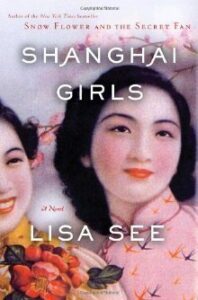
Pearl and May are sisters, living carefree lives in Shanghai, the Paris of Asia. But when Japanese bombs fall on their beloved city, they set out on the journey of a lifetime, one that will take them through the Chinese countryside, in and out of the clutch of brutal soldiers, and across the Pacific to the shores of America.
In 1937, Shanghai is the Paris of Asia, a city of great wealth and glamour, the home of millionaires and beggars, gangsters and gamblers, patriots and revolutionaries, artists and warlords. Thanks to the financial security and material comforts provided by their father’s prosperous rickshaw business, twenty-one-year-old Pearl Chin and her younger sister, May, are having the time of their lives. Though both sisters wave off authority and tradition, they couldn’t be more different: Pearl is a Dragon sign, strong and stubborn, while May is a true Sheep, adorable and placid. Both are beautiful, modern, and carefree . . . until the day their father tells them that he has gambled away their wealth and that in order to repay his debts he must sell the girls as wives to suitors who have traveled from California to find Chinese brides.
As Japanese bombs fall on their beloved city, Pearl and May set out on the journey of a lifetime, one that will take them through the Chinese countryside, in and out of the clutch of brutal soldiers, and across the Pacific to the shores of America. In Los Angeles they begin a fresh chapter, trying to find love with the strangers they have married, brushing against the seduction of Hollywood, and striving to embrace American life even as they fight against discrimination, brave Communist witch hunts, and find themselves hemmed in by Chinatown’s old ways and rules.
Welcome Back!
Track your reading progress and sync your library.