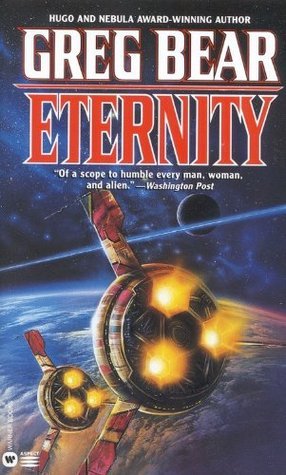
A visitor from the end of time comes to take a handful of strangers into space, where they must destroy the ultimate marvel of science in this powerful sf classic.”Modern mainstream SF of the highest order…Bear rockets the story ever onward and upward”. — Chicago Tribune
The souls of those long dead are entering the universe at an alarming rate. Stealing the bodies of the living, they are grouping together into powerful consortiums led by leaders from history. An increasingly desperate Confederation Navy is struggling to stem the tide as the race for the universe's most powerful weapon begins. But if the dead can return to life, who will be the ultimate victors?
Moving Mars is a story of human courage and love set within the greater saga of a planetary liberation movement. Mars is a colonial world, governed by corporate interests on Earth. The citizens of Mars are hardworking, but held back by their lack of access to the best education, and the desire of the Earthly powers to keep the best new inventions for themselves. The young Martians -- the second and third generations born on Mars -- have little loyalty to Earth, and a strong belief that their planet can be independent. The revolution begins slowly, but will grow in power over decades of political struggle until it becomes irresistible.
Told through the eyes of an extraordinary character, Casseia Majumdar, a daughter of one of Mars' oldest, most conservative Binding Multiples, Moving Mars is Greg Bear's brilliant conception of the human colonization of the red planet, with lovingly painted details and a grand historical sweep, embellishing an audacious scientific speculation.
Late in the twenty-sixth century, the human race has advanced enough to accidentally trigger the Inhibitors - alien killing machines designed to detect intelligent life and destroy it. The only hope for humanity lies in the recovery of a secret cache of doomsday weapons -and a renegade named Clavain who is determined to find them. But other factions want the weapons for their own purposes - and the weapons themselves have another agenda altogether...
Phssthpok the Pak had been traveling for most of his thirty-two thousand years. His save, develop, and protect the group of Pak breeders sent out into space some two and a half million years before . . .
Brennan was a Belter, the product of a fiercely independent, somewhat anarchic society living in, on, and around an outer asteroid belt. The Belters were rebels, one and all, and Brennan was a smuggler. The Belt worlds had been tracking the Pak ship for days—Brennan figured to meet that ship first . . .
He was never seen again—at least not by those alive at the time.
The very far future: The galaxy is a drifting wreck of black holes, neutron stars, and chill white dwarfs. The age of star formation is long past. Yet there is life here, feeding off the energies of the stellar remnants, and there is mind, a tremendous galaxy-spanning intelligence each of whose thoughts lasts a hundred thousand years. And this mind cradles memories of a long-gone age when a more compact universe was full of light... The 27th century: Proxima Centauri, an undistinguished red dwarf star, is the nearest star to our sun. How would it be to live on such a world?
To save Earth from the crushing grip of totalitarianism, Kyra Davis journeys from the planet's rebel enclaves to the decadence of a lunar colony to a new world threatened by a dying star as she seeks to rescue the leader of Earth's last refuge of freedom. Reprint.
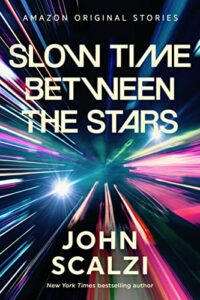
An artificial intelligence on a star-spanning mission explores the farthest horizons of human potential—and its own purpose—in a mind-bending short story by New York Times bestselling author John Scalzi.
Equipped with the entirety of human knowledge, a sentient ship is launched on a last-ditch journey to find a new home for civilization. Trillions of miles. Tens of thousands of years. In the space between, the AI has plenty of time to think about life, the vastness of the universe, everything it was meant to do, and—with a perspective created but not limited by humans—what it should do.
John Scalzi’s Slow Time Between the Stars is part of The Far Reaches, a collection of science-fiction stories that stretch the imagination and open the heart. They can be read or listened to in one sitting.
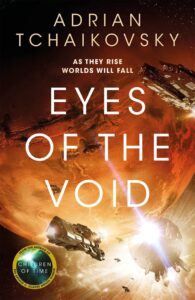
The Arthur C. Clarke award-winning author of Children of Time brings us the second novel in an extraordinary space opera trilogy about humanity on the brink of extinction, and how one man's discovery will save or destroy us all.
After eighty years of fragile peace, the Architects are back, wreaking havoc as they consume entire planets. In the past, Originator artefacts – vestiges of a long-vanished civilization – could save a world from annihilation. This time, the Architects have discovered a way to circumvent these protective relics. Suddenly, no planet is safe.
Facing impending extinction, the Human Colonies are in turmoil. While some believe a unified front is the only way to stop the Architects, others insist humanity should fight alone. And there are those who would seek to benefit from the fractured politics of war – even as the Architects loom ever closer.
Idris, who has spent decades running from the horrors of his past, finds himself thrust back onto the battlefront. As an Intermediary, he could be one of the few to turn the tide of war. With a handful of allies, he searches for a weapon that could push back the Architects and save the galaxy. But to do so, he must return to the nightmarish unspace, where his mind was broken and remade.
What Idris discovers there will change everything.
Welcome Back!
Track your reading progress and sync your library.