Fast food has hastened the malling of our landscape, widened the chasm between rich and poor, fueled an epidemic of obesity, and propelled American cultural imperialism abroad. That’s a lengthy list of charges, but here Eric Schlosser makes them stick with an artful mix of first-rate reportage, wry wit, and careful reasoning.
Schlosser’s myth-shattering survey stretches from California’s subdivisions where the business was born to the industrial corridor along the New Jersey Turnpike where many fast food’s flavors are concocted. Along the way, he unearths a trove of fascinating, unsettling truths — from the unholy alliance between fast food and Hollywood to the seismic changes the industry has wrought in food production, popular culture, and even real estate. (back cover)
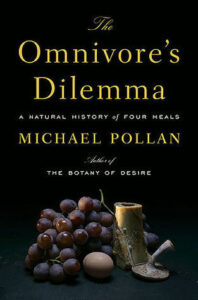
What should we have for dinner? For omnivore like ourselves, this simple question has always posed a dilemma. When you can eat just about anything nature (or the supermarket) has to offer, deciding what you should eat will inevitably stir anxiety, especially when some of the foods on offer might shorten your life. Today, buffered by one food fad after another, America is suffering from what can only be described as a national eating disorder. The omnivore’s dilemma has returned with a vengeance, as the cornucopia of the modern American supermarket and fast-food outlet confronts us with a bewildering and treacherous food landscape. What’s at stake in our eating choices is not only our own and our children’s health, but the health of the environment that sustains life on earth. The Omnivore's Dilemma is groundbreaking book, in which one of America’s most fascinating, original, and elegant writers turns his own omnivorous mind to the seemingly straightforward question of what we should have for dinner. The question has confronted us since man discovered fire, but according to Michael Pollan, the bestselling author of The Botany of Desire, how we answer it today, at the dawn of the twenty-first century, may well determine our very survival as a species. Should we eat a fast-food hamburger? Something organic? Or perhaps something we hunt, gather, or grow ourselves? To find out, Pollan follows each of the food chains that sustain us—industrial food, organic or alternative food, and food we forage ourselves—from the source to a final meal, and in the process develops a definitive account of the American way of eating. His absorbing narrative takes us from Iowa cornfields to food-science laboratories, from feedlots and fast-food restaurants to organic farms and hunting grounds, always emphasizing our dynamic coevolutionary relationship with the handful of plant and animal species we depend on. Each time Pollan sits down to a meal, he deploys his unique blend of personal and investigative journalism to trace the origins of everything consumed, revealing what we unwittingly ingest and explaining how our taste for particular foods and flavors reflects our evolutionary inheritance. The surprising answers Pollan offers to the simple question posed by this book have profound political, economic, psychological, and even moral implications for all of us. Ultimately, this is a book as much about visionary solutions as it is about problems, and Pollan contends that, when it comes to food, doing the right thing often turns out to be the tastiest thing an eater can do. Beautifully written and thrillingly argued, The Omnivore’s Dilemma promises to change the way we think about the politics and pleasure of eating. For anyone who reads it, dinner will never again look, or taste, quite the same.
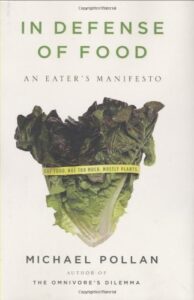
Michael Pollan's last book, The Omnivore's Dilemma, launched a national conversation about the American way of eating; now In Defense of Food shows us how to change it, one meal at a time. Pollan proposes a new answer to the question of what we should eat that comes down to seven simple but liberating words: Eat food. Not too much. Mostly plants. Pollan's bracing and eloquent manifesto shows us how we can start making thoughtful food choices that will enrich our lives, enlarge our sense of what it means to be healthy, and bring pleasure back to eating.,,,
"Diamond has written a book of remarkable scope ... one of the most important and readable works on the human past published in recent years."
Winner of the Pulitzer Prize and a national bestseller: the global account of the rise of civilization that is also a stunning refutation of ideas of human development based on race.
In this "artful, informative, and delightful" (William H. McNeill, New York Review of Books) book, Jared Diamond convincingly argues that geographical and environmental factors shaped the modern world. Societies that had a head start in food production advanced beyond the hunter-gatherer stage, and then developed writing, technology, government, and organized religion—as well as nasty germs and potent weapons of war—and adventured on sea and land to conquer and decimate preliterate cultures. A major advance in our understanding of human societies, Guns, Germs, and Steel chronicles the way that the modern world came to be and stunningly dismantles racially based theories of human history.
Winner of the Pulitzer Prize, the Phi Beta Kappa Award in Science, the Rhone-Poulenc Prize, and the Commonwealth Club of California's Gold Medal
For those who could read between the lines, the censored news out of China was terrifying. But the president insisted there was nothing to worry about.
Fortunately, we are still a nation of skeptics. Fortunately, there are those among us who study pandemics and are willing to look unflinchingly at worst-case scenarios. Michael Lewis’s taut and brilliant nonfiction thriller pits a band of medical visionaries against the wall of ignorance that was the official response of the Trump administration to the outbreak of COVID-19.
The characters you will meet in these pages are as fascinating as they are unexpected. A thirteen-year-old girl’s science project on transmission of an airborne pathogen develops into a very grown-up model of disease control. A local public-health officer uses her worm’s-eye view to see what the CDC misses, and reveals great truths about American society. A secret team of dissenting doctors, nicknamed the Wolverines, has everything necessary to fight the pandemic: brilliant backgrounds, world-class labs, prior experience with the pandemic scares of bird flu and swine flu…everything, that is, except official permission to implement their work.
Michael Lewis is not shy about calling these people heroes for their refusal to follow directives that they know to be based on misinformation and bad science. Even the internet, as crucial as it is to their exchange of ideas, poses a risk to them. They never know for sure who else might be listening in.
A good book may have the power to change the way we see the world, but a great book actually becomes part of our daily consciousness, pervading our thinking to the point that we take it for granted, and we forget how provocative and challenging its ideas once were—and still are. The Structure of Scientific Revolutions is that kind of book. When it was first published in 1962, it was a landmark event in the history and philosophy of science. Fifty years later, it still has many lessons to teach.
With The Structure of Scientific Revolutions, Kuhn challenged long-standing linear notions of scientific progress, arguing that transformative ideas don’t arise from the day-to-day, gradual process of experimentation and data accumulation but that the revolutions in science, those breakthrough moments that disrupt accepted thinking and offer unanticipated ideas, occur outside of “normal science,” as he called it. Though Kuhn was writing when physics ruled the sciences, his ideas on how scientific revolutions bring order to the anomalies that amass over time in research experiments are still instructive in our biotech age.
This new edition of Kuhn’s essential work in the history of science includes an insightful introduction by Ian Hacking, which clarifies terms popularized by Kuhn, including paradigm and incommensurability, and applies Kuhn’s ideas to the science of today. Usefully keyed to the separate sections of the book, Hacking’s introduction provides important background information as well as a contemporary context. Newly designed, with an expanded index, this edition will be eagerly welcomed by the next generation of readers seeking to understand the history of our perspectives on science.
Data is fundamental to the modern world. From economic development, to healthcare, to education and public policy, we rely on numbers to allocate resources and make crucial decisions. But because so much data fails to take into account gender, because it treats men as the default and women as atypical, bias and discrimination are baked into our systems. And women pay tremendous costs for this bias, in time, money, and often with their lives.
Celebrated feminist advocate Caroline Criado Perez investigates the shocking root cause of gender inequality and research in Invisible Women, diving into women’s lives at home, the workplace, the public square, the doctor’s office, and more. Built on hundreds of studies in the US, the UK, and around the world, and written with energy, wit, and sparkling intelligence, this is a groundbreaking, unforgettable exposé that will change the way you look at the world.
Yuval Noah Harari, author of the critically-acclaimed New York Times bestseller and international phenomenon Sapiens, returns with an equally original, compelling, and provocative book, turning his focus toward humanity’s future, and our quest to upgrade humans into gods.
Over the past century humankind has managed to do the impossible and rein in famine, plague, and war. This may seem hard to accept, but, as Harari explains in his trademark style—thorough, yet riveting—famine, plague and war have been transformed from incomprehensible and uncontrollable forces of nature into manageable challenges. For the first time ever, more people die from eating too much than from eating too little; more people die from old age than from infectious diseases; and more people commit suicide than are killed by soldiers, terrorists and criminals put together. The average American is a thousand times more likely to die from binging at McDonalds than from being blown up by Al Qaeda.
What then will replace famine, plague, and war at the top of the human agenda? As the self-made gods of planet earth, what destinies will we set ourselves, and which quests will we undertake? Homo Deus explores the projects, dreams and nightmares that will shape the twenty-first century—from overcoming death to creating artificial life. It asks the fundamental questions: Where do we go from here? And how will we protect this fragile world from our own destructive powers? This is the next stage of evolution. This is Homo Deus.
With the same insight and clarity that made Sapiens an international hit and a New York Times bestseller, Harari maps out our future.
Every schoolchild learns about the mutually beneficial dance of honeybees and flowers: The bee collects nectar and pollen to make honey and, in the process, spreads the flowers’ genes far and wide. In The Botany of Desire, Michael Pollan ingeniously demonstrates how people and domesticated plants have formed a similarly reciprocal relationship. He masterfully links four fundamental human desires—sweetness, beauty, intoxication, and control—with the plants that satisfy them: the apple, the tulip, marijuana, and the potato. In telling the stories of four familiar species, Pollan illustrates how the plants have evolved to satisfy humankind’s most basic yearnings. And just as we’ve benefited from these plants, we have also done well by them. So who is really domesticating whom?
Welcome Back!
Track your reading progress and sync your library.