From the Earth to the Moon
Een in de 19e eeuw geschreven verhaal over een reis naar de maan, waaruit blijkt dat de schrijver in technisch opzicht zijn tijd ver vooruit was
Based on the true story of Alexander Selkirk, who survived alone for almost five years on an uninhabited island off the coast of Chile, The Mysterious Island is considered by many to be Jules Verne’s masterpiece. “Wide-eyed mid-nineteenth-century humanistic optimism in a breezy, blissfully readable translation by Stump” (Kirkus Reviews), here is the enthralling tale of five men and a dog who land in a balloon on a faraway, fantastic island of bewildering goings-on and their struggle to survive as they uncover the island’s secret.
When an unidentified “monster” threatens international shipping, French oceanographer Pierre Aronnax and his unflappable assistant Conseil join an expedition organized by the US Navy to hunt down and destroy the menace. After months of fruitless searching, they finally grapple with their quarry, but Aronnax, Conseil, and the brash Canadian harpooner Ned Land are thrown overboard in the attack, only to find that the “monster” is actually a futuristic submarine, the Nautilus, commanded by a shadowy, mystical, preternaturally imposing man who calls himself Captain Nemo. Thus begins a journey of 20,000 leagues—nearly 50,000 miles—that will take Captain Nemo, his crew, and these three adventurers on a journey of discovery through undersea forests, coral graveyards, miles-deep trenches, and even the sunken ruins of Atlantis. Jules Verne’s novel of undersea exploration has been captivating readers ever since its first publication in 1870, and Frederick Paul Walter’s reader-friendly, scientifically meticulous translation of this visionary science fiction classic is complete and unabridged down to the smallest substantive detail.
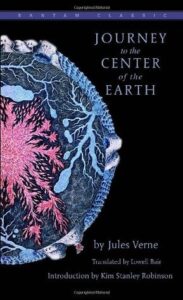
An adventurous geology professor chances upon a manuscript in which a 16th-century explorer claims to have found a route to the earth's core. Professor Lidenbrock can't resist the opportunity to investigate, and with his nephew Axel, he sets off across Iceland in the company of Hans Bjelke, a native guide.
The expedition descends into an extinct volcano toward a sunless sea, where they encounter a subterranean world of luminous rocks, antediluvian forests, and fantastic marine life — a living past that holds the secrets to the origins of human existence.
In the year 1689, a cabal of Barbary galley slaves -- including one Jack Shaftoe, aka King of the Vagabonds, aka Half-Cocked Jack -- devises a daring plan to win freedom and fortune. A great adventure ensues -- a perilous race for an enormous prize of silver ... nay, gold ... nay, legendary gold. In Europe, the exquisite and resourceful Eliza, Countess de la Zeur, is stripped of her immense personal fortune by France's most dashing privateer. Penniless and at risk from those who desire either her or her head (or both), she is caught up in a web of international intrigue, even as she desperately seeks the return of her most precious possession. Meanwhile, Newton and Leibniz continue to propound their grand theories as their infamous rivalry intensifies, stubborn alchemy does battle with the natural sciences, dastardly plots are set in motion ... and Daniel Waterhouse seeks passage to the Massachusetts colony in hopes of escaping the madness into which his world has descended. This P.S. edition features an extra 16 pages of insights into the book, including author interviews, recommended reading, and more.
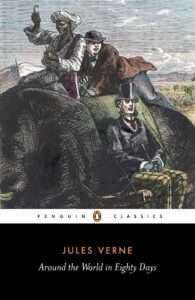
One night in the reform club, Phileas Fogg bets his companions that he can travel across the globe in just eighty days. Breaking the well-established routine of his daily life, he immediately sets off for Dover with his astonished valet Passepartout. Passing through exotic lands and dangerous locations, they seize whatever transportation is at hand—whether train or elephant—overcoming set-backs and always racing against the clock.
Foundation begins a new chapter in the story of man's future. As the Old Empire crumbles into barbarism throughout the million worlds of the galaxy, Hari Seldon and his band of psychologists must create a new entity, the Foundation-dedicated to art, science, and technology-as the beginning of a new empire.
Foundation and Empire describes the mighty struggle for power amid the chaos of the stars in which man stands at the threshold of a new enlightened life which could easily be destroyed by the old forces of barbarism.
Second Foundation follows the Seldon Plan after the First Empire's defeat and describes its greatest threat-a dangerous mutant strain gone wild, which produces a mind capable of bending men's wills, directing their thoughts, reshaping their desires, and destroying the universe.
This adaptation for BBC Radio 4 was first broadcast in 1973 with a cast which included Lee Montague, Maurice Denham, John Justin, Angela Plesence, Wolfe Morris, Julian Glover and Prunella Scales.
This edition features George Orwell’s best-known novels—1984 and Animal Farm—with an introduction by Christopher Hitchens.
In 1984, London is a grim city where Big Brother is always watching you and the Thought Police can practically read your mind. Winston Smith joins a secret revolutionary organisation called The Brotherhood, dedicated to the destruction of the Party. Together with his beloved Julia, he hazards his life in a deadly match against the powers that be.
Animal Farm is Orwell’s classic satire of the Russian Revolution - an account of the bold struggle, initiated by the animals, that transforms Mr. Jones’s Manor Farm into Animal Farm - a wholly democratic society built on the credo that All Animals Are Created Equal. But are they? AUTHOR: George Orwell (1903-1950) was born in India and served with the Imperial Police in Burma before joining the Republican Army in the Spanish Civil War. Orwell was the author of six novels as well as numerous essays and nonfiction works.
The astonishing novel Brave New World, originally published in 1932, presents Aldous Huxley's vision of the future--of a world utterly transformed. Through the most efficient scientific and psychological engineering, people are genetically designed to be passive and therefore consistently useful to the ruling class. This powerful work of speculative fiction sheds a blazing critical light on the present and is considered to be Aldous Huxley's most enduring masterpiece.
The non-fiction work Brave New World Revisited, published in 1958, is a fascinating work in which Huxley uses his tremendous knowledge of human relations to compare the modern-day world with his prophetic fantasy envisioned in Brave New World, including the threats to humanity, such as over-population, propaganda, and chemical persuasion.