God Is Not Great makes the ultimate case against religion. In a series of acute readings of the major religious texts, Christopher Hitchens demonstrates the ways in which religion is man-made, dangerously sexually repressive, and distorts the very origins of the cosmos. Above all, Hitchens argues that the concept of an omniscient God has profoundly damaged humanity, and proposes that the world might be a great deal better off without “him.”
Books similar to God Is Not Great: How Religion Poisons Everything
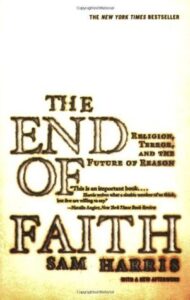
In The End of Faith, Sam Harris delivers a startling analysis of the clash between reason and religion in the modern world. He offers a vivid, historical tour of our willingness to suspend reason in favor of religious beliefs—even when these beliefs inspire the worst human atrocities. While warning against the encroachment of organized religion into world politics, Harris draws on insights from neuroscience, philosophy, and Eastern mysticism to deliver a call for a truly modern foundation for ethics and spirituality that is both secular and humanistic.
Winner of the 2005 PEN/Martha Albrand Award for Nonfiction.
In Sapiens, he explored our past. In Homo Deus, he looked to our future. Now, one of the most innovative thinkers on the planet turns to the present to make sense of today's most pressing issues.
How do computers and robots change the meaning of being human? How do we deal with the epidemic of fake news? Are nations and religions still relevant? What should we teach our children?
Yuval Noah Harari's 21 Lessons for the 21st Century is a probing and visionary investigation into today's most urgent issues as we move into the uncharted territory of the future. As technology advances faster than our understanding of it, hacking becomes a tactic of war, and the world feels more polarized than ever, Harari addresses the challenge of navigating life in the face of constant and disorienting change and raises the important questions we need to ask ourselves in order to survive.
In twenty-one accessible chapters that are both provocative and profound, Harari builds on the ideas explored in his previous books, untangling political, technological, social, and existential issues and offering advice on how to prepare for a very different future from the world we now live in: How can we retain freedom of choice when Big Data is watching us? What will the future workforce look like, and how should we ready ourselves for it? How should we deal with the threat of terrorism? Why is liberal democracy in crisis?
Harari's unique ability to make sense of where we have come from and where we are going has captured the imaginations of millions of readers. Here he invites us to consider values, meaning, and personal engagement in a world full of noise and uncertainty. When we are deluged with irrelevant information, clarity is power. Presenting complex contemporary challenges clearly and accessibly, 21 Lessons for the 21st Century is essential reading.
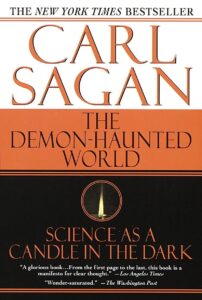
How can we make intelligent decisions about our increasingly technology-driven lives if we don’t understand the difference between the myths of pseudoscience and the testable hypotheses of science? Pulitzer Prize-winning author and distinguished astronomer Carl Sagan argues that scientific thinking is critical not only to the pursuit of truth but to the very well-being of our democratic institutions.
Casting a wide net through history and culture, Sagan examines and authoritatively debunks such celebrated fallacies of the past as witchcraft, faith healing, demons, and UFOs. And yet, disturbingly, in today's so-called information age, pseudoscience is burgeoning with stories of alien abduction, channeling past lives, and communal hallucinations commanding growing attention and respect. As Sagan demonstrates with lucid eloquence, the siren song of unreason is not just a cultural wrong turn but a dangerous plunge into darkness that threatens our most basic freedoms.
At the heart of this classic, seminal book is Julian Jaynes's still-controversial thesis that human consciousness did not begin far back in animal evolution but instead is a learned process that came about only three thousand years ago and is still developing. The implications of this revolutionary scientific paradigm extend into virtually every aspect of our psychology, our history and culture, our religion -- and indeed our future.
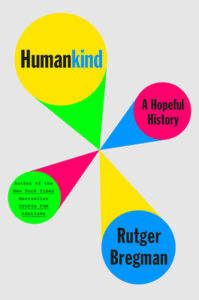
From the author of Utopia For Realists, a revolutionary argument that the innate goodness and cooperation of human beings has been the greatest factor in our success
If one basic principle has served as the bedrock of bestselling author Rutger Bregman's thinking, it is that every progressive idea -- whether it was the abolition of slavery, the advent of democracy, women's suffrage, or the ratification of marriage equality -- was once considered radical and dangerous by the mainstream opinion of its time. With Humankind, he brings that mentality to bear against one of our most entrenched ideas: namely, that human beings are by nature selfish and self-interested.
By providing a new historical perspective of the last 200,000 years of human history, Bregman sets out to prove that we are in fact evolutionarily wired for cooperation rather than competition, and that our instinct to trust each other has a firm evolutionary basis going back to the beginning of Homo sapiens. Bregman systematically debunks our understanding of the Milgram electrical-shock experiment, the Zimbardo prison experiment, and the Kitty Genovese "bystander effect."
In place of these, he offers little-known true stories: the tale of twin brothers on opposing sides of apartheid in South Africa who came together with Nelson Mandela to create peace; a group of six shipwrecked children who survived for a year and a half on a deserted island by working together; a study done after World War II that found that as few as 15% of American soldiers were actually capable of firing at the enemy.
The ultimate goal of Humankind is to demonstrate that while neither capitalism nor communism has on its own been proven to be a workable social system, there is a third option: giving "citizens and professionals the means (left) to make their own choices (right)." Reorienting our thinking toward positive and high expectations of our fellow man, Bregman argues, will reap lasting success. Bregman presents this idea with his signature wit and frankness, once again making history, social science and economic theory accessible and enjoyable for lay readers.
Charles Darwin, whose 1859 masterpiece "On the Origin of Species" shook society to its core, would surely have raised an incredulous eyebrow at the controversy over evolution still raging 150 years later.
"The Greatest Show on Earth" is a stunning counter-attack on creationists, followers of "Intelligent Design" and all those who still question evolution as scientific fact. In this brilliant tour de force, Richard Dawkins pulls together the incontrovertible evidence that underpins it: from living examples of natural selection to clues in the fossil record; from plate tectonics to molecular genetics.
"The Greatest Show on Earth" comes at a critical time as systematic opposition to the fact of evolution flourishes as never before in many schools worldwide. Dawkins wields a devastating argument against this ignorance whilst sharing with us his palpable love of science and the natural world. Written with elegance, wit and passion, it is hard-hitting, absorbing and totally convincing.
Dedicated as few men have been to the life of reason, Bertrand Russell has always been concerned with the basic questions to which religion also addresses itself -- questions about man's place in the universe and the nature of the good life, questions that involve life after death, morality, freedom, education, and sexual ethics. He brings to his treatment of these questions the same courage, scrupulous logic, and lofty wisdom for which his other work as philosopher, writer, and teacher has been famous. These qualities make the essays included in this book perhaps the most graceful and moving presentation of the freethinker's position since the days of Hume and Voltaire.
"I am as firmly convinced that religions do harm as I am that they are untrue," Russell declares in his Preface, and his reasoned opposition to any system or dogma which he feels may shackle man's mind runs through all the essays in this book, whether they were written as early as 1899 or as late as 1954.
The book has been edited, with Lord Russell's full approval and cooperation, by Professor Paul Edwards of the Philosophy Department of New York University. In an Appendix, Professor Edwards contributes a full account of the highly controversial "Bertrand Russell Case" of 1940, in which Russell was judicially declared "unfit" to teach philosophy at the College of the City of New York.
Whether the reader shares or rejects Bertrand Russell's views, he will find this book an invigorating challenge to set notions, a masterly statement of a philosophical position, and a pure joy to read.
Why I am not a Christian -- Has religion made useful contributions to civilization? -- What I believe -- Do we survive death? -- Seems, madam? Nay, it is -- Free man's worship -- On Catholic and Protestant skeptics -- Life in the Middle Ages -- Fate of Thomas Paine -- Nice people -- New generation -- Our sexual ethics -- Freedom and the colleges -- Can religion cure our troubles? -- Religion and morals -- Appendix: How Bertrand Russell was prevented from teaching at the College of the City of New York
***30th Anniversary Edition*** Cover note: Each copy of the anniversary edition of The Blind Watchmaker features a unique biomorph. No two covers are exactly alike.
Acclaimed as the most influential work on evolution written in the last hundred years, The Blind Watchmaker offers an inspiring and accessible introduction to one of the most important scientific discoveries of all time. A brilliant and controversial book which demonstrates that evolution by natural selection - the unconscious, automatic, blind yet essentially non-random process discovered by Darwin - is the only answer to the biggest question of all: why do we exist?
Welcome Back!
Track your reading progress and sync your library.