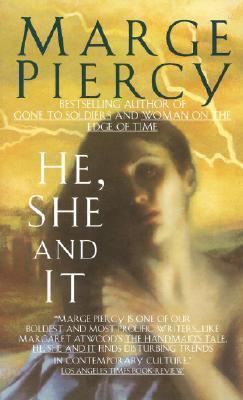
In the middle of the twenty-first century, life as we know it has changed for all time. Shira Shipman’s marriage has broken up, and her young son has been taken from her by the corporation that runs her zone, so she has returned to Tikva, the Jewish free town where she grew up. There, she is welcomed by Malkah, the brilliant grandmother who raised her, and meets an extraordinary man who is not a man at all, but a unique cyborg implanted with intelligence, emotions–and the ability to kill….

Called "fascinating" by the New York Times upon its first publication in 1984, Native Tongue won wide critical praise and cult status, and has often been compared to the futurist fiction of Margaret Atwood. Set in the twenty-second century, the novel tells of a world where women are once again property, denied civil rights and banned from public life. Earth's wealth depends on interplanetary commerce with alien races, and linguists--a small, clannish group of families--have become the ruling elite by controlling all interplanetary communication. Their women are used to breed perfect translators for all the galaxies' languages.
Nazareth Chornyak, the most talented linguist of the family, is exhausted by her constant work translating for trade organizations, supervising the children's language education, running the compound, and caring for the elderly men. She longs to retire to the Barren House, where women past childbearing age knit, chat, and wait to die. What Nazareth comes to discover is that a slow revolution is going on in the Barren Houses: there, word by word, women are creating a language of their own to free them from men's control.
Barbaric customs and bizarre human cults are prserved on the planet Elsewhere. The rest of the universe has been taken over by the Hobbs Land Gods, which means that everyone alive, with the exception of the people on Elsewhere, lives in perfect harmony with nature and with each other. But Elsewhere is ruled by computer-encrypted professors who have been dead for a thousand years. The professors were dedicated to maintaining human diversity. Their ancient analogs are dedicated to something far more sinister. The time has come to consider whether enslavement by the Hobbs Land Gods is not preferable to the depravity being cultivated on Elsewhere. The time has come to ask the Big Question: what is the Destiny of Man? And answer it . . .
After being unjustly committed to a mental institution, Connie Ramos is contacted by an envoy from the year 2137, who shows her a utopian future of sexual and racial equality and environmental harmony.
But Connie also bears witness to another potential outcome: a dystopian society of grotesque exploitation. One will become our world. And Connie herself may strike the decisive blow...
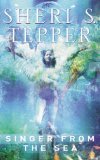
An accomplished student and heiress to a great title, Genevieve has been brought up as a Proper Young Lady, carefully instructed in the Covenants. She must soon take up the time-honoured responsibilities of that is to marry a nobleman of her father's choosing and bear a child at the age of thirty. But Genevieve remembers all the stories and the secret knowledge learned from her mother, now long dead, and she yearns to heed the call of the sea -- though she has never even seen the vast waters that cover most of the surface of her home planet of Haven. And she begins to uncover bitter truths about the seemingly backward planet of Haven . . .
Classic fantasy from the amazing Sheri S. Tepper. Women rule in Women's Country. Women live apart from men, sheltering the remains of civilization They have cut themselves off with walls and by ordinance from marauding males. Waging war is all men are good for. Men are allowed to fight their barbaric battles! amongst themselves, garrison against garrison. For the sake of his pride, each boy child ritualistically rejects his mother when he comes of age to be a warrior. But all the secrets of civilization are strictly the possession of women. Naturally, there are men who want to know what the women know! And when Stavia meets Chernon, the battle of the sexes begins all over again. Foolishly, she provides books for Chernon to read. Before long, Chernon is hatching a plan of revenge against women!
Hugo and Nebula award-winning author David Brin is one of the most eloquent, imaginative voices in science fiction. Now he returns with a new novel rich in texture, universal in theme, monumental in scope--pushing the genre to new heights.
Young Maia is fast approaching a turning point in her life. As a half-caste var, she must leave the clan home of her privileged half sisters and seek her fortune in the world. With her twin sister, Leie, she searches the docks of Port Sanger for an apprenticeship aboard the vessels that sail the trade routes of the Stratoin oceans.
On her far-reaching, perilous journey of discovery, Maia will endure hardship and hunger, imprisonment and loneliness, bloody battles with pirates and separation from her twin. And along the way, she will meet a traveler who has come an unimaginable distance--and who threatens the delicate balance of the Stratoins' carefully maintained, perfect society....
Both exciting and insightful, Glory Season is a major novel, a transcendent saga of the human spirit.
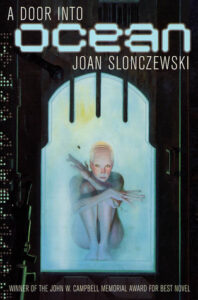
Joan Slonczewski's A Door into Ocean is the novel upon which the author's reputation as an important SF writer principally rests.
A ground-breaking work both of feminist SF and of world-building hard SF, it concerns the Sharers of Shora, a nation of women on a distant moon in the far future who are pacifists, highly advanced in biological sciences, and who reproduce by parthenogenesis--there are no males--and tells of the conflicts that erupt when a neighboring civilization decides to develop their ocean world, and send in an army.
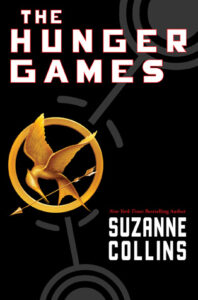
Winning means fame and fortune. Losing means certain death. The Hunger Games have begun. . . .
In the ruins of a place once known as North America lies the nation of Panem, a shining Capitol surrounded by twelve outlying districts. The Capitol is harsh and cruel and keeps the districts in line by forcing them all to send one boy and one girl between the ages of twelve and eighteen to participate in the annual Hunger Games, a fight to the death on live TV.
Sixteen-year-old Katniss Everdeen regards it as a death sentence when she steps forward to take her sister's place in the Games. But Katniss has been close to dead before-and survival, for her, is second nature. Without really meaning to, she becomes a contender. But if she is to win, she will have to start making choices that weigh survival against humanity and life against love.
Welcome Back!
Track your reading progress and sync your library.