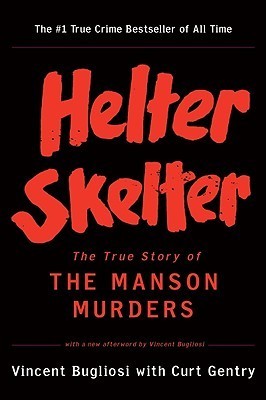
Prosecuting attorney in the Manson trial, Vincent Bugliosi held a unique insider’s position in one of the most baffling and horrifying cases of the twentieth century: the cold-blooded Tate-LaBianca murders carried out by Charles Manson and four of his followers. What motivated Manson in his seemingly mindless selection of victims, and what was his hold over the young women who obeyed his orders? Here is the gripping story of this famous and haunting crime. 50 pages of b/w photographs.
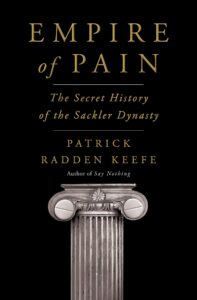
The highly anticipated portrait of three generations of the Sackler family, by the prize-winning, bestselling author of Say Nothing.
The Sackler name adorns the walls of many storied institutions: Harvard, the Metropolitan Museum of Art, Oxford, the Louvre. They are one of the richest families in the world, known for their lavish donations to the arts and sciences. The source of the family fortune was vague, however, until it emerged that the Sacklers were responsible for making and marketing OxyContin, a blockbuster painkiller that was a catalyst for the opioid crisis.
Empire of Pain is a masterpiece of narrative reporting and writing, exhaustively documented and ferociously compelling.
Author Erik Larson imbues the incredible events surrounding the 1893 Chicago World's Fair with such drama that readers may find themselves checking the book's categorization to be sure that 'The Devil in the White City' is not, in fact, a highly imaginative novel. Larson tells the stories of two men: Daniel H. Burnham, the architect responsible for the fair's construction, and H.H. Holmes, a serial killer masquerading as a charming doctor.
Burnham's challenge was immense. In a short period of time, he was forced to overcome the death of his partner and numerous other obstacles to construct the famous "White City" around which the fair was built. His efforts to complete the project, and the fair's incredible success, are skillfully related along with entertaining appearances by such notables as Buffalo Bill Cody, Susan B. Anthony, and Thomas Edison.
The activities of the sinister Dr. Holmes, who is believed to be responsible for scores of murders around the time of the fair, are equally remarkable. He devised and erected the World's Fair Hotel, complete with crematorium and gas chamber, near the fairgrounds and used the event as well as his own charismatic personality to lure victims.
Combining the stories of an architect and a killer in one book, mostly in alternating chapters, seems like an odd choice but it works. The magical appeal and horrifying dark side of 19th-century Chicago are both revealed through Larson's skillful writing. - John Moe
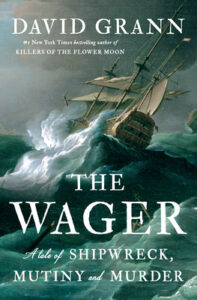
From the #1 New York Times bestselling author of Killers of the Flower Moon, a page-turning story of shipwreck, survival, and savagery, culminating in a court martial that reveals a shocking truth. The powerful narrative reveals the deeper meaning of the events on the Wager, showing that it was not only the captain and crew who ended up on trial, but the very idea of empire.
On January 28, 1742, a ramshackle vessel of patched-together wood and cloth washed up on the coast of Brazil. Inside were thirty emaciated men, barely alive, and they had an extraordinary tale to tell. They were survivors of His Majesty's Ship the Wager, a British vessel that had left England in 1740 on a secret mission during an imperial war with Spain. While the Wager had been chasing a Spanish treasure-filled galleon known as "the prize of all the oceans," it had wrecked on a desolate island off the coast of Patagonia. The men, after being marooned for months and facing starvation, built the flimsy craft and sailed for more than a hundred days, traversing nearly 3,000 miles of storm-wracked seas. They were greeted as heroes.
But then . . . six months later, another, even more decrepit craft landed on the coast of Chile. This boat contained just three castaways, and they told a very different story. The thirty sailors who landed in Brazil were not heroes - they were mutineers. The first group responded with countercharges of their own, of a tyrannical and murderous senior officer and his henchmen. It became clear that while stranded on the island the crew had fallen into anarchy, with warring factions fighting for dominion over the barren wilderness. As accusations of treachery and murder flew, the Admiralty convened a court martial to determine who was telling the truth. The stakes were life-and-death--for whomever the court found guilty could hang.
The Wager is a grand tale of human behavior at the extremes told by one of our greatest nonfiction writers. Grann's recreation of the hidden world on a British warship rivals the work of Patrick O'Brian, his portrayal of the castaways' desperate straits stands up to the classics of survival writing such as The Endurance, and his account of the court martial has the savvy of a Scott Turow thriller. As always with Grann's work, the incredible twists of the narrative hold the reader spellbound.
Suspected of killing Vera Donovan, her wealthy employer, Dolores Claiborne tells police the story of her life, harkening back to her disintegrating marriage and the suspicious death of her violent husband, Joe St. George, thirty years earlier. Dolores also tells of Vera's physical and mental decline and of her loyalty to an employer who has become emotionally demanding in recent years.
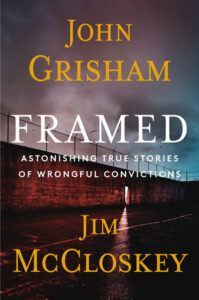
Ten harrowing true stories of wrongful convictions. Impeccably researched and grippingly told, Framed offers an inside look at the injustice faced by the victims of the United States criminal justice system.
A fundamental principle of our legal system is a presumption of innocence, but once someone has been found guilty there is very little room to prove doubt. Framed shares ten true stories of men who were innocent but found guilty and forced to sacrifice friends, families, wives, and decades of their lives to prison while the guilty parties remained free. In each of the stories, John Grisham and Jim McCloskey recount the dramatic hard-fought battles for exoneration. They take a close look at what leads to wrongful convictions in the first place, and the racism, misconduct, flawed testimony, and the corrupt court system that can make them so hard to reverse.
Told with page-turning suspense as only John Grisham can deliver, Framed is the story of overcoming adversity when the battle already seems lost, and the deck is stacked against you.
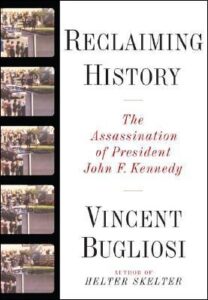
This extraordinary and historic book required twenty years to research and write. The oft-challenged findings of the Warren Commission Lee Harvey Oswald, acting alone, shot and killed President John F. Kennedy are here confirmed beyond all doubt. But "Reclaiming History" does much more than that. In addition to providing a powerful and unprecedented narrative of events and a biography of the assassin, it confronts and destroys every one of the conspiracy theories that have grown up since the assassination, exposing their selective use of evidence, flawed logic, and outright deceptions. So thoroughly documented, so compellingly lucid in its conclusions, "Reclaiming History" is, in a sense, the investigation that completes the work of the Warren Commission. In it, Vincent Bugliosi, the nation's foremost prosecutor, takes on the most important murder in American history. At 1:00 p.m. on November 22, 1963, President John F. Kennedy was pronounced dead, the victim of a sniper attack during his motorcade through Dallas. That may be the only fact generally agreed upon in the vast literature spawned by the assassination. National polls reveal that an overwhelming majority of Americans (75%) believe that there was a high-level conspiracy behind Lee Harvey Oswald. Many even believe that Oswald was entirely innocent. In this continuously absorbing, powerful, ground-breaking book, Vincent Bugliosi shows how we have come to believe such lies about an event that changed the course of history. The brilliant prosecutor of Charles Manson and the man who forged an iron-clad case of circumstantial guilt around O. J. Simpson in his best-selling "Outrage "Bugliosi is perhaps the only man in America capable of writing the definitive book on the Kennedy assassination. This is an achievement that has for years seemed beyond reach. No one imagined that such a book would ever be written: a single volume that once and for all resolves, beyond any reasonable doubt, every lingering question as to what happened in Dallas and who was responsible. There have been hundreds of books about the assassination, but there has never been a book that covers "the entire case," including addressing each and every conspiracy theory and the facts, or alleged facts, on which they are based. In this monumental work, the author has raised scholarship on the assassination to a new and final level, one that far surpasses all other books on the subject. It adds resonance, depth, and closure to the admirable work of the Warren Commission. "Reclaiming History" is a narrative compendium of fact, forensic evidence, reexamination of key witnesses, and common sense. Every detail and nuance is accounted for, every conspiracy theory revealed as a fraud on the American public. Bugliosi's irresistible logic, command of the evidence, and ability to draw startling inferences shed fresh light on this American nightmare. At last it all makes sense.
Utterly unique in its astonishing intimacy, as jarringly frightening as when it first appeared, Ann Rule's The Stranger Beside Me defies our expectation that we would surely know if a monster lived among us, worked alongside of us, appeared as one of us. With a slow chill that intensifies with each heart-pounding page, Rule describes her dawning awareness that Ted Bundy, her sensitive coworker on a crisis hotline, was one of the most prolific serial killers in America. He would confess to killing at least thirty-six young women from coast to coast, and was eventually executed for three of those cases. Drawing from their correspondence that endured until shortly before Bundy's death, and striking a seamless balance between her deeply personal perspective and her role as a crime reporter on the hunt for a savage serial killer -- the brilliant and charismatic Bundy, the man she thought she knew -- Rule changed the course of true-crime literature with this unforgettable chronicle.
Welcome Back!
Track your reading progress and sync your library.