Homage to Catalonia
In 1936 George Orwell travelled to Spain to report on the Civil War and instead joined the fight against the Fascists. This famous account describes the war and Orwell’s own experiences. Introduction by Lionel Trilling.
"In August 2003 a young Iraqi blogger began reporting her experiences as a civilian observer in Baghdad. Calling herself Riverbend, she has offered searing eyewitness accounts of daily life in the war zone and has garnered a worldwide audience hungry for unfiltered news and fresh analysis." "Riverbend's blog, Baghdad Burning, collected here for the first time, responds to events both personal and political - from the impact on her family of the invasion's aftermath to the Abu Ghraib prison abuses. She reveals for us most sharply the fate of Iraqi women, whose rights and freedoms are falling victim to rising fundamentalisms." Describing the reality of regime change in Iraq in a voice at turns outraged, witty, and deeply moving, Riverbend is a witness to the recent events that are shaping the future of her homeland.
A memoir of astonishing power, savagery, and ashen lyricism, 'Storm of Steel' illuminates not only the horrors but also the fascination of total war, seen through the eyes of an ordinary German soldier.
Young, tough, patriotic, but also disturbingly self-aware, Jünger exulted in the Great War, which he saw not just as a great national conflict, but more importantly as a unique personal struggle.
Leading raiding parties, defending trenches against murderous British incursions, simply enduring as shells tore his comrades apart, Jünger kept testing himself, braced for the death that will mark his failure.
Published shortly after the war's end, 'Storm of Steel' was a worldwide bestseller and can now be rediscovered through Michael Hofmann's brilliant new translation.
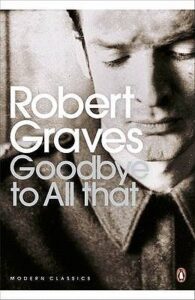
An autobiographical work that describes firsthand the great tectonic shifts in English society following the First World War, Robert Graves's Goodbye to All That is a matchless evocation of the Great War's haunting legacy, published in Penguin Modern Classics.
In 1929 Robert Graves went to live abroad permanently, vowing 'never to make England my home again'. This is his superb account of his life up until that 'bitter leave-taking': from his childhood and desperately unhappy school days at Charterhouse, to his time serving as a young officer in the First World War that was to haunt him throughout his life. It also contains memorable encounters with fellow writers and poets, including Siegfried Sassoon and Thomas Hardy, and looks at his increasingly unhappy marriage to Nancy Nicholson. Goodbye to All That, with its vivid, harrowing descriptions of the Western Front, is a classic war document, and also has immense value as one of the most candid self-portraits of an artist ever written.
Robert Ranke Graves (1895-1985) was a British poet, novelist, and critic. He is best known for the historical novel I, Claudius and the critical study of myth and poetry The White Goddess. His autobiography, Goodbye to All That, was published in 1929, quickly establishing itself as a modern classic. Graves also translated Apuleius, Lucan and Suetonius for the Penguin Classics, and compiled the first modern dictionary of Greek Mythology, The Greek Myths. His translation of The Rubáiyát of Omar Khayyám (with Omar Ali-Shah) is also published in Penguin Classics.
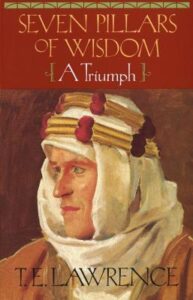
Seven Pillars of Wisdom (em português, Os Sete Pilares da Sabedoria) é um clássico da literatura mundial, designado por Winston Churchill como "um dos maiores livros já escritos na língua inglesa". Narra a participação de seu autor, Thomas Edward Lawrence, conhecido universalmente como Lawrence da Arábia, no movimento nacionalista árabe contra a dominação turca, como parte do esforço britânico na Primeira Guerra Mundial para derrotar a Alemanha, da qual a Turquia era aliada.
Seu título é uma alusão a uma frase da Bíblia, no Livro dos Provérbios (IX,1).
Escrito originalmente em 1919, Lawrence perde os manuscritos na Estação ferroviária de Reading. Uma segunda versão é finalizada no ano seguinte, mas, insatisfeito com o resultado, o autor a destrói. Finalmente em 1926, Lawrence escreve uma terceira versão, revisada por George Bernard Shaw e distribuído em uma edição artesanal restrita a amigos e escritores. Foi publicado pela primeira vez em 1935.
O escritor britânico E.M. Forster assim resume seu conteúdo: "Descreve a revolta na Arábia contra os turcos, vista por um inglês que nela tomou parte. No que seria aparentemente uma simples crônica militar, Lawrence da Arábia teceu um painel inusitado de retratos, descrições, filosofias, emoções, aventuras e sonhos. Para levar a cabo sua missão, serviu-se de uma extraordinária erudição, uma memória impecável, um estilo que ele próprio inventou...uma total desconfiança em si mesmo e uma fé ainda maior".
Em 1962 o épico do deserto é levado às telas de cinema. Sob a direção de David Lean, o filme Lawrence of Arabia ganhou sete oscars e a consagração do American Film Institute como um dos dez melhores filmes de todos os tempos.
(Fonte:Wikipédia)
The devastating story of war through the eyes of a child soldier. Beah tells how, at the age of twelve, he fled attacking rebels and wandered a land rendered unrecognizable by violence. By thirteen, he’d been picked up by the government army, and became a soldier.
My new friends have begun to suspect I haven’t told them the full story of my life.
“Why did you leave Sierra Leone?”
“Because there is a war.”
“You mean, you saw people running around with guns and shooting each other?”
“Yes, all the time.”
“Cool.”
I smile a little.
“You should tell us about it sometime.”
“Yes, sometime.”
This is how wars are fought now: by children, hopped-up on drugs and wielding AK-47s. Children have become soldiers of choice. In the more than fifty conflicts going on worldwide, it is estimated that there are some 300,000 child soldiers. Ishmael Beah used to be one of them.
What is war like through the eyes of a child soldier? How does one become a killer? How does one stop? Child soldiers have been profiled by journalists, and novelists have struggled to imagine their lives. But until now, there has not been a first-person account from someone who came through this hell and survived.
In A Long Way Gone, Beah, now twenty-five years old, tells a riveting story: how at the age of twelve, he fled attacking rebels and wandered a land rendered unrecognizable by violence. By thirteen, he’d been picked up by the government army, and Beah, at heart a gentle boy, found that he was capable of truly terrible acts.
This is a rare and mesmerizing account, told with real literary force and heartbreaking honesty.
On a clear night in late June 2005, four U.S. Navy SEALs left their base in northern Afghanistan for the mountainous Pakistani border. Their mission was to capture or kill a notorious al Qaeda leader known to be ensconced in a Taliban stronghold surrounded by a small but heavily armed force. Less then twenty-four hours later, only one of those Navy SEALs remained alive.
This is the story of fire team leader Marcus Luttrell, the sole survivor of Operation Redwing, and the desperate battle in the mountains that led, ultimately, to the largest loss of life in Navy SEAL history. But it is also, more than anything, the story of his teammates, who fought ferociously beside him until he was the last one left-blasted unconscious by a rocket grenade, blown over a cliff, but still armed and still breathing. Over the next four days, badly injured and presumed dead, Luttrell fought off six al Qaeda assassins who were sent to finish him, then crawled for seven miles through the mountains before he was taken in by a Pashtun tribe, who risked everything to protect him from the encircling Taliban killers.
A six-foot-five-inch Texan, Leading Petty Officer Luttrell takes us, blow-by-blow, through the brutal training of America's warrior elite and the relentless rites of passage required by the Navy SEALs. He transports us to a monstrous battle fought in the desolate peaks of Afghanistan, where the beleaguered American team plummeted headlong a thousand feet down a mountain as they fought back through flying shale and rocks. In this rich , moving chronicle of courage, honor, and patriotism, Marcus Luttrell delivers one of the most powerful narratives ever written about modern warfare-and a tribute to his teammates, who made the ultimate sacrifice for their country.
A national bestseller when it first appeared in 1963, The Fire Next Time galvanized the nation and gave passionate voice to the emerging civil rights movement. At once a powerful evocation of James Baldwin’s early life in Harlem and a disturbing examination of the consequences of racial injustice, the book is an intensely personal and provocative document. It consists of two “letters,” written on the occasion of the centennial of the Emancipation Proclamation, that exhort Americans, both black and white, to attack the terrible legacy of racism. Described by The New York Times Book Review as “sermon, ultimatum, confession, deposition, testament, and chronicle…all presented in searing, brilliant prose,” The Fire Next Time stands as a classic of our literature.
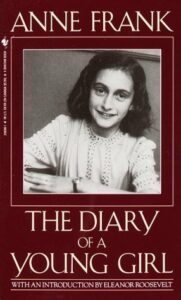
Discovered in the attic where she spent the final years of her life, Anne Frank’s Diary has become a timeless classic; a powerful reminder of the horrors of war and a moving testament to the resilience of the human spirit.
In 1942, as the Nazis occupied Holland, thirteen-year-old Anne Frank and her Jewish family fled their home in Amsterdam and went into hiding. For the next two years, until they were betrayed to the Gestapo, the Franks and another family lived in the cramped “Secret Annexe” of an old office building. Cut off from the outside world, they endured hunger, boredom, the strain of close quarters, and the constant fear of discovery and death.
Through it all, Anne documented her experiences in a diary filled with vivid observations. At times thoughtful, poignant, and even unexpectedly funny, her writing offers a remarkable window into the strength and vulnerability of the human spirit. It’s both a compelling self-portrait of a bright, spirited young woman and a heartbreaking glimpse of a life that should have been far longer.