
A poignant coming-of-age novel set in a Welsh mining town, Richard Llewellyn’s How Green Was My Valley is a paean to a more innocent age.
Growing up in a mining community in rural South Wales, Huw Morgan is taught many harsh lessons – at the kitchen table, at Chapel and around the pit-head. Looking back on the hardships of his early life, where difficult days are faced with courage but the valleys swell with the sound of Welsh voices, it becomes clear that there is nowhere so green as the landscape of his own memory.
An immediate bestseller on publication in 1939, How Green Was My Valley quickly became one of the best-loved novels of the twentieth century. Poetic and nostalgic, it is an elegy to a lost world.

The beloved American classic about a young girl's coming-of-age at the turn of the century, Betty Smith's A Tree Grows in Brooklyn is a poignant and moving tale filled with compassion and cruelty, laughter and heartache, crowded with life and people and incident.
The story of young, sensitive, and idealistic Francie Nolan and her bittersweet formative years in the slums of Williamsburg has enchanted and inspired millions of readers for more than sixty years.
By turns overwhelming, sublime, heartbreaking, and uplifting, the daily experiences of the unforgettable Nolans are raw with honesty and tenderly threaded with family connectedness -- in a work of literary art that brilliantly captures a unique time and place as well as incredibly rich moments of universal experience.
This is one of McMurtry's most memorable novels - the basis for the film of the same name. Set in a small, dusty Texas town, it introduces Jacy, Duane and Sonny, teenagers stumbling towards adulthood, discovering the beguiling mysteries of sex and the even more baffling mysteries of love.
A stunning, lyrical novel set in the rolling foothills of the Appalachians in which a young girl discovers stark truths that will haunt her for the rest of her life.
"A girl comes of age against the knife."
So begins the story of Betty Carpenter. Born in a bathtub in 1954 to a Cherokee father and white mother, Betty is the sixth of eight siblings. The world they inhabit is one of poverty and violence--both from outside the family, and also, devastatingly, from within. The lush landscape, rich with birdsong, wild fruit, and blazing stars, becomes a kind of refuge for Betty, but when her family's darkest secrets are brought to light, she has no choice but to reckon with the brutal history hiding in the hills, as well as the heart-wrenching cruelties and incredible characters she encounters in her rural town of Breathed, Ohio.
But despite the hardship she faces, Betty is resilient. Her curiosity about the natural world, her fierce love for her sisters, and her father's brilliant stories are kindling for the fire of her own imagination, and in the face of all she bears witness to, Betty discovers an escape: she begins to write. She recounts the horrors of her family's past and present with pen and paper and buries them deep in the dirt--moments that has stung her so deeply, she could not tell them, until now.
Inspired by the life of her own mother, Tiffany McDaniel sets out to free the past by telling this heartbreaking yet magical story--a remarkable novel that establishes her as one of the freshest and most important voices in American fiction.
An “evocative read and a powerful portrait of friendship, feminism, and political activism” (People) set against three transformative decades in Tehran, Iran—from nationally bestselling author Marjan Kamali.
In 1950s Tehran, seven-year-old Ellie lives in grand comfort until the untimely death of her father, forcing Ellie and her mother to move to a tiny home downtown. Lonely and bearing the brunt of her mother’s endless grievances, Ellie dreams for a friend to alleviate her isolation.
Luckily, on the first day of school, she meets Homa, a kind girl with a brave and irrepressible spirit. Together, the two girls play games, learn to cook in the stone kitchen of Homa’s warm home, wander through the colorful stalls of the Grand Bazaar, and share their ambitions of becoming “lion women.”
But their happiness is disrupted when Ellie and her mother are afforded the opportunity to return to their previous bourgeois life. Now a popular student at the best girls’ high school in Iran, Ellie’s memories of Homa begin to fade. Years later, however, her sudden reappearance in Ellie’s privileged world alters the course of both of their lives.
Together, the two young women come of age and pursue their own goals for meaningful futures. But as the political turmoil in Iran builds to a breaking point, one earth-shattering betrayal will have enormous consequences.
“Reminiscent of The Kite Runner and My Brilliant Friend, The Lion Women of Tehran is a mesmerizing tale” (BookPage) of love and courage, and a sweeping exploration of how profoundly we are shaped by those we meet when we are young.
Through six turbulent months of 1934, 17-year-old Cassandra Mortmain keeps a journal, filling three notebooks with sharply funny yet poignant entries about her home, a ruined Suffolk castle, and her eccentric and penniless family. By the time the last diary shuts, there have been great changes in the Mortmain household, not the least of which is that Cassandra is deeply, hopelessly, in love.
A spellbinding story - by turns poignant and electrifying - about the magical, often forbidden, discoveries of childhood and a lifelong journey that begins unexpectedly with a spectacular sea voyage.
In the early 1950s, an eleven-year-old boy in Colombo boards a ship bound for England. At mealtimes he is seated at the "cat's table" - as far from the Captain's Table as can be - with a ragtag group of "insignificant" adults and two other boys, Cassius and Ramadhin. As the ship makes its way across the Indian Ocean, through the Suez Canal, into the Mediterranean, the boys tumble from one adventure to another, bursting all over the place like freed mercury. But there are other diversions as well: one man talks with them about jazz and women, another opens the door to the world of literature. The narrator's elusive, beautiful cousin Emily becomes his confidante, allowing him to see himself "with a distant eye" for the first time, and to feel the first stirring of desire. Another Cat's Table denizen, the shadowy Miss Lasqueti, is perhaps more than what she seems. And very late every night, the boys spy on a shackled prisoner, his crime and his fate a galvanizing mystery that will haunt them forever.
As the narrative moves between the decks and holds of the ship and the boy's adult years, it tells a spellbinding story - by turns poignant and electrifying - about the magical, often forbidden, discoveries of childhood and a lifelong journey that begins unexpectedly with a spectacular sea voyage.
Giants in the Earth (Norwegian: Verdens Grøde) is a novel by Norwegian-American author Ole Edvart Rølvaag. First published in Norway as two books in 1924 and 1925, the author collaborated with Minnesotan Lincoln Colcord on the English translation.
The novel follows a Norwegian family's struggles as they try to make a new life as pioneers in the Dakota territory. Rølvaag is interested in psychology and the human cost of empire building, at a time when other writers focused on the glamor and romance of the West. The book reflects his personal experiences as a settler as well as the immigrant homesteader experience of his wife’s family. Both the grim realities of pioneering and the gloomy fatalism of the Norse mind are captured in depictions of snow storms, locusts, poverty, hunger, loneliness, homesickness, the difficulty of fitting into a new culture, and the estrangement of immigrant children who grow up in a new land. It is a novel at once palpably European and distinctly American.
Giants in the Earth was turned into an opera by Douglas Moore and Arnold Sundgaard; it won the Pulitzer Prize for Music in 1951.
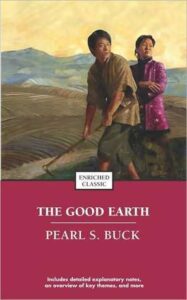
This tells the poignant tale of a Chinese farmer and his family in old agrarian China. The humble Wang Lung glories in the soil he works, nurturing the land as it nurtures him and his family. Nearby, the nobles of the House of Hwang consider themselves above the land and its workers; but they will soon meet their own downfall.
Hard times come upon Wang Lung and his family when flood and drought force them to seek work in the city. The working people riot, breaking into the homes of the rich and forcing them to flee. When Wang Lung shows mercy to one noble and is rewarded, he begins to rise in the world, even as the House of Hwang falls.
Welcome Back!
Track your reading progress and sync your library.